The I Ching (Yijing, or Book of Changes) is an ancient Chinese text built on 64 hexagrams, each made of six broken (yin) or solid (yang) lines. It began as a divination manual and became a core Confucian classic and a book of philosophy. To consult it, you cast six lines and read the resulting hexagram.
What is the I Ching, in plain terms?
The I Ching is a book of 64 short oracles. Each oracle belongs to one hexagram, a stack of six lines, and the book gives that hexagram a name, a short statement and one comment for each of its lines. The oldest layer was a divination manual from the Western Zhou period, which makes it one of the oldest Chinese classics.
Over the following centuries, commentaries were added that treated the same symbols as a way of thinking about change, timing and decisions. The result is a mix of symbols, divination records, history, folklore and philosophy. In the second century BCE, under the Han dynasty, it was placed among the Five Classics of Confucianism, and people have kept writing commentaries on it for some two thousand years.
Today the same book is read in three ways: as an oracle you consult, as a classic of Chinese thought, and as a guide for thinking through a decision. Those readings overlap, and the sections below take them in turn.
What does "I Ching" mean?
"I Ching" is the older Wade–Giles spelling of Yijing (易經). The first character, 易 (yì), means "change", and the second, 經 (jīng), means "classic" or "scripture", so the title is usually translated Classic of Changes or Book of Changes. The text at its core is also called the Zhouyi (周易), the "Changes of Zhou", after the Zhou dynasty.
Both spellings, I Ching and Yijing, refer to the same book. English writers use whichever they like, and this site uses I Ching because it is the one most readers search for.
How is the I Ching built: lines, trigrams and 64 hexagrams?
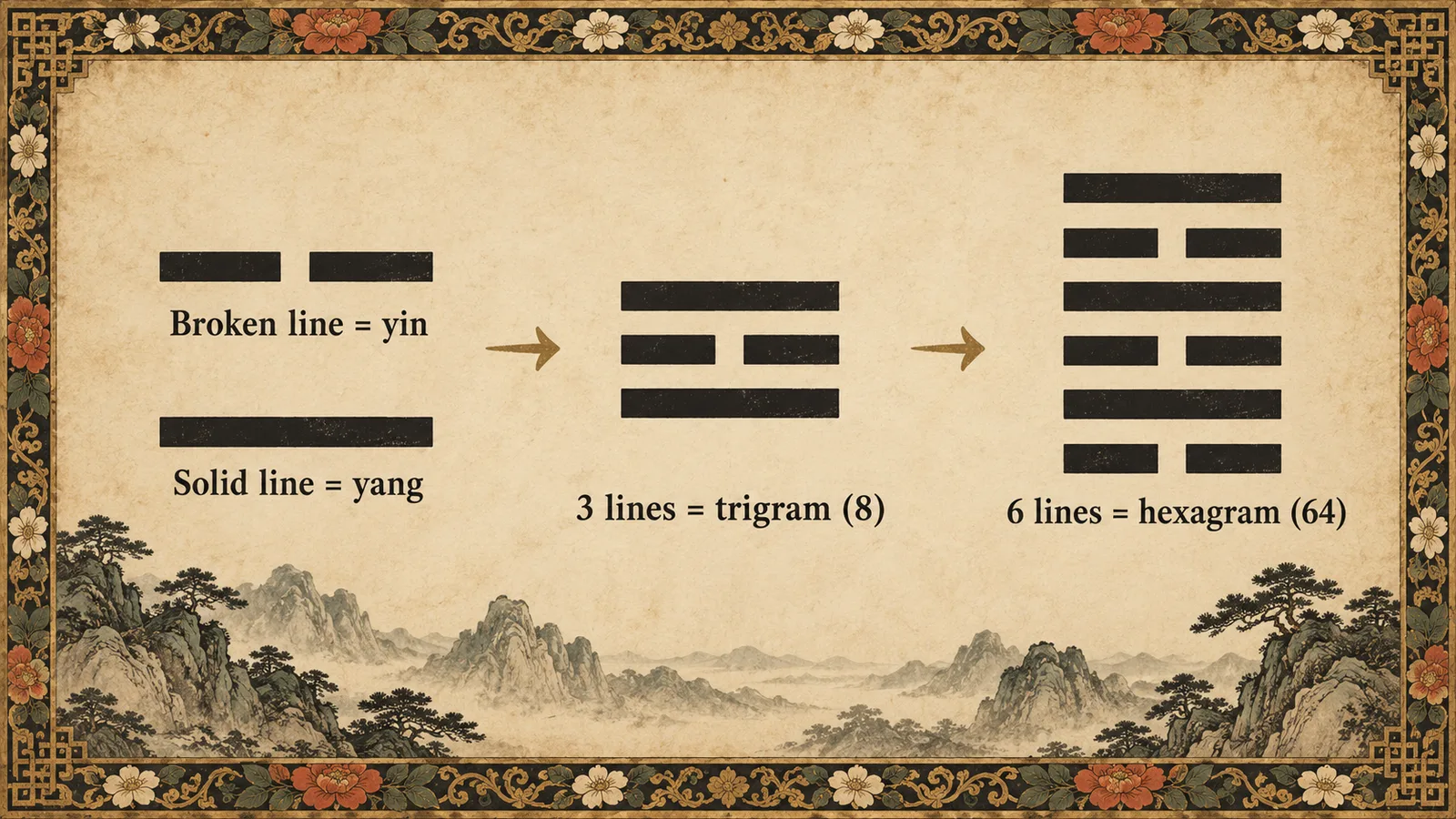
The whole system starts with two kinds of line. A solid line (⚊) is yang and a broken line (⚋) is yin. Stack three of them and you get a trigram, which gives 2 × 2 × 2 = 8 possibilities. Stack six and you get a hexagram, which gives 2⁶ = 64. Equivalently, a hexagram is two trigrams, one above the other, and 8 × 8 = 64.
The eight trigrams are Qian, Dui, Li, Zhen, Xun, Kan, Gen and Kun. Their traditional images are heaven, lake, fire, thunder, wind, water, mountain and earth. In a hexagram, the lower trigram is made of lines 1 to 3 and the upper trigram of lines 4 to 6. Lines are always counted from the bottom up, which is also the order in which you build one when you cast.
The 64 hexagrams are numbered in what is called the King Wen sequence, the order of the received text. The book opens with Hexagram 1, Qian, usually called The Creative in Wilhelm's English, and Hexagram 2, Kun, The Receptive. It ends with Hexagram 63, Jiji, and Hexagram 64, Weiji. Hexagram 64 is often translated "Ferrying Incomplete", and many readers find the ending meaningful: the book closes on a process that is still going rather than on a finished state.
| Numbers | Hexagrams in King Wen order (Chinese and pinyin) |
|---|---|
| 1–8 | 乾 Qián, 坤 Kūn, 屯 Zhūn, 蒙 Méng, 需 Xū, 訟 Sòng, 師 Shī, 比 Bǐ |
| 9–16 | 小畜 Xiǎo Xù, 履 Lǚ, 泰 Tài, 否 Pǐ, 同人 Tóng Rén, 大有 Dà Yǒu, 謙 Qiān, 豫 Yù |
| 17–24 | 隨 Suí, 蠱 Gǔ, 臨 Lín, 觀 Guān, 噬嗑 Shìhé, 賁 Bì, 剝 Bō, 復 Fù |
| 25–32 | 无妄 Wúwàng, 大畜 Dà Xù, 頤 Yí, 大過 Dà Guò, 坎 Kǎn, 離 Lí, 咸 Xián, 恆 Héng |
| 33–40 | 遯 Dùn, 大壯 Dà Zhuàng, 晉 Jìn, 明夷 Míng Yí, 家人 Jiā Rén, 睽 Kuí, 蹇 Jiǎn, 解 Jiě |
| 41–48 | 損 Sǔn, 益 Yì, 夬 Guài, 姤 Gòu, 萃 Cuì, 升 Shēng, 困 Kùn, 井 Jǐng |
| 49–56 | 革 Gé, 鼎 Dǐng, 震 Zhèn, 艮 Gèn, 漸 Jiàn, 歸妹 Guī Mèi, 豐 Fēng, 旅 Lǚ |
| 57–64 | 巽 Xùn, 兌 Duì, 渙 Huàn, 節 Jié, 中孚 Zhōng Fú, 小過 Xiǎo Guò, 既濟 Jì Jì, 未濟 Wèi Jì |
English names for the hexagrams differ from one translation to another, so this list gives the Chinese names only. When you look up a hexagram, check the number as well as the name.
What are the three layers of the I Ching?
The book is easiest to understand as three layers, built up over several centuries.
- The hexagrams. The symbols come first in the traditional account, credited to the legendary Fu Xi, who is said to have devised the trigrams by observing patterns in heaven and on earth.
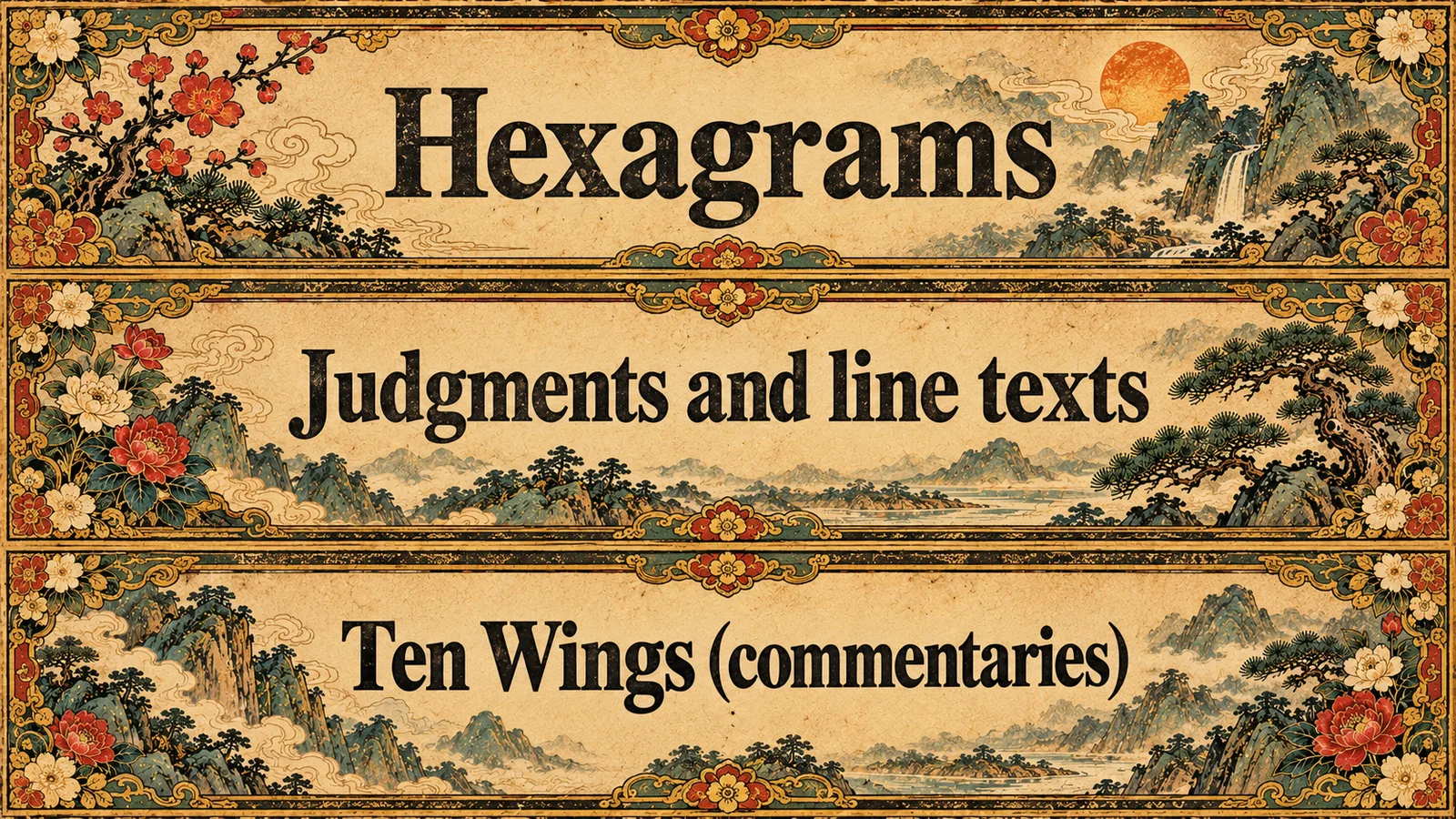
- The judgments and line statements. The short text attached to each hexagram and each line. Tradition credits King Wen and the Duke of Zhou, around the 11th century BCE, though many modern scholars place the core text a little later in the Western Zhou, perhaps the late 9th century BCE.
- The Ten Wings. A set of commentaries, in ten sections, which turned the oracle into a philosophical work. They include the Xici (the "Attached Statements"), which describes the yarrow-stalk method, and the Shuogua, on the trigrams. They date from roughly the 5th to the 2nd century BCE. Later tradition credited them to Confucius, though most scholars doubt it.
There is no single author and no single date, so "who wrote the I Ching?" has a layered answer. Even the text itself was not completely fixed: a silk manuscript found at Mawangdui, in a tomb sealed in 168 BCE, arranges the hexagrams in a different order, and a bamboo-strip copy from about 300 BCE has small variations in wording. The version we read today is one form of a text that once existed in several.
Is the I Ching fortune-telling or philosophy?
It is both, and the two were never really opposites. Two early histories, the Zuo Zhuan and the Guoyu, record more than twenty consultations of the book for royal families between 671 and 487 BCE. For the people who used it, the oracle answered a real question about what to do next, and the answer came with a way to pause, review the past, see the present clearly and plan the next step.
Later readers pushed the book in different directions. Han dynasty commentators used it as a map of the cosmos. Wang Bi (3rd century) read each hexagram as a situation in which a person has room to act. In the 12th century, the Neo-Confucian Zhu Xi insisted the book was first of all for divination and should be consulted that way, and he is credited with the standard form of the yarrow-stalk procedure. Today, people who love the philosophy and people who love the oracle are using the same text for different purposes.
How does an I Ching reading work?
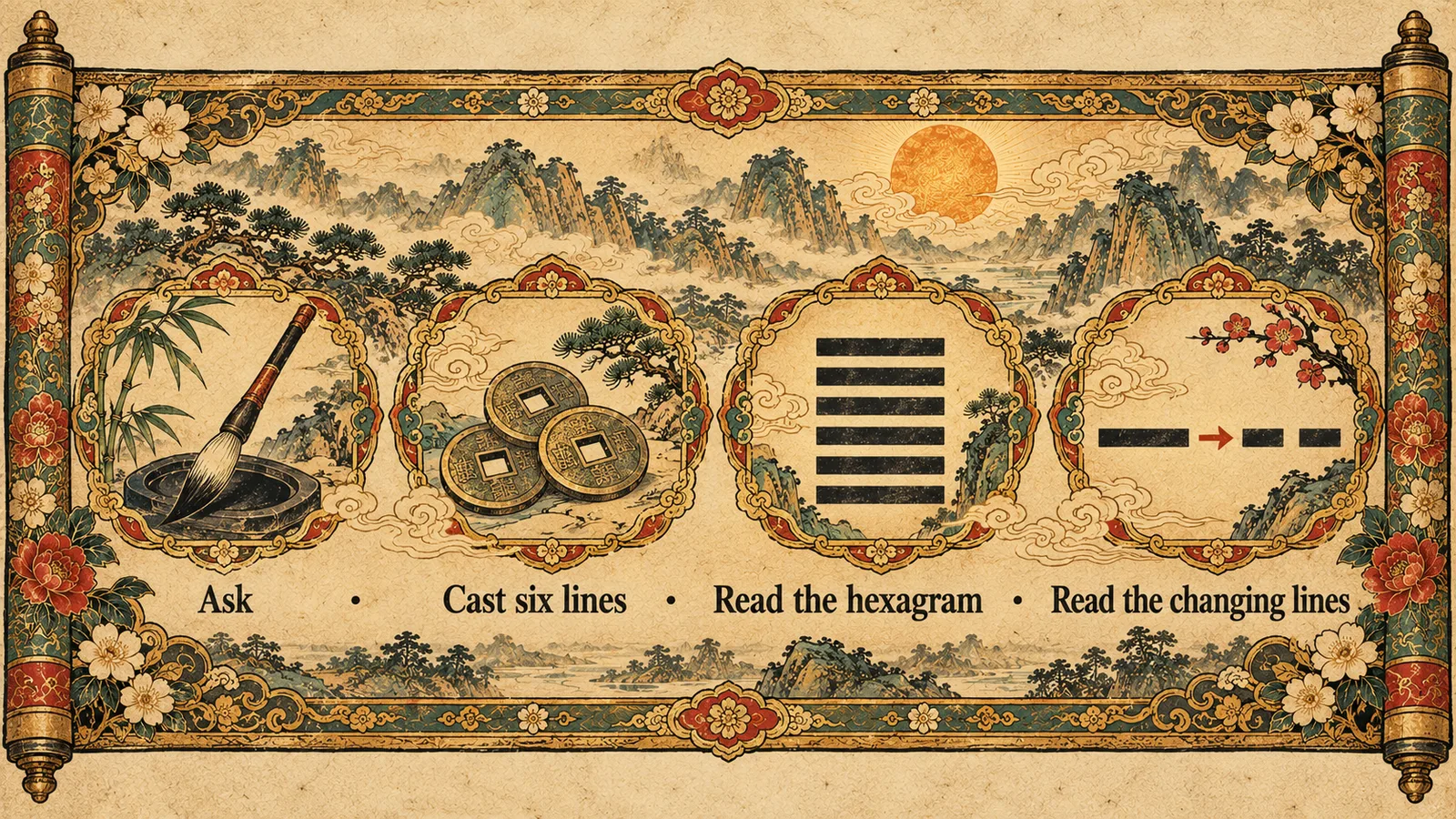
A reading follows four steps, in the same order whichever method you use.
- Ask. Write down the question or situation. A clear question makes the answer easier to read.
- Cast six lines, from the bottom up. Traditionally you divide 50 yarrow stalks, of which 49 are used. A faster method tosses three coins six times. Each cast produces a number: 6, 7, 8 or 9. Odd numbers (7 and 9) are solid lines, and even numbers (6 and 8) are broken lines.
- Read the hexagram. Find the hexagram you built, with its lower and upper trigram, and read its name and judgment.
- Read the changing lines, if there are any. A 6 (old yin) and a 9 (old yang) are "changing" lines. You read the text for each changing line, then flip those lines to form a second hexagram that shows where the situation may be heading. If you cast no 6 or 9, there is nothing to change and the reading stops at the first hexagram.
The two main methods give lines with slightly different odds. With three coins, a changing yin line and a changing yang line are equally likely (1 in 8 each). With yarrow stalks, a changing yang line (3 in 16) is more likely than a changing yin line (1 in 16). The yarrow-stalk procedure as we know it was set down by Zhu Xi (1130–1200), and the coin method came later and is the most popular today.
To try it yourself, our three-coin tutorial walks through every throw, and our guide to changing lines shows how a changing line becomes a second hexagram. Reading the Yijing means working from the hexagram, its line texts and images, which is what the hexagram experience does, while GOOD TIMING's Liu Yao reading builds a six-line chart with branches, Five Phases and the casting date to judge one specific matter; I Ching vs. Liu Yao compares the two in full.
What does a worked casting look like?
Here is one casting from start to finish. The question is "Should I take on a bigger role at work this year?" Casting from the bottom up, the six throws come out 7, 7, 7, 7, 9, 7.
| Line | Throw | Line drawn | Notes |
|---|---|---|---|
| 6 (top) | 7 | ⚊ solid | stable yang |
| 5 | 9 | ⚊ solid | changing yang |
| 4 | 7 | ⚊ solid | stable yang |
| 3 | 7 | ⚊ solid | stable yang |
| 2 | 7 | ⚊ solid | stable yang |
| 1 (bottom) | 7 | ⚊ solid | stable yang |
All six lines are solid, so the first hexagram is Hexagram 1, Qian (乾), The Creative: strong, steady, forward-moving energy. It is a good sign for a question about stepping up, because Qian is about making full use of your strength.
Only line 5 is changing. In Qian, the text for the fifth line is the "flying dragon in the heavens", and the classic advice is that it is favourable to see a great person. The fifth place is the ruler's seat, the strongest and most visible position in a hexagram, so this line says that the moment to be seen has come, and that a respected mentor or sponsor will help.
Now flip line 5 from solid to broken. The second hexagram is Hexagram 14, Da You (大有), Possession in Great Measure, with fire above heaven. It points to where the situation is heading: abundance, recognition and a lot of light on your work. Read together, the answer is a favourable one. The base is strong, the visible step is the right one now, and the direction is toward growth, provided you stay modest and accept advice from someone you trust.
How did the I Ching reach English readers?
English readers met the book in the 19th and 20th centuries through translations. James Legge's The Yî King (1882) is free to read online. Richard Wilhelm's German translation appeared in the 1920s, and Cary F. Baynes put it into English in 1950. That edition carries a foreword by the psychologist C. G. Jung, who also wrote about synchronicity, the idea of meaningful coincidence. If that connection interests you, see what synchronicity is.
Other well-loved English translations include Richard John Lynn's, which follows the Wang Bi commentary, and Richard Rutt's, which draws on the archaeological finds of the 20th century. Translators choose names and wording differently, so reading a hexagram in two translations is a good habit.
Good to know
Research has not shown that the I Ching predicts events, and traditions differ on how it works, so treat a reading as guidance for your choices. Different translations word things differently, so there is no single "right" version. It is cast in the moment for a question, unlike a birth-chart method such as BaZi. If you are still choosing between methods, our guide to which divination method can help.
Frequently asked questions
What does I Ching mean?
I Ching (Yijing, 易經) means "Classic of Changes" or "Book of Changes". 易 means change and 經 means classic. It is also called the Zhouyi, the Changes of Zhou.
How many hexagrams are there?
There are 64. Each hexagram has six lines, each solid or broken, so there are 2⁶ = 64 combinations. Equivalently, each is a pair of the eight trigrams (8 × 8 = 64).
Is the I Ching fortune-telling or philosophy?
Both. It began as a divination manual, and later commentaries, the Ten Wings, turned it into a work of philosophy. Many readers use it for both: to put a question to the oracle and to think over the answer.
Who wrote the I Ching?
No single person. Tradition credits Fu Xi with the hexagrams, King Wen and the Duke of Zhou with the statements, and Confucius with the Ten Wings. Scholars today describe a text that grew in layers, with a core from the Western Zhou period and commentaries from the 5th to the 2nd century BCE.
How do you consult the I Ching?
Ask a question, then cast six lines from the bottom up, using yarrow stalks or three coins. Read the hexagram you built, then any changing lines and the second hexagram they create. Our three-coin guide shows the full procedure.