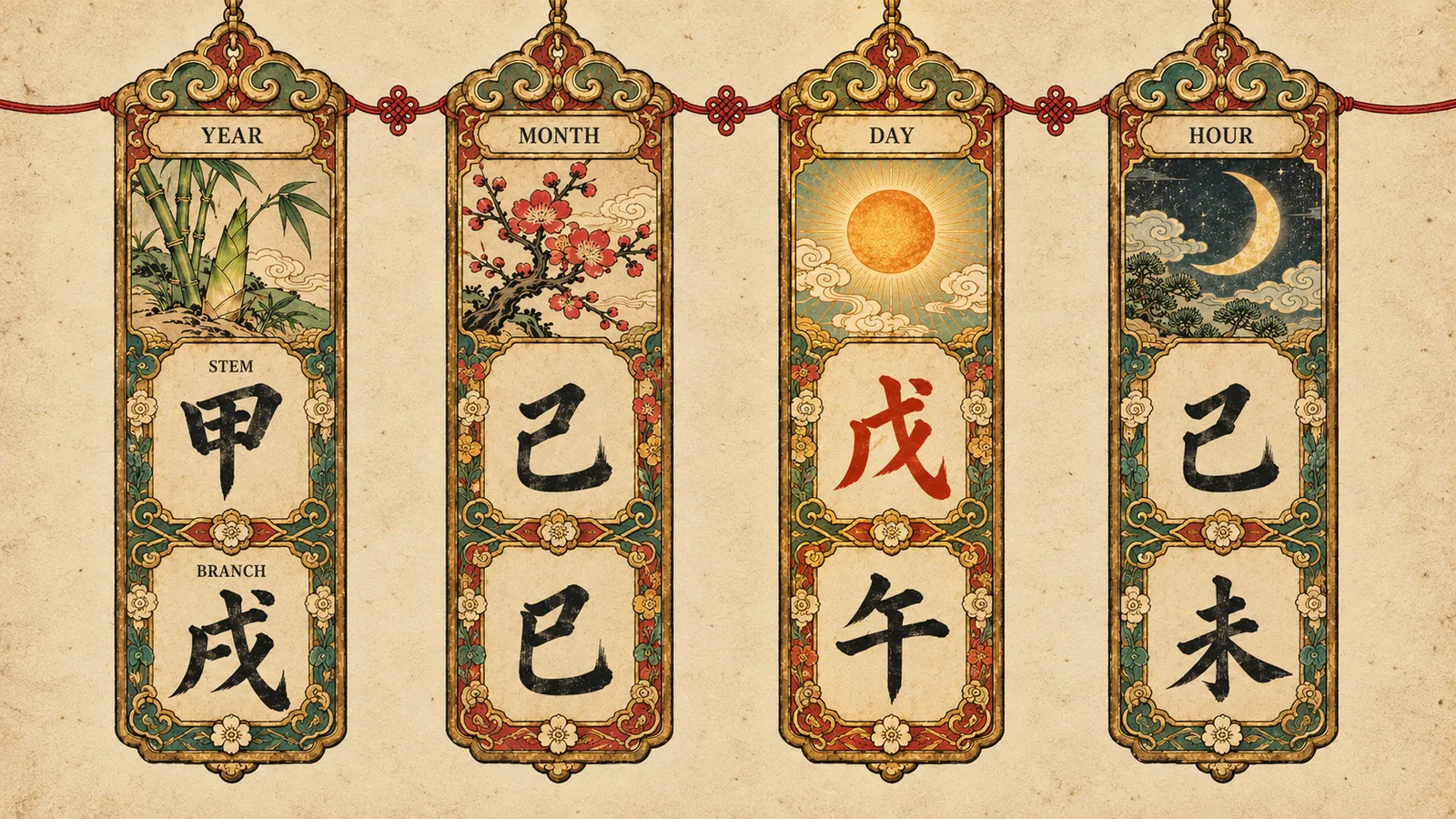
BaZi is a Chinese birth-chart tradition that represents a birth using four pairs of characters: year, month, day and hour. Each pair contains a Heavenly Stem and an Earthly Branch. Four pairs make eight characters—ba zi. Readers interpret the relationships among them, their seasonal setting and timing cycles rather than drawing random cards.
The useful first step is not memorizing predictions about your zodiac animal. It is learning what the chart actually contains. This guide builds a complete fictional example, distinguishes calendar calculation from traditional interpretation, and explains why an apparently small change in birth information can matter.
Four pillars, not four separate horoscopes
A pillar is one column with a stem above a branch. Charts do not all arrange the columns in the same direction, so read the headings before assuming that the far-left column is the year.
| Pillar | What identifies it | What to check first |
|---|---|---|
| Year | The year’s stem–branch pair under the chosen boundary rule | Whether the birth is near the year boundary |
| Month | The seasonal month and its stem | Which solar-term interval contains the birth |
| Day | The day’s position in the repeating cycle | The date and day-change convention |
| Hour | The two-hour branch and a stem derived from the day stem | Birth time, place and time settings |
The Hong Kong Observatory’s stem–branch tables document the ten stems, twelve branches, sixty-pair cycle and the connection between traditional hours and clock time. These are calendrical relationships. Whether a chart predicts someone’s life is a different question; an accurate calendar calculation does not establish predictive validity.
The familiar zodiac animal belongs to a branch, commonly the year branch. It is only one part of a chart. Two people born in the same animal year can have different month, day and hour pillars.
A complete chart you can check
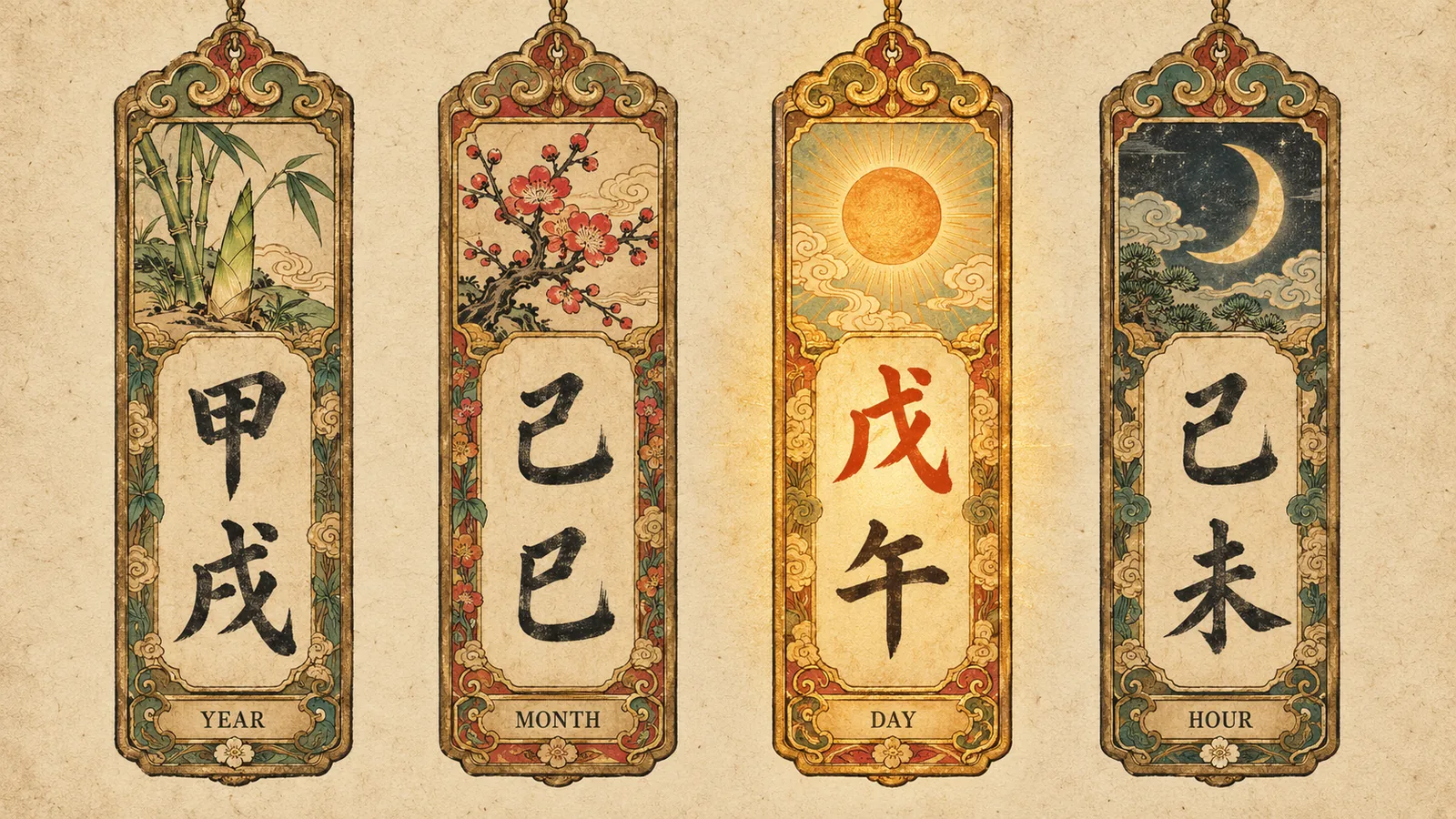
Our invented birth record is June 1, 1994, at 14:30 in Shanghai, using the Asia/Shanghai civil time zone, no true-solar-time adjustment, a Li Chun year boundary and solar-term months. It is not a customer record or an example chosen to prove a personality claim.
| Layer | Year | Month | Day | Hour |
|---|---|---|---|---|
| Heavenly Stem | 甲 Jia | 己 Ji | 戊 Wu | 己 Ji |
| Earthly Branch | 戌 Xu | 巳 Si | 午 Wu | 未 Wei |
| Combined pillar | 甲戌 | 己巳 | 戊午 | 己未 |
The GOOD TIMING calculator produces this chart with those settings. The year, month and day match the June 1, 1994 calendar entry; its hour table also gives Ji Wei for 13:00–15:00. This cross-check verifies the example’s characters, not the page’s separate auspicious-day claims.
Read the chart in three passes.
First, locate the day stem, 戊 Wu. This is the Day Master: the reference point used when interpreting other stems and relationships. It is not the year stem 甲, and it is not the whole day pillar 戊午.
Second, notice the month branch 巳 Si. It places the example in a seasonal setting. Traditional BaZi analysis gives the season substantial weight; the same day stem in another month is not automatically read the same way.
Third, look across the entire chart. Repeated characters, hidden stems within branches and the ways elements support or constrain one another become relevant. Those observations should be assembled before offering conclusions about a person. “Wu Earth” alone is not enough to decide someone’s career, relationship prospects or temperament.
What the Five Phases do—and do not—mean
Wood, Fire, Earth, Metal and Water are the traditional Five Phases, often translated as Five Elements. Here they describe a system of relationships, not chemical ingredients or quantities measured in a body.
A beginner may count the visible characters and notice several Earth stems. That is a legitimate observation about the printed chart. It does not, by itself, establish the Day Master’s strength or which element is favorable. The month, roots, hidden stems and interactions can change the reading.
For example, an app’s chart might show no Water in its most prominent row. It would be a leap to prescribe a Water-themed purchase, predict illness or call the person emotionally deficient. A display count and a complete interpretation are different things. Schools also differ in how they weigh chart structures, seasonal adjustment and favorable elements.
The Day Master guide explains the ten stems and shows how to locate the reference character without turning it into a fixed personality label.
Why the calendar settings matter
BaZi is not simply the eight characters printed beside a lunar birthday. In the convention used for this example, the year changes at Li Chun, and the month changes at the relevant jie solar-term boundary, not on the first of each lunar month.
Births near a boundary require particular care. A few minutes may move a birth into another traditional hour; a different day-change convention can affect a late-night birth. Historical daylight-saving rules and time-zone changes are also matters of calculation, not something a reader should invent from a modern clock offset.
GOOD TIMING’s default BaZi convention uses midnight for the day change and offers other documented calculation choices. True solar time is an optional adjustment using location; it is not silently applied to this example. Keep the settings with a saved chart so that a second calculation can be meaningfully compared.
If the time is unknown, leave it unknown. A guessed noon time can create a convincing-looking but unsupported fourth pillar. See BaZi without an exact birth time for a side-by-side example of what remains usable.
What to expect from an online BaZi reading
In GOOD TIMING’s BaZi tool, enter the birth details and check the resulting chart before reading the AI interpretation. Verify the date format, location, time zone and whether the time is exact or unknown. The computed pillars are the evidence; the prose is an interpretation of that evidence, not a new way to calculate it.
A useful first question might be, “What work patterns stand out in this chart?” A more focused question could ask how the chart’s traditional relationships are being interpreted in connection with a particular concern. Neither requires sharing names, employer details or other unnecessary private information.
BaZi and Western astrology can use the same birth record but produce different charts. One is not a translation of the other. Our comparison guide separates the two systems without ranking their accuracy.
Questions beginners often ask
Is the Day Master my Chinese zodiac sign?
No. The Day Master is the stem of the day pillar. The familiar animal sign usually refers to the year branch. In our example, the year branch is Xu, the Dog, while the Day Master is Wu Earth.
Does a missing element mean something is wrong?
Not on its own. A visible-element count leaves out much of the chart’s structure and says nothing by itself about a person’s health or worth. Interpret the full chart before assigning significance to an apparent absence.
Is BaZi a scientific personality test?
It is a traditional interpretive system, not a validated diagnostic instrument. You can check the calendar arithmetic independently while treating the life reading as symbolic interpretation rather than measured fact.