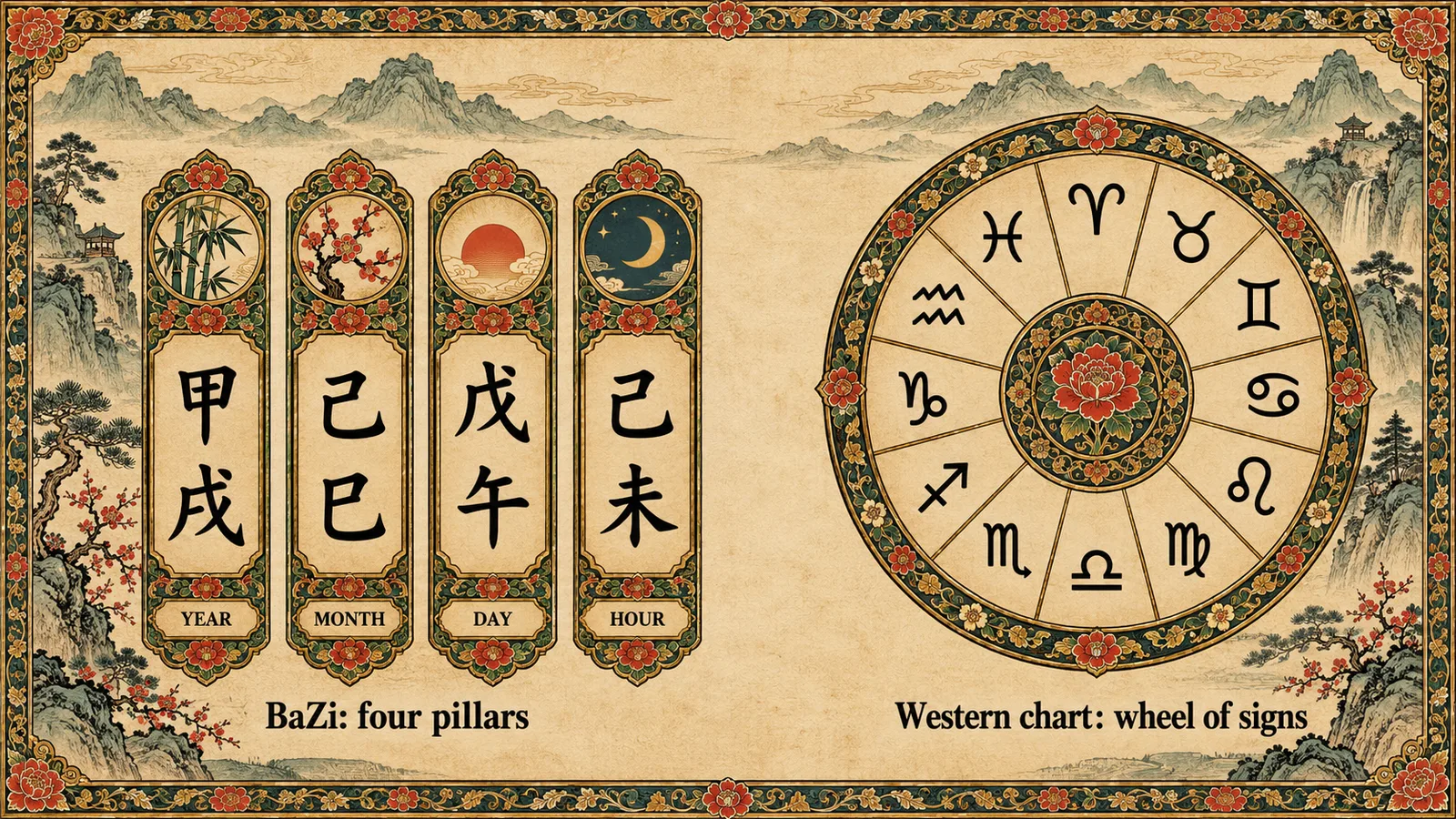
BaZi and Western natal astrology both begin with birth information, but they calculate and interpret different structures. BaZi organizes the birth into four stem–branch pillars. Western natal astrology maps celestial positions into a zodiac and relates them through aspects, angles and, when the birth time is known, houses. One is not a translated version of the other.
The comparison here concerns the solar-term Four Pillars approach used by GOOD TIMING and its tropical Western natal chart with Placidus houses. Other BaZi conventions, sidereal zodiacs and house systems exist. Naming the settings is more useful than declaring one universal “Eastern chart” and one universal “Western chart.”
What goes into each chart?
| Feature | BaZi / Four Pillars | Western natal astrology |
|---|---|---|
| Main structure | Year, month, day and hour stem–branch pairs | Planetary longitudes, zodiac signs, aspects and houses |
| Central reference | Day Master, the day’s Heavenly Stem | No single universal equivalent; Sun, Moon and Ascendant have different roles |
| Element framework | Wood, Fire, Earth, Metal, Water | Fire, Earth, Air, Water |
| Time boundaries | Calendar cycles, solar terms, day-change and hour conventions | Continuous celestial motion, local horizon and chosen house system |
| Unknown birth time | Hour pillar omitted; boundary-sensitive uncertainty remains | Ascendant and houses omitted; time-sensitive planetary details need caution |
The Hong Kong Observatory’s stem-and-branch tables explain the calendrical pairing. They do not validate personality or destiny claims. Similarly, calculating a planet’s longitude is an astronomical operation; interpreting that position as a life theme is an astrological practice.
One fictional birth, two outputs
Take June 1, 1994, 14:30 in Shanghai, using Asia/Shanghai and coordinates 31.23° N, 121.47° E. The example uses civil time without a true-solar-time correction.
Our BaZi calculation gives 甲戌 / 己巳 / 戊午 / 己未. Its Day Master is 戊, Yang Earth. The Western calculation uses the tropical zodiac and Placidus: the Sun is approximately 10.55° Gemini, and the Ascendant approximately 15.93° Libra.
These are reproducible local calculation outputs, not a reading of a real person and not an accuracy test of prediction. The BaZi date and hour pillars were also checked against an independent calendar.
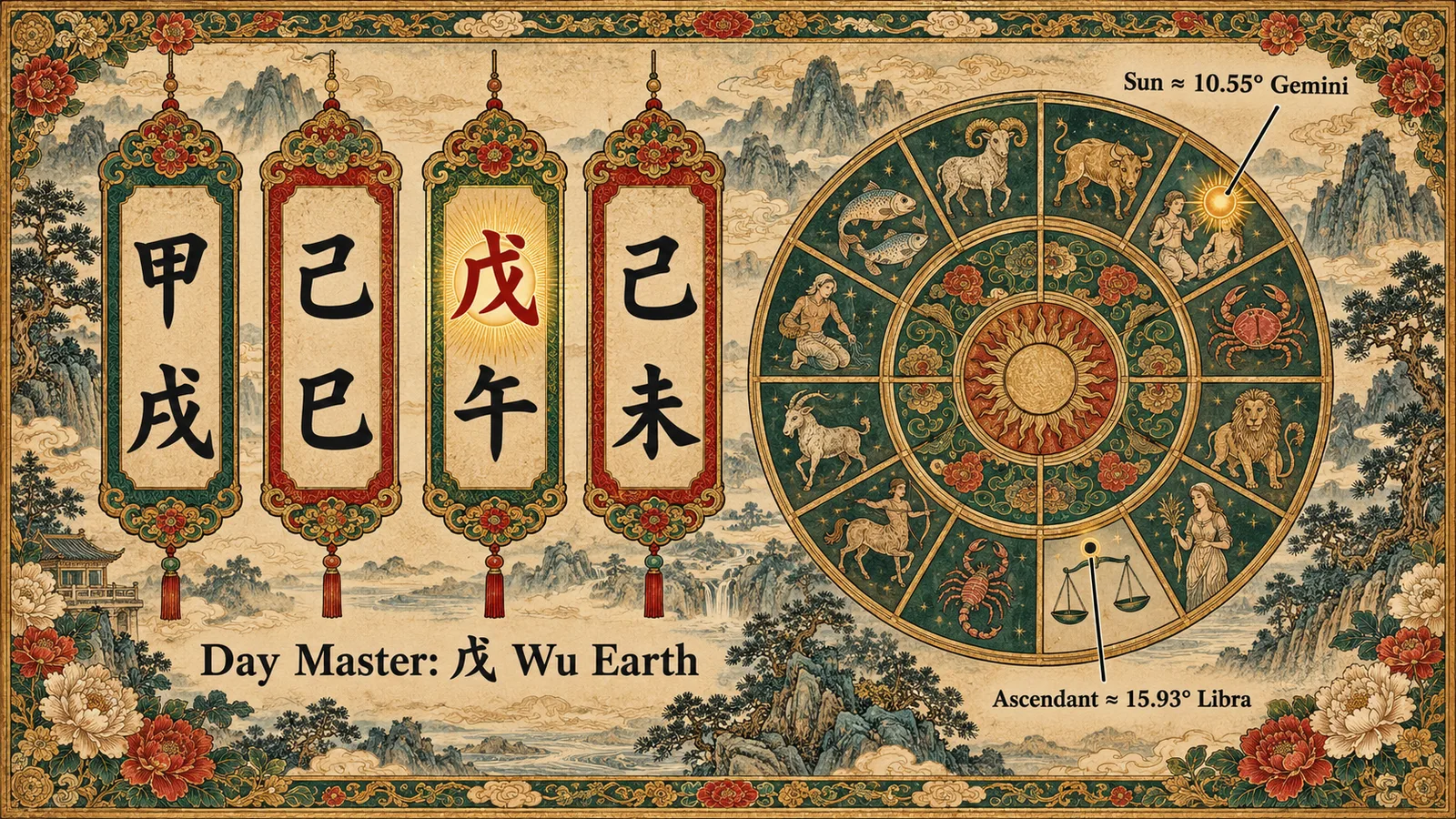
There is no contradiction in Earth appearing as the Day Master while the Sun is in an Air sign. The labels belong to different relationship systems. Converting “Earth” into “must be a Taurus” would erase the information each method actually uses.
How would they approach the same question?
Suppose the question is, “What patterns might shape how I work with other people?”
A BaZi reading can examine relationships to the Day Master, the seasonal month, the stems and branches and their interactions. It should not turn a count of Earth characters into the entire answer. A Western reading can compare relevant planets, aspects and houses; it should not answer solely from the Sun sign.
For the fictional chart above, knowing only “Wu Earth” and “Gemini Sun” is insufficient for a developed comparison. A useful reader must show which additional parts of the chart support a specific interpretation. Otherwise two attractive personality descriptions can seem to agree or disagree without ever examining equivalent evidence.
This is where the systems offer different vocabularies, not a contest with an established winner. We have no controlled evidence that one predicts individual outcomes more accurately than the other.
Birth time matters differently
A change of hour can alter a BaZi hour pillar and its relationships. Near midnight or a solar-term boundary, other pillars may be affected depending on convention. In a Western chart, the local angles and house cusps move with time and location. Astrodienst’s birth-time guidance emphasizes accurate time and provides a no-houses option for unknown times.
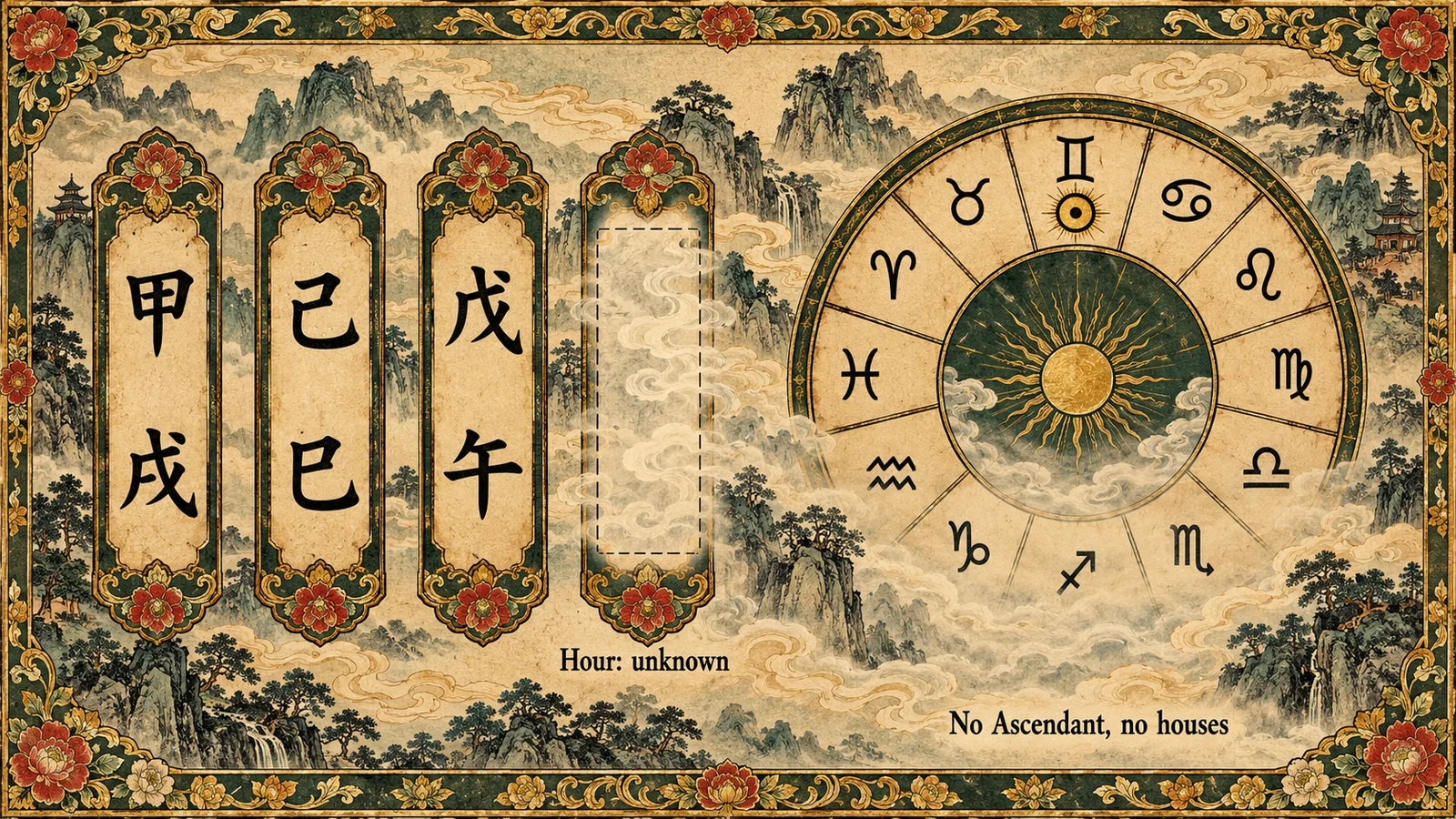
Neither method should manufacture precision from an unknown input. See BaZi without an exact birth time for a two-hour comparison and the boundary cases that deserve attention.
Which should you choose?
Choose BaZi if you want to explore the Four Pillars’ calendar-based relationships and are interested in the Day Master, five phases and timing cycles. Choose Western astrology if you want a planetary chart and the relationships among signs, aspects and houses. Familiarity with the language matters: a chart you can examine is more useful than a supposedly superior system whose evidence remains hidden.
For an immediate question without birth data, a card reading or an I Ching cast may be a better fit than inventing a birth time. Different methods can illuminate the same concern, but repeated readings do not form a scientific vote.
GOOD TIMING offers BaZi and Astrology as distinct tools. Start with the available birth details, check the displayed settings and uncertainty, then ask a question the chart can actually address. For the foundations, read What is BaZi? and Astrology for beginners.