Yes, a limited BaZi reading is possible when the birth date is reliable but the time is unknown. You normally work with the available year, month and day pillars and leave the hour pillar absent. You should not quietly invent a time to make the chart look complete.
There is an important qualification: the first three pillars are not guaranteed to be unaffected in every case. A birth near midnight, Li Chun or a month-changing solar term can make the unknown time relevant to the date or seasonal boundary as well. The right question is not “Can the software fill every box?” but “Which parts of this particular chart are supported by the information we actually have?”
First distinguish three different uncertainties
| What you know | What it supports | What not to assume |
|---|---|---|
| An exact recorded time | A full calculation under stated time rules | That the record, zone or daylight-saving conversion is infallible |
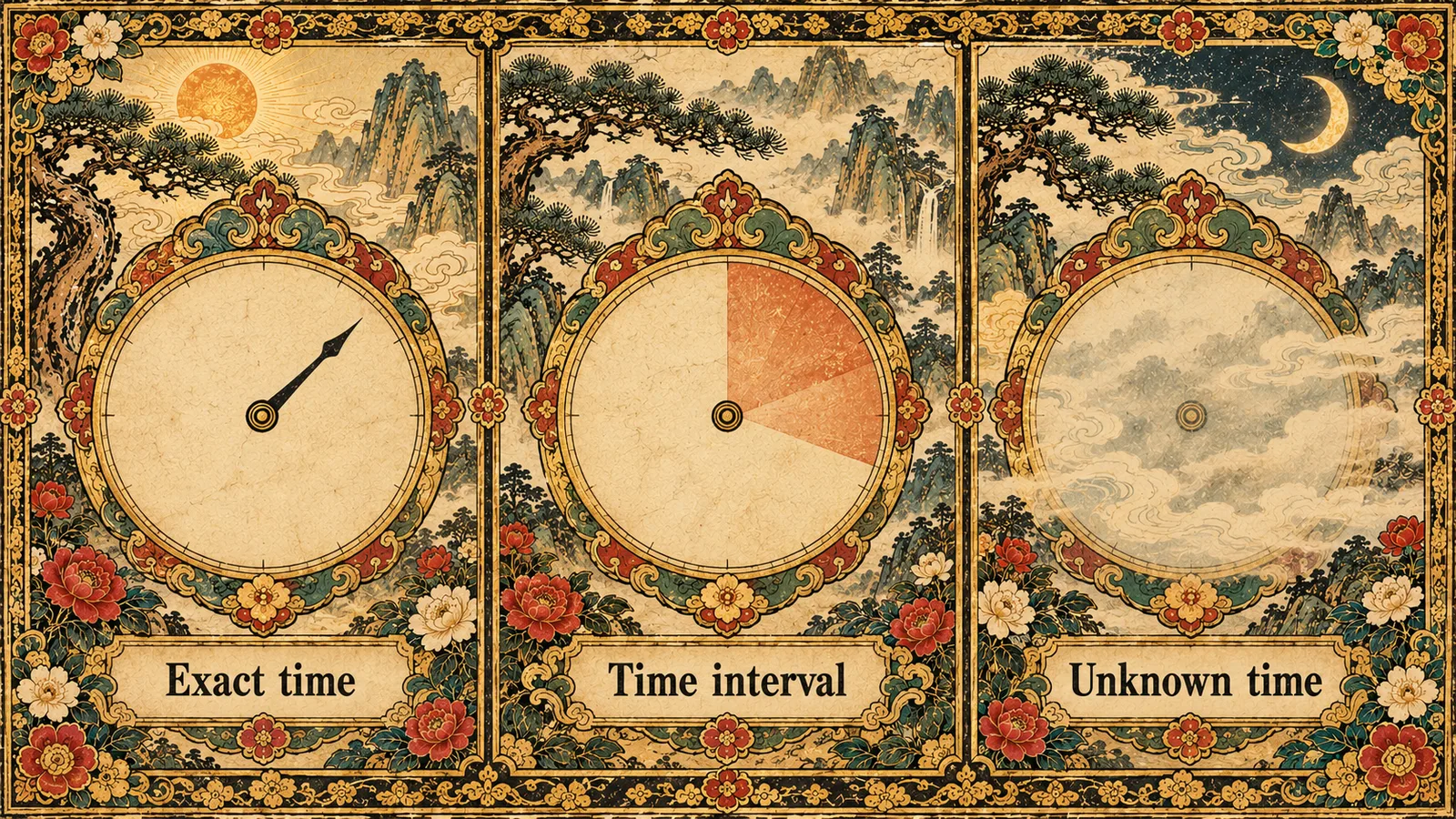
| A bounded interval, such as 14:00–16:30 | Comparing the possible calculations within that interval | That the midpoint is the real time |
| The date only | A partial chart, with boundary checks | That noon supplies a valid hour pillar |
A family recollection of “after lunch” is useful context, but it is not equivalent to a timestamp. Record it as an interval or a recollection. If a civil birth record is available, check what it actually says rather than asking a chart to authenticate it.
A calculated example: the same date, two hours
Use our fictional Shanghai birth date, June 1, 1994, with Asia/Shanghai civil time and no true-solar-time correction. The example is away from midnight and the relevant year and month boundaries.
| Input time | Year | Month | Day | Hour |
|---|---|---|---|---|
| 14:30 | 甲戌 | 己巳 | 戊午 | 己未 Ji Wei |
| 16:30 | 甲戌 | 己巳 | 戊午 | 庚申 Geng Shen |
| Unknown | 甲戌 | 己巳 | 戊午 | Intentionally omitted |
The first two rows were calculated with the same settings except for the time. They agree with the hour sequence in the date’s calendar table. The Hong Kong Observatory identifies Wei as 13:00–15:00 and Shen as 15:00–17:00, and documents how the day stem determines the hour stem.
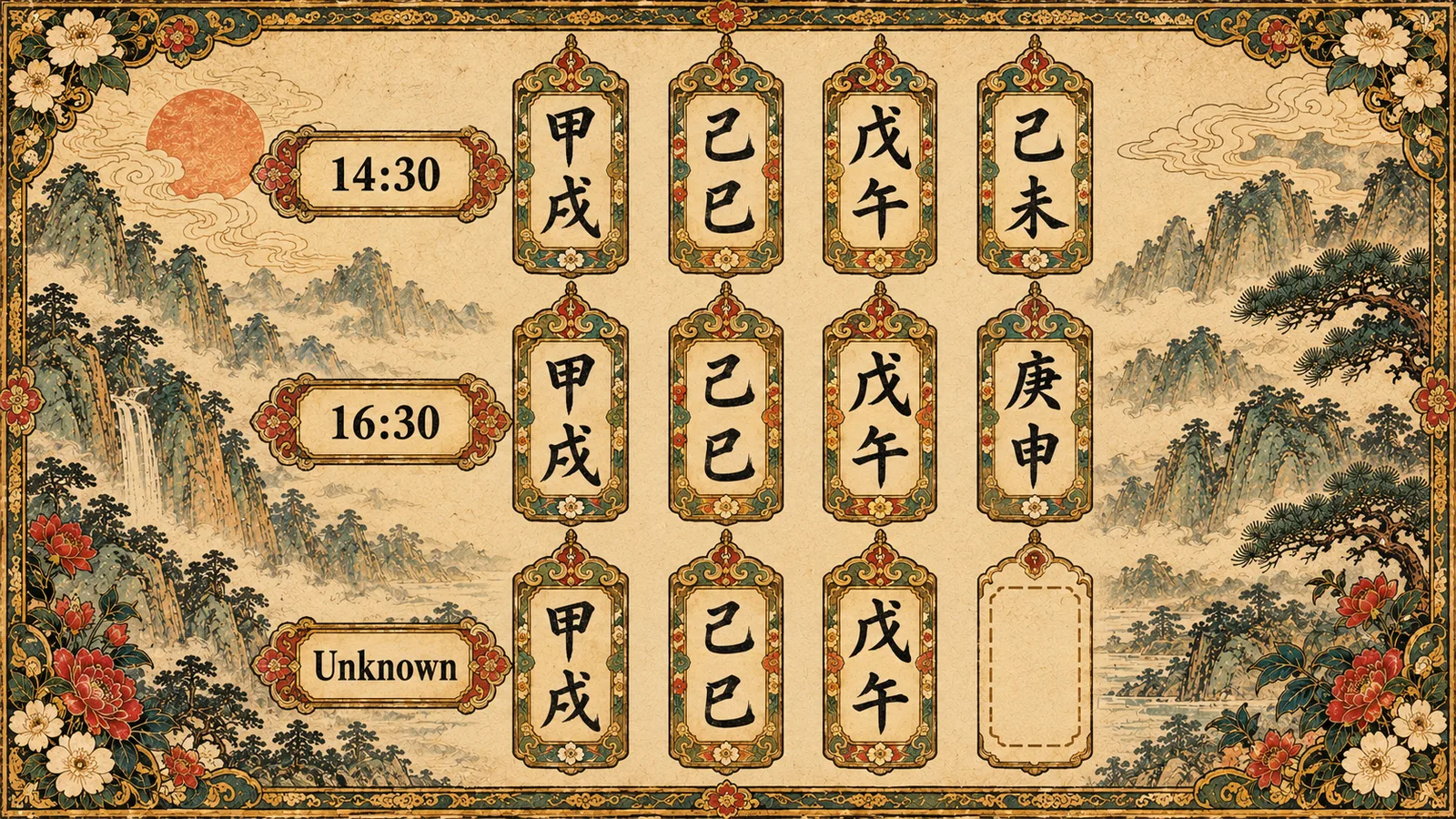
Notice what actually changes. It is not merely a time label beneath an otherwise identical reading: both characters of the hour pillar differ. That can change the traditional relationships being interpreted. At the same time, the example does not justify inventing two contrasting biographies. Its purpose is to show the uncertainty in the evidence.
The unknown-time row is not a third possible hour. It represents missing information. A calculator may internally use a neutral reference time to obtain calendar data, but that must not be presented as the person’s real birth time or used to fabricate a fourth pillar.
What can still be discussed?
For this particular example, the Day Master remains Wu Earth and the month setting remains Si. A reader can explain those known components and the relationships among the three available pillars. They can also say which interpretation would depend on the missing hour.
A useful reading would distinguish “this relationship is visible in the known pillars” from “this would require confirmation of the hour.” It would not treat the omission as a technicality while presenting an equally detailed, equally confident full-life forecast.
Some traditions associate the hour pillar with later-life themes, children or aspirations, but it does not follow that every reading about those subjects becomes impossible without an hour—or that they can be reconstructed from a single label. Interpretive weighting varies, and the whole method matters.
When can the first three pillars also be uncertain?
The worked date is deliberately straightforward. Other dates are not.
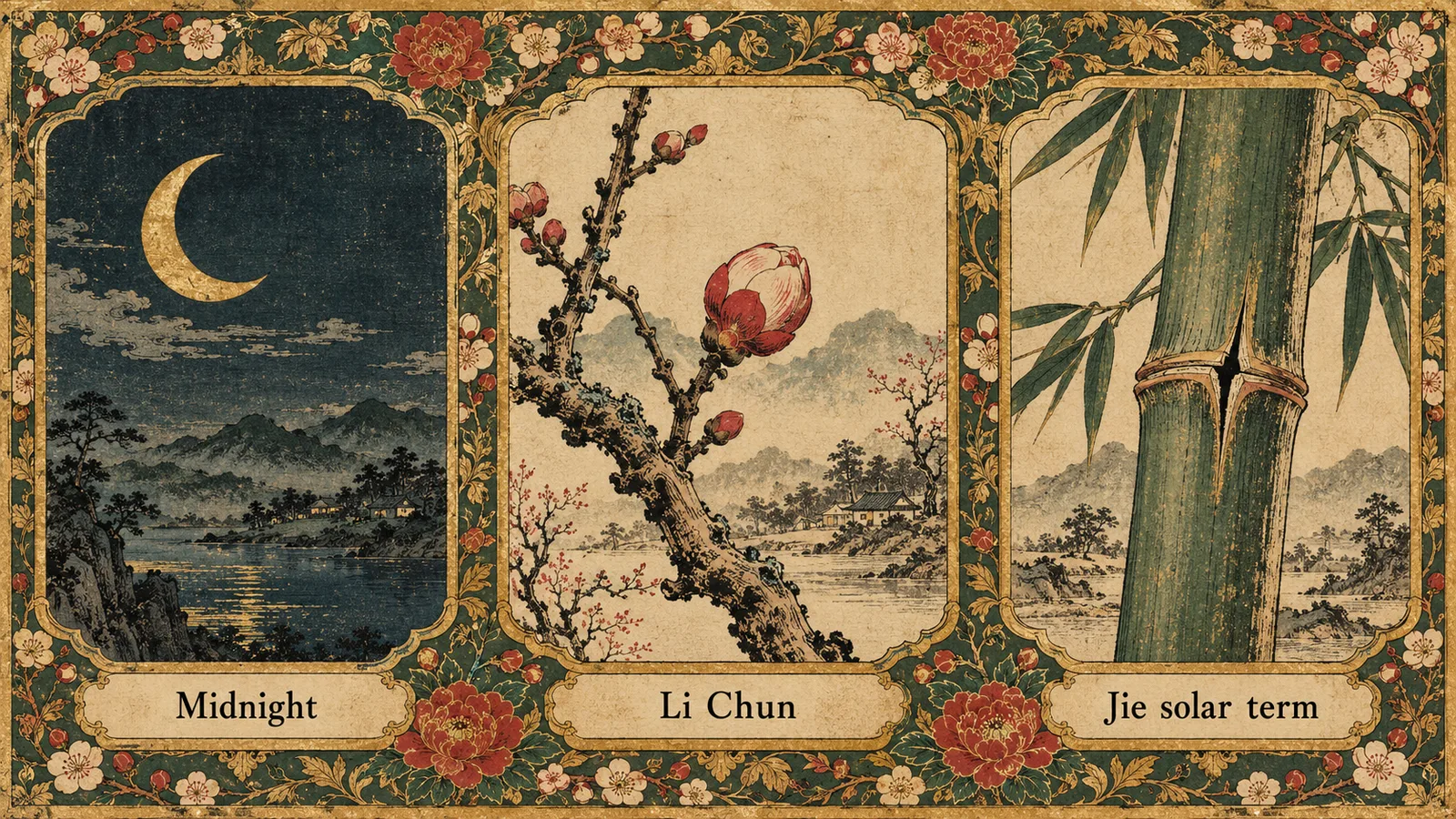
Near midnight: if the remembered interval straddles midnight, the civil date itself may need checking. Schools also differ on when the BaZi day changes; GOOD TIMING supports a stated day-change convention rather than assuming every reader agrees.
Near Li Chun: under the Li Chun year convention, a birth before or after the exact boundary can fall in a different year pillar.
On a month-changing solar-term date: the time of the term matters. A date-only input may not resolve which month setting applies.
With uncertain place or historical time rules: a clock time needs its location and historical time-zone context. An optional true-solar-time adjustment is another declared convention, not a universal correction that should be imposed silently.
None of this requires pretending that all date-only readings are unusable. It means checking whether the uncertainty matters for this date, instead of making an unconditional promise about “six certain characters.”
Can a reader recover my birth time?
Birth-time rectification is an interpretive practice in which a practitioner compares candidate charts with reported life events. It is not independent documentary proof of the birth time. A plausible fit can still leave several candidates.
GOOD TIMING’s unknown-time option is not an automatic promise to discover your exact birth time. If you have two plausible intervals, compare them as hypotheses and preserve the original uncertainty. Do not turn a speculative match into a supposedly confirmed birth record.
There is also a privacy trade-off: rectification can invite a great deal of personal history. Share only what you actually want the service to process, and distinguish a request for clarification from a request for an extensive biography.
How to start honestly in GOOD TIMING
Open the BaZi tool, enter the date and place, and select the unknown-time option when appropriate. Inspect the chart before interpreting it: the hour pillar should be omitted rather than filled with an arbitrary guess.
Ask something the known chart can address, such as “What relationships are visible among these three pillars, and which part of the interpretation depends on the hour?” This is still a meaningful reading question. It makes the scope explicit rather than asking the AI to conceal a missing input.
For the underlying chart structure, read What Is BaZi?. For the reference character in the day pillar, see the Day Master guide. Both help you separate a stable calculation from an interpretation that remains conditional on missing information.