The Day Master is the Heavenly Stem of the day pillar in a BaZi chart. It is one character, not your animal year, your entire day pillar or the element that appears most often. Traditional readers use it as a reference point for interpreting the other parts of the chart.
There are ten possible Day Masters: a yin and a yang stem for each of Wood, Fire, Earth, Metal and Water. Learning those ten names helps you read a chart. Treating them as ten complete personality types does not.
Find the character before interpreting it
Consider this fictional chart, calculated for June 1, 1994, 14:30 in Shanghai using civil time:
| Year | Month | Day | Hour | |
|---|---|---|---|---|
| Stem | 甲 Jia | 己 Ji | 戊 Wu | 己 Ji |
| Branch | 戌 Xu | 巳 Si | 午 Wu | 未 Wei |
The Day Master is 戊, because it occupies the stem row of the day column. The year stem 甲 is not the Day Master, and the branch 午 is not another name for it. The two Wu sounds also refer to different characters here: 戊 is a stem; 午 is a branch.
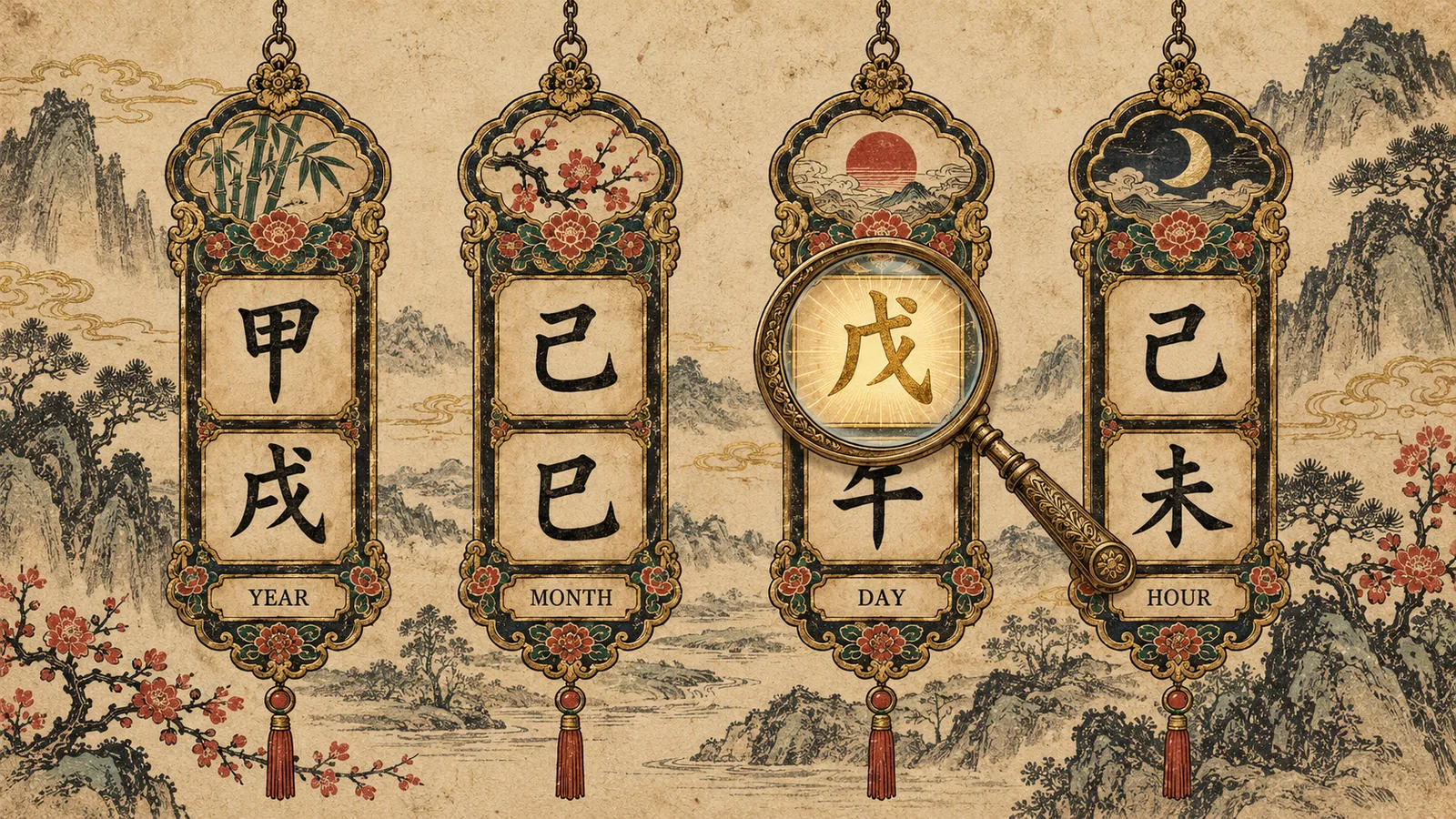
If your app arranges the pillars in the reverse direction, the same rule applies: find the column labeled Day, then its stem. Do not memorize “the third square from the left.” See the complete BaZi example for the calculation settings and independent calendar check.
The ten Heavenly Stems in five pairs
The table below is a reference alphabet, not a prediction. Yin and yang distinguish relationships within the system; they do not mean weak and strong, female and male, or good and bad.
| Phase | Yang stem | Yin stem |
|---|---|---|
| Wood | 甲 Jia | 乙 Yi |
| Fire | 丙 Bing | 丁 Ding |
| Earth | 戊 Wu | 己 Ji |
| Metal | 庚 Geng | 辛 Xin |
| Water | 壬 Ren | 癸 Gui |
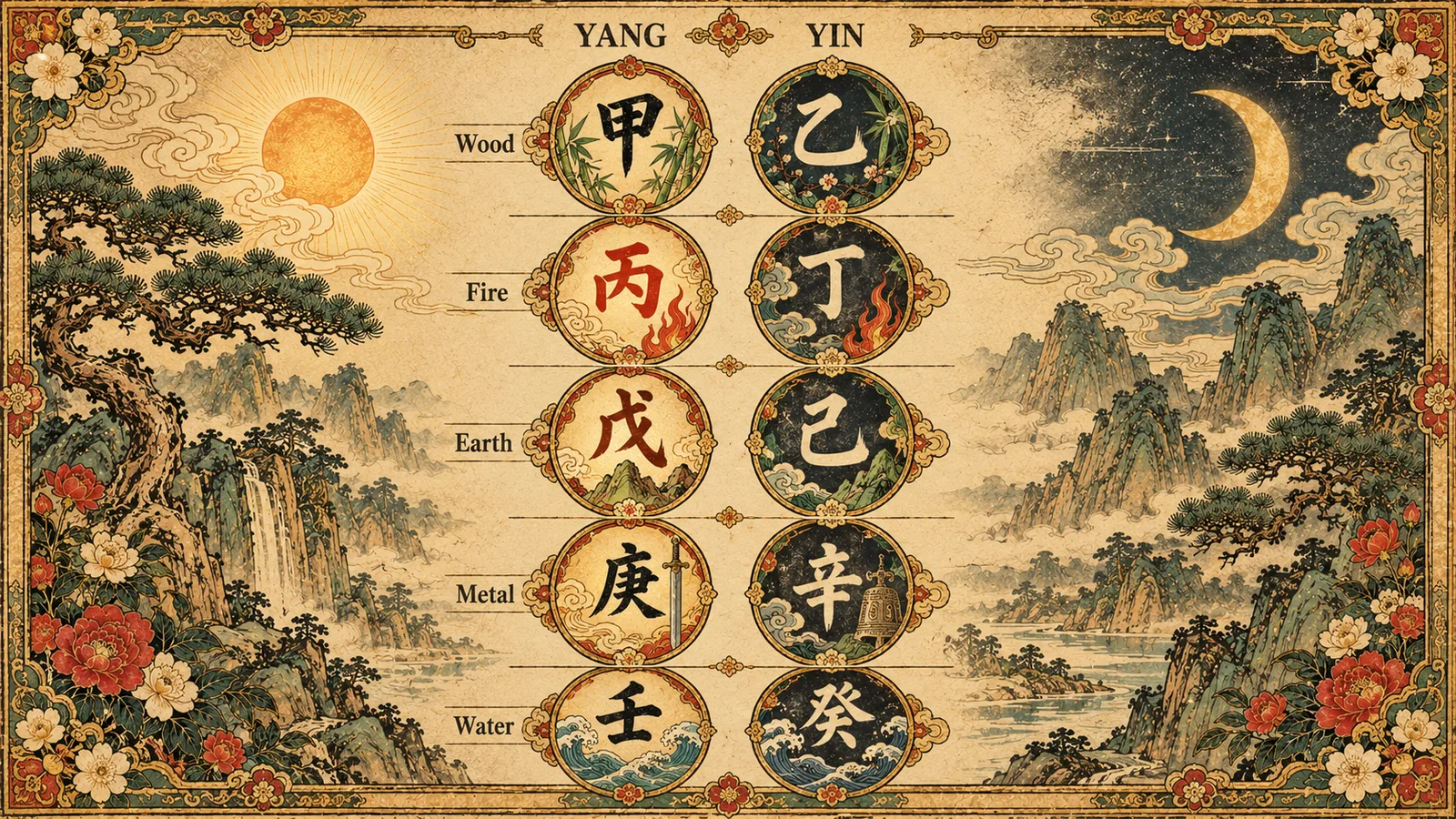
The Hong Kong Observatory lists the stems and their order in the calendrical cycle. Traditional BaZi teaching adds their phase and polarity relationships; for an example of practitioner instruction, see Joey Yap’s introductory notes. Those interpretive associations should not be confused with astronomical measurements of personality.
Traditional imagery can make the pairs easier to remember. Jia Wood is often pictured as a substantial tree, Yi Wood as more flexible growth; Wu Earth as a mountain or broad terrain, Ji Earth as cultivated ground. These are teaching images, not literal descriptions of everybody with that stem. Different teachers emphasize different images.
What changes when you use the Day Master as a reference?
The same phase can play a different role depending on which Day Master you start from. In the traditional generating cycle, Wood generates Fire. For a Wood Day Master, Fire therefore belongs to the broad Output relationship. For a Fire Day Master, Wood belongs to the broad Resource relationship because it generates that Day Master.
That is a relationship inside a symbolic system—not a claim that a Wood person must become an artist or a Fire person must work in education. Polarity further distinguishes the paired categories commonly called the Ten Gods or Ten Relationships.
This explains why a list of elements is not yet a reading. Before discussing a role, you need to know what that role is relative to. Before applying it to a real concern, you need the rest of the chart and the question.
One Day Master, more than one setting
Return to our Wu Earth example. Its month branch is Si, its day branch is Wu, and its other stems include Jia and Ji. Those details are not optional background once the reading becomes more than a beginner’s label.
Now consider a conceptual comparison, not a second calculated birth chart: Wu Earth in a Si-month setting versus Wu Earth in a Zi-month setting. The Day Master is unchanged, but the seasonal context is different. You would need to re-examine the chart’s support, roots and interactions rather than copy a “Wu Earth personality” paragraph.
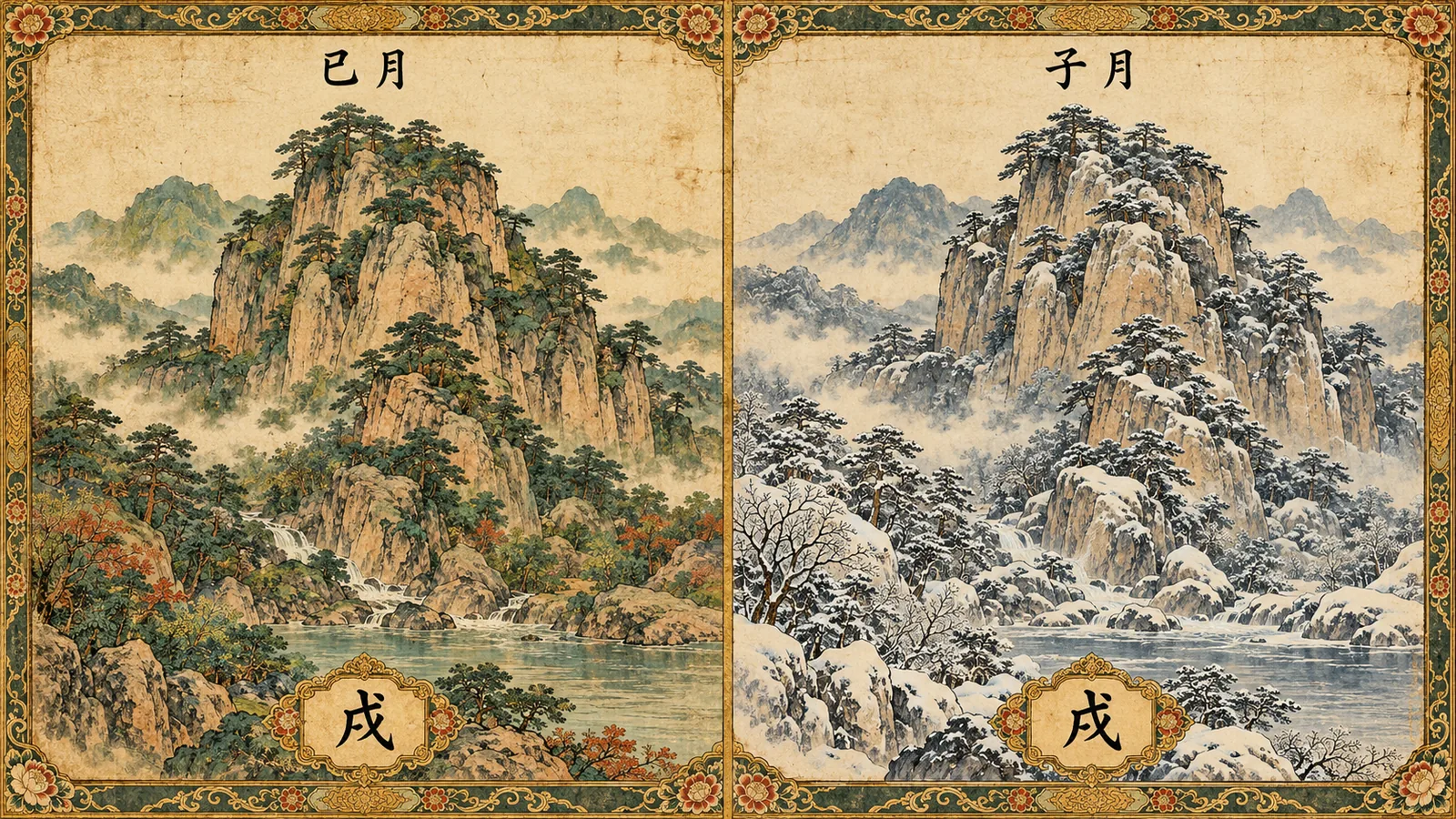
This diagram deliberately does not invent the remaining pillars. Without a complete second chart, it would be misleading to declare one person strong and the other weak, or one season automatically fortunate. The lesson is narrower and useful: a shared Day Master does not make two charts equivalent.
Why your animal sign or a missing element cannot replace it
A familiar zodiac animal usually comes from the year branch. Someone may therefore be born in a Dog year and have a Wu Earth Day Master, as in our example. These labels answer different questions about the chart.
Likewise, “my chart has lots of Earth” is not the definition of an Earth Day Master. The reference character remains the day stem even if another phase is more visible elsewhere.
Avoid turning “missing Water” into an automatic remedy. A visible count leaves out hidden stems and weighting, and it does not establish what a particular chart needs. Nor does a favorable element automatically prescribe clothing, jewellery or medical treatment.
How to use this in your own reading
Open GOOD TIMING’s BaZi chart with your actual birth details. Locate the day stem and check that the time settings are the ones you intended. If the birth time is unknown, preserve that uncertainty rather than filling in a guessed hour.
Then ask a question that moves beyond the label: “How does the month setting affect the interpretation of my Day Master?” or “Which relationships in the full chart are relevant to my work question?” These invite an explanation of the chart rather than a generic biography.
If different calculators give different Day Masters, compare the birth date, time zone and day-change convention first. That is a calculation discrepancy to investigate, not proof that you have two personalities. The birth-time guide shows why late-night and uncertain-time cases need care.
A short answer to a common question
Can I understand my whole BaZi chart from the Day Master? No. It tells you where the interpretation is anchored. It does not replace the other seven characters, the season, hidden relationships or the timing method used by a reader. Finding it correctly is the beginning of reading a chart—not the end.