Maybe it started with a horoscope you read on a quiet morning.
Or with a friend who looked at you and said, "That is so Scorpio."
Or with the strange feeling that your Sun sign describes only part of you, and you want to know what the rest of the story is.
Astrology for beginners can feel like learning a new language. There are twelve signs, ten planets, twelve houses, symbols, degrees and terms like "rising," "trine" and "retrograde." The good news is that astrology is built from a few simple pieces. Once you understand what each piece does, the whole birth chart starts to make sense.
This guide walks you through the basics of astrology step by step: the Big Three, the signs, the elements, the planets, the houses and the aspects, plus how to read your own chart for the first time and how to follow the sky as it moves.
Let's explore it together, one layer at a time.
What Is Astrology?
Astrology is a symbolic system that links the positions of the Sun, Moon and planets to human life, personality and timing. It is one of the oldest systems of meaning-making in the world. Its roots go back to ancient Mesopotamia, and it developed through Hellenistic Egypt and Greece, India, the Islamic world and medieval Europe. Chinese astrology grew from a separate tradition.
Most Western astrology today, including this guide, uses the tropical zodiac, which is anchored to the seasons: Aries begins at the spring equinox in the Northern Hemisphere. Vedic (Jyotish) astrology uses the sidereal zodiac, anchored to the stars, so its sign dates differ by about 24 days.
An honest note before we begin: there is no established scientific evidence that the planets shape personality or events. Many people still find astrology valuable as a language for self-reflection, a way to name patterns, ask better questions and feel connected to the rhythms of the sky. That is the spirit of this guide. Your chart is a mirror, not a verdict.
Horoscopes and astrology are not the same thing. A daily horoscope in a magazine is written for everyone who shares a Sun sign, which is roughly one in twelve people on Earth. Astrology itself is far more personal: it looks at the full sky at the exact moment you were born. If horoscopes have never felt quite right to you, that does not mean astrology has nothing to offer. It may just mean you have only met one twelfth of it.
Your Big Three: Sun, Moon and Rising Sign
When people ask "What's your sign?" they usually mean your Sun sign, the sign the Sun was in on the day you were born. But beginners quickly learn that three placements matter most. Together, they are called the Big Three.
The Sun sign: your core self
The Sun describes your central identity, your vitality and what you are growing toward. It is the sign most horoscopes use, because it depends only on your birth date.
The Moon sign: your emotional world
The Moon describes your feelings, needs, instincts and what makes you feel safe. The Moon changes sign about every two and a half days, so you need your birth date and approximate time to know yours.
The rising sign (Ascendant): how you meet the world
The rising sign is the sign that was coming up over the eastern horizon at the exact moment you were born. It describes your first impressions, your style and your approach to new situations. It changes roughly every two hours, so you need an accurate birth time to find it.
A simple way to remember the Big Three: the Sun is who you are becoming, the Moon is what you need, and the rising sign is how you show up.
The 12 Zodiac Signs
Each sign is a style of energy. Here are approximate Sun sign dates (exact dates shift by a day or so each year; in 2026, for example, the Sun enters Scorpio on October 23), along with each sign's element and a few keywords.
| Sign | Approximate dates | Element | Keywords |
|---|---|---|---|
| Aries | Mar 21 – Apr 19 | Fire | courage, initiative, directness |
| Taurus | Apr 20 – May 20 | Earth | steadiness, comfort, loyalty |
| Gemini | May 21 – Jun 20 | Air | curiosity, conversation, variety |
| Cancer | Jun 21 – Jul 22 | Water | care, home, emotional memory |
| Leo | Jul 23 – Aug 22 | Fire | warmth, creativity, self-expression |
| Virgo | Aug 23 – Sep 22 | Earth | detail, service, improvement |
| Libra | Sep 23 – Oct 22 | Air | harmony, fairness, partnership |
| Scorpio | Oct 23 – Nov 21 | Water | depth, intensity, transformation |
| Sagittarius | Nov 22 – Dec 21 | Fire | freedom, meaning, adventure |
| Capricorn | Dec 22 – Jan 19 | Earth | ambition, structure, patience |
| Aquarius | Jan 20 – Feb 18 | Air | originality, community, ideals |
| Pisces | Feb 19 – Mar 20 | Water | compassion, imagination, intuition |
If you were born near the start or end of a sign (on the "cusp"), check a birth chart calculator. You belong to one sign, not two, and your exact birth time decides which.
The Four Elements and Three Modalities
The fastest way to understand a sign is to know its element and its modality. Together they describe what kind of energy a sign has and how it moves.
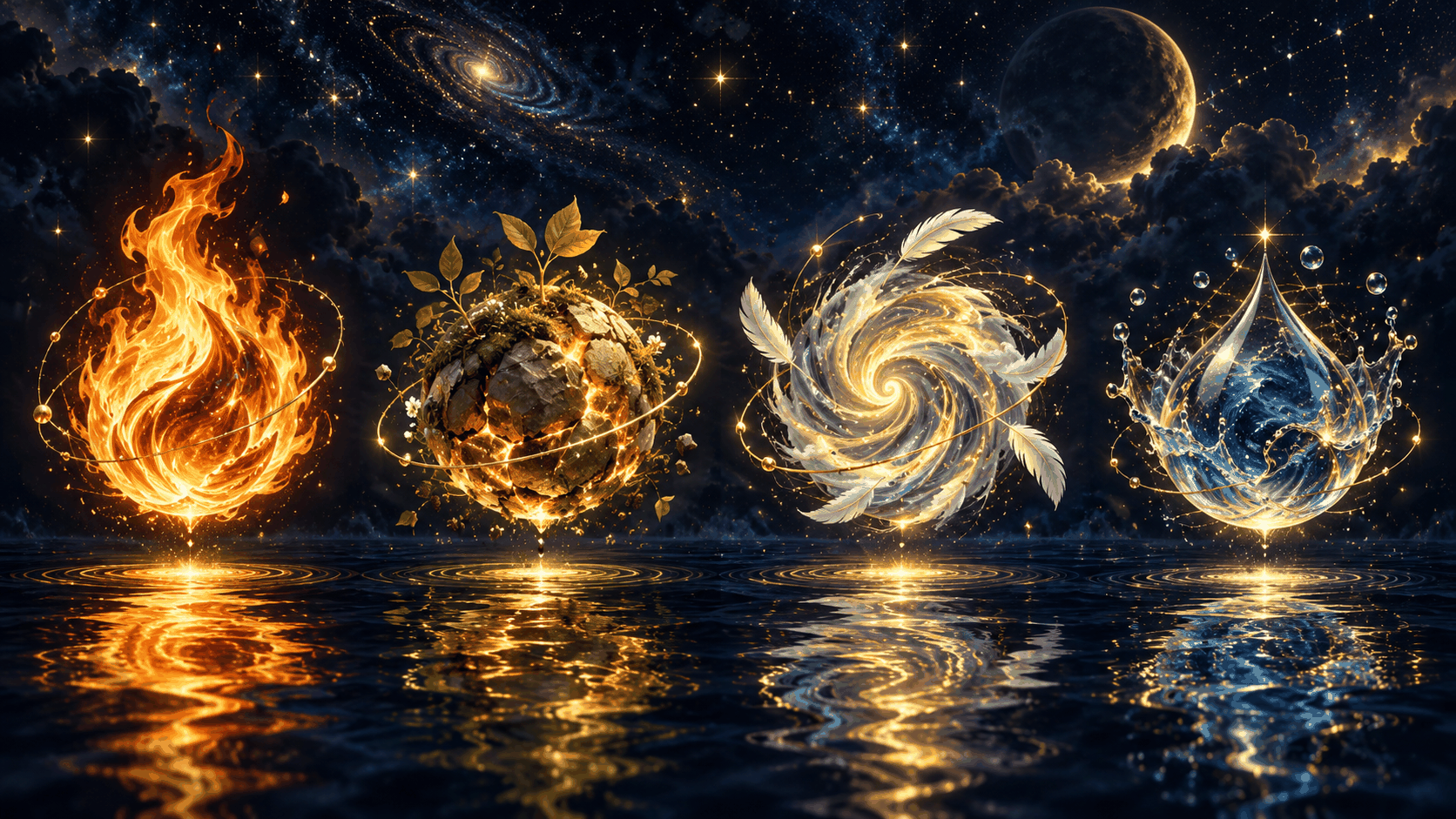
The four elements
- Fire (Aries, Leo, Sagittarius): passion, action, inspiration. Fire wants to begin, express and lead.
- Earth (Taurus, Virgo, Capricorn): practicality, the body, the material world. Earth wants to build, steady and make things real.
- Air (Gemini, Libra, Aquarius): ideas, communication, connection. Air wants to understand, exchange and share.
- Water (Cancer, Scorpio, Pisces): feeling, intuition, emotional bonds. Water wants to feel, merge and protect.
The three modalities
- Cardinal (Aries, Cancer, Libra, Capricorn): the initiators. Each begins a season.
- Fixed (Taurus, Leo, Scorpio, Aquarius): the sustainers. They hold, deepen and persist.
- Mutable (Gemini, Virgo, Sagittarius, Pisces): the adapters. They end a season and prepare for change.
Put them together and each sign becomes easier to picture. Scorpio is fixed water: deep, steady feeling that does not let go easily. Gemini is mutable air: quick, changeable curiosity. Capricorn is cardinal earth: practical initiative that builds step by step.
A quick example
Imagine someone with the Sun in Leo, the Moon in Cancer and Virgo rising. At their core (Sun), they want to create and be seen. Emotionally (Moon), they need closeness, familiarity and a safe home base. To the world (rising), they first come across as modest, organized and helpful. People who meet them at work may never guess how much they love the spotlight, and the people closest to them may be the only ones who see how sensitive they are. None of this is a prediction. It is a set of questions: Does this fit? Where does it not?
The Planets: The Voices in Your Chart
If the signs are styles of energy, the planets are the parts of you that use that energy. Each planet speaks in the voice of the sign it is in.
| Planet | What it represents | Moves through the zodiac in about |
|---|---|---|
| Sun | identity, purpose, vitality | 1 year |
| Moon | emotions, needs, instincts | 27–28 days |
| Mercury | thinking, speaking, learning | about 1 year (with retrogrades) |
| Venus | love, beauty, values, pleasure | about 1 year (with retrogrades) |
| Mars | drive, desire, courage, conflict | about 2 years |
| Jupiter | growth, luck, faith, meaning | about 12 years |
| Saturn | structure, limits, maturity | about 29 years |
| Uranus | change, freedom, surprise | about 84 years |
| Neptune | dreams, spirituality, ideals | about 165 years |
| Pluto | power, depth, transformation | about 248 years |
The Sun, Moon, Mercury, Venus and Mars are called the personal planets. They move quickly and describe your everyday personality. Jupiter and Saturn are the social planets. Uranus, Neptune and Pluto are the outer or generational planets: they move so slowly that everyone born within several years shares the same sign for them, so their house placement in your chart matters more than their sign.
So "Venus in Leo" means your way of loving (Venus) has a warm, generous, expressive style (Leo). "Mars in Virgo" means your drive works best through careful, practical effort.
Planetary rulers
Each sign is also traditionally "ruled" by a planet that shares its flavor: Mars rules Aries, Venus rules Taurus and Libra, Mercury rules Gemini and Virgo, the Moon rules Cancer, the Sun rules Leo, Jupiter rules Sagittarius, and Saturn rules Capricorn. Modern astrologers often add Pluto to Scorpio, Uranus to Aquarius and Neptune to Pisces, while traditional astrologers keep Mars, Saturn and Jupiter. The planet that rules your rising sign is called your chart ruler, and it is worth reading about early on.
The 12 Houses: Where Life Happens
The houses are the twelve areas of life in a birth chart. They are calculated from your birth time and place, starting from your rising sign. If planets are who and signs are how, houses are where.
| House | Area of life |
|---|---|
| 1st | self, body, first impressions |
| 2nd | money, possessions, self-worth |
| 3rd | communication, siblings, learning, neighborhood |
| 4th | home, family, roots |
| 5th | romance, creativity, play, children |
| 6th | daily work, routines, health |
| 7th | partnership, marriage, close one-on-one relationships |
| 8th | intimacy, shared resources, transformation |
| 9th | travel, beliefs, higher learning |
| 10th | career, reputation, public life |
| 11th | friends, groups, hopes |
| 12th | rest, solitude, the subconscious |
A planet in a house brings its energy to that area of life. Venus in the 10th house might point to someone whose charm shows up at work; the Moon in the 4th house suggests that home and family are central to emotional security.
Aspects: How the Planets Talk to Each Other
Aspects are the angles between planets in your chart. They show which parts of you work together easily and which create tension (and therefore growth). The five major aspects are:
- Conjunction (0°): two planets blend together. Intense and focused.
- Sextile (60°): a friendly opportunity that rewards effort.
- Square (90°): friction that pushes you to act and grow.
- Trine (120°): natural ease and flow, sometimes taken for granted.
- Opposition (180°): a pull between two sides that seeks balance.
Do not be afraid of squares and oppositions. Many astrologers say they are where the most interesting stories in a chart live, because tension is what moves us.
How to Read Your Birth Chart in 5 Steps
Your birth chart (natal chart) is a map of the sky at the moment and place you were born. To make one, you need your birth date, birth time and birth place. Then try these five steps.
Step 1: Find your Big Three
Write down your Sun, Moon and rising signs. Read a little about each one, and notice which descriptions feel familiar.
Step 2: Notice the elements
Count how many planets you have in fire, earth, air and water. A chart heavy in one element, or missing one, tells you a lot about your natural style.
Step 3: Look at the personal planets
Find the signs of Mercury, Venus and Mars. These describe how you think, love and act, and they are often the "aha" placements for beginners.
Step 4: Find the busiest houses
Which houses hold the most planets? Those areas of life are likely to be important themes for you.
Step 5: Look at one or two aspects
Pick the closest aspect to your Sun or Moon and ask what conversation those two planets might be having inside you.
Keep it slow. Read one placement a day, write a sentence about how it shows up in your life, and come back to it. A chart is learned over months, not in one evening.
Following the Sky: Transits, Retrogrades and Moon Phases
Your birth chart is fixed, but the sky keeps moving. Transits are the current positions of the planets and how they interact with your chart. They are what horoscopes and astrology forecasts describe.
Three easy ways for beginners to follow the sky:
- Moon phases. The new moon is traditionally a time for intentions and the full moon for release and completion. Try our new moon ritual and full moon rituals guides.
- Mercury retrograde. About three times a year, Mercury appears to move backward, a traditional time to review and reflect. See every date in our Mercury retrograde 2026 dates guide.
- Sun sign seasons. Each month, the Sun enters a new sign. Scorpio season begins on October 23, 2026, a classic time for depth and honesty.
Following the Moon for a few months is one of the best ways to feel astrology in your own life rather than just reading about it.
Common Beginner Mistakes
- Reading only your Sun sign. It is just one of at least ten placements.
- Guessing your birth time. Your rising sign and houses depend on it. Check a birth certificate or ask family if you can.
- Treating "bad" placements as fate. No placement is good or bad. Each has gifts and challenges.
- Using astrology to judge people. "Never date a Gemini" is not astrology; it is a stereotype.
- Learning everything at once. Start with signs, elements and planets. Add houses, then aspects.
- Forgetting free will. Astrology describes tendencies and timing as a symbolic language. You still choose what to do.
Explore Astrology and Tarot With GOOD TIMING
If you would like to try astrology in a gentle, guided way, start with an astrology reading at GOOD TIMING. Many people also like to pair astrology with tarot: astrology describes the weather, and a card helps you decide what to do in it. A one card tarot reading is a simple daily companion, or you can ask a fuller question in a free tarot reading. If repeating numbers keep catching your eye, explore them with our angel numbers tool.
Start a One Card Tarot Reading →
Frequently Asked Questions
What are the basics of astrology for beginners?
Start with four building blocks: the 12 zodiac signs (styles of energy), the planets (parts of you that use that energy), the 12 houses (areas of life) and the aspects (how planets relate). Then learn your Big Three: your Sun, Moon and rising signs.
What do I need to make my birth chart?
You need your birth date, exact birth time and birth place. The date gives your planets' signs, while the time and place give your rising sign and houses. Without a birth time, you can still read the signs of most planets.
What is the difference between my Sun, Moon and rising sign?
Your Sun sign describes your core identity and purpose. Your Moon sign describes your emotions and needs. Your rising sign describes how you meet the world and the first impression you make.
What is the best way to start learning astrology?
Learn your Big Three, then the elements and modalities, then the personal planets. Read one placement at a time, keep a short journal, and follow the Moon phases for a few months to connect the symbols to your real life.
Is astrology scientifically proven?
No. There is no established scientific evidence that planetary positions shape personality or events. Many people use astrology as a symbolic language for self-reflection, and it works best that way.
What is the difference between Western and Vedic astrology?
Western astrology usually uses the tropical zodiac, tied to the seasons. Vedic astrology uses the sidereal zodiac, tied to the constellations, so its signs are shifted by about 24 days. Many people find their Vedic Sun sign is the sign before their Western one.
What does it mean when a planet is retrograde?
A retrograde planet appears to move backward from Earth's point of view. Astrologers read retrogrades as times to review and revisit the themes of that planet, such as communication for Mercury or relationships for Venus.
Final Thoughts: The Sky Is a Language You Can Learn
Astrology can look complicated from the outside: twelve signs, ten planets, twelve houses and a circle full of lines. But it is built from simple ideas. Planets are the voices, signs are the styles, houses are the places and aspects are the conversations between them.
Start with your Big Three. Learn the elements. Read one placement at a time, and notice how it shows up on an ordinary Tuesday. Slowly, the chart stops looking like a puzzle and starts sounding like a story you already half know.
Look up, start small, and let the sky help you understand yourself a little better.