To cast an I Ching hexagram, toss three coins six times. Give one face a value of 2 and the other a value of 3, add the three values after each toss, and record the resulting line from the bottom upward. Only totals of 6 and 9 are changing lines. Reverse those lines to construct the relating, or changed, hexagram.
You do not need antique coins or a special table. You need a consistent scoring convention and a record you can check. This guide takes you through an original worked example, including every throw, both trigrams and the final transformation. It teaches the calculation first; interpreting the answer is a separate step.
Decide what you are asking before you cast
Write down the question and any relevant context. “How might this collaboration develop over the next month?” gives the reading a subject and a time horizon. “Should I accept the invitation?” asks for a judgment about a particular choice. Neither needs to be rewritten as a question about personal growth if that is not what you want to know.
Keep the question with your six results. Otherwise, it is easy to revisit a hexagram later and unintentionally read it as an answer to something else.
The example below uses deliberately chosen throws for teaching. It is not a customer reading or a prediction that has been verified.
Assign the two coin faces their values
Choose three coins whose faces you can distinguish. For this guide, one face is yin, worth 2, and the other is yang, worth 3. Write that choice down before the first throw. Heads and tails are convenient labels, but different coins and teaching traditions use different face conventions; consistency matters more than the label.
The Columbia-hosted introduction to the I Ching describes this 2/3 scoring method and the bottom-up construction. It is one established way of casting, not a claim that every historical I Ching consultation used coins.
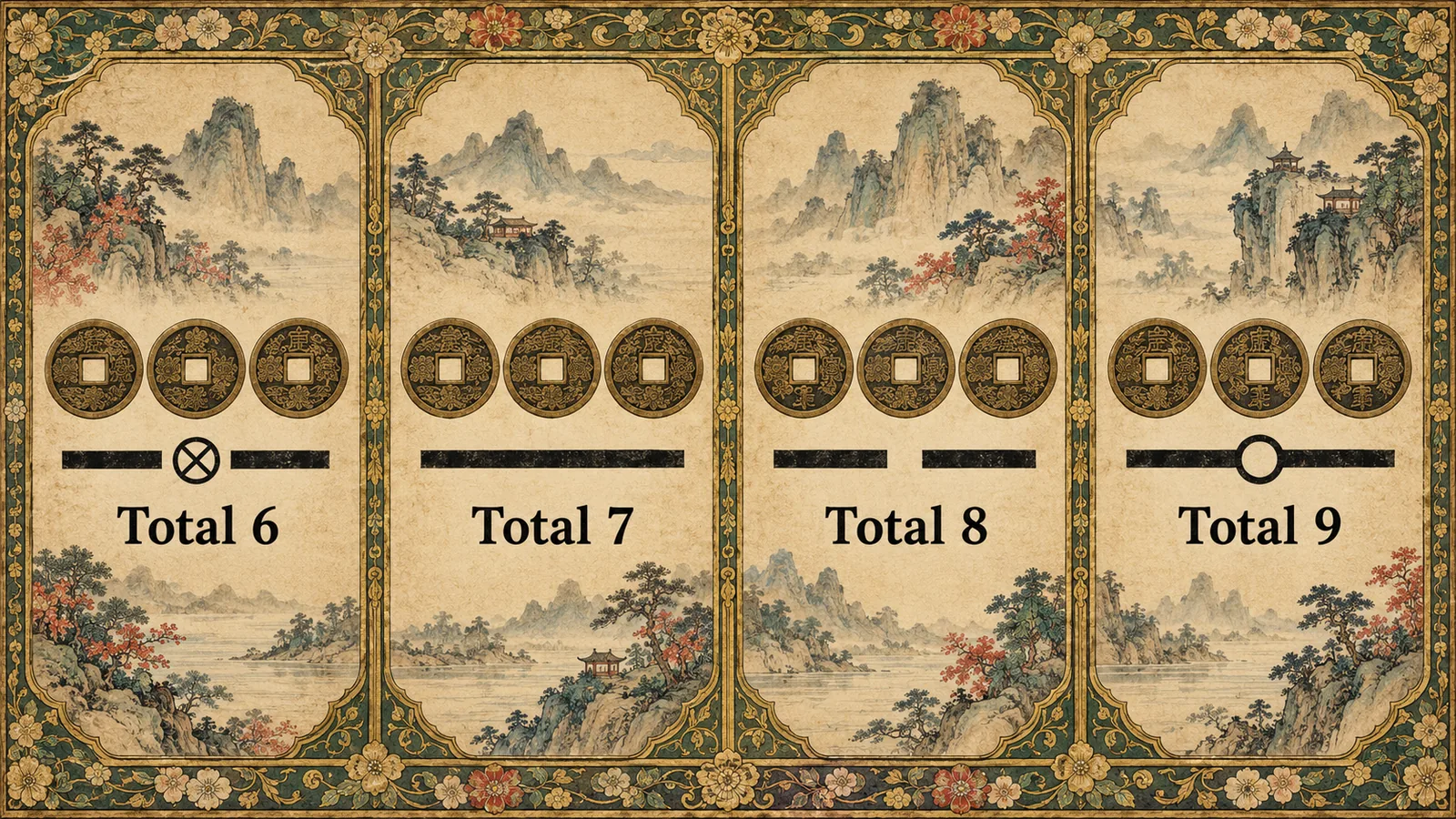
| Total | One possible combination | Line you draw | Does it change? |
|---|---|---|---|
| 6 | 2 + 2 + 2 | Broken yin line | Yes: it becomes solid yang |
| 7 | 2 + 2 + 3 | Solid yang line | No |
| 8 | 2 + 3 + 3 | Broken yin line | No |
| 9 | 3 + 3 + 3 | Solid yang line | Yes: it becomes broken yin |
A 7 and a 9 both begin as yang, but only the 9 moves. A 6 and an 8 both begin as yin, but only the 6 moves. Record the number as well as the line: a plain solid or broken line alone does not preserve this distinction.
With three independent fair coins, there are eight equally likely face combinations. One gives 6, three give 7, three give 8 and one gives 9. The probabilities are therefore 1/8, 3/8, 3/8 and 1/8—not four equal quarters. These are the coin method's probabilities; do not silently substitute them for the yarrow-stalk method.
Toss six times and build upward
The first throw is line 1, at the bottom. The sixth is line 6, at the top. A convenient notebook method is to reserve six spaces and fill the lowest one first.
Here is our complete teaching sequence:
| Throw | Coin values | Total | Position and result |
|---|---|---|---|
| 1 | 2 + 2 + 3 | 7 | Bottom line: stable yang |
| 2 | 2 + 3 + 3 | 8 | Line 2: stable yin |
| 3 | 2 + 2 + 2 | 6 | Line 3: changing yin |
| 4 | 3 + 3 + 3 | 9 | Line 4: changing yang |
| 5 | 2 + 2 + 3 | 7 | Line 5: stable yang |
| 6 | 2 + 3 + 3 | 8 | Top line: stable yin |
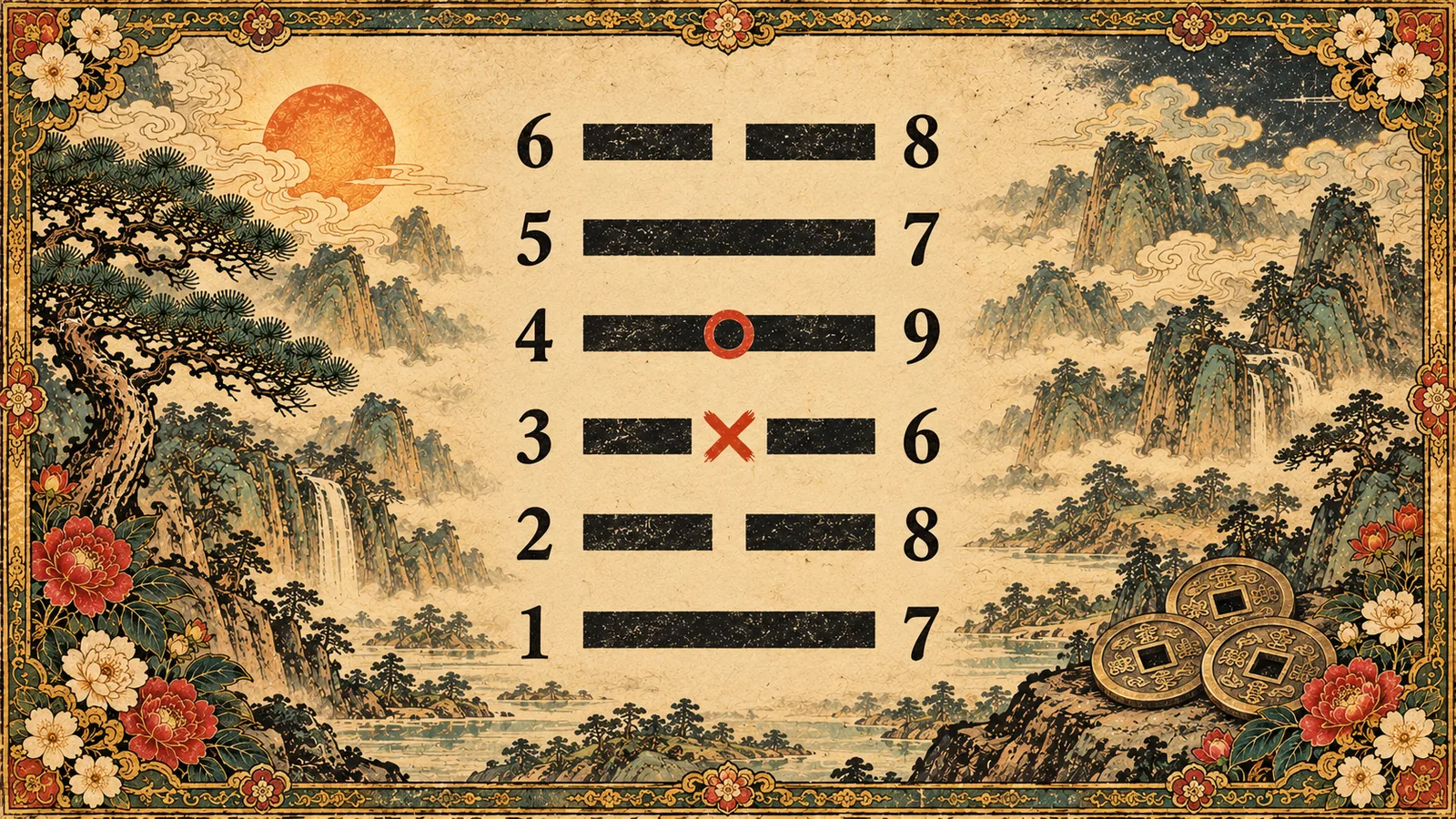
Notice the difference between the order of the table and the drawing. The table records the throws in time order, first to sixth. The drawing places the sixth result at the top. Reversing that relationship is a common way to identify the wrong hexagram.
If a coin lands on its edge or falls where you cannot read it, resolve the invalid throw using a convention you chose beforehand. Do not recast a valid result simply because you prefer another one.
Identify the primary hexagram
Read the lower three lines first. In this example, lines 1–3 are yang, yin, yin: the lower trigram is Thunder, Zhen. Lines 4–6 are yang, yang, yin: the upper trigram is Lake, Dui.
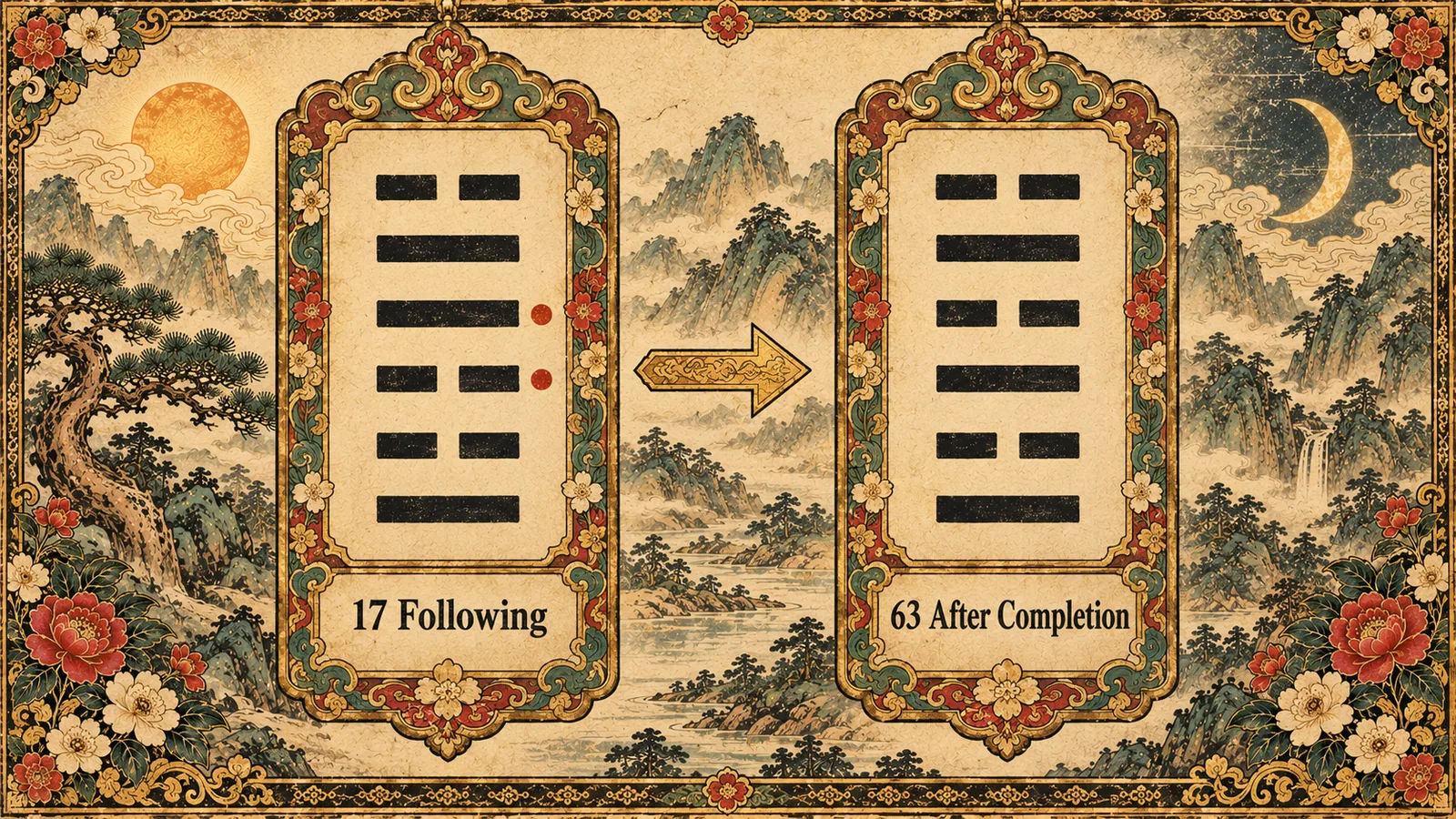
Lake above Thunder identifies Hexagram 17, Sui—Following. That is the primary hexagram. The name comes after the line pattern has been established; you do not choose a name that fits the answer you were hoping to receive.
The six-line structure is shared by several traditions. A text-centered reading may focus on the hexagram and relevant line statements. A Na Jia Liu Yao reading adds its own technical relationships and calendrical evidence. Our existing I Ching vs. Liu Yao guide explains that distinction without treating them as unrelated systems.
Change lines 3 and 4—and no others
Line 3 has a value of 6, so its broken yin line becomes solid yang. Line 4 has a value of 9, so its solid yang line becomes broken yin. The other four lines remain exactly as they were.
The transformed lower trigram is now yang, yin, yang: Fire, Li. The upper trigram is yin, yang, yin: Water, Kan. Water above Fire identifies Hexagram 63, Ji Ji—After Completion.
Your calculation receipt is therefore:
17.3.4 → 63, with the original bottom-to-top values 7, 8, 6, 9, 7, 8.
This compact notation preserves the primary figure, the moving positions and the resulting figure. The values preserve enough information to reconstruct the cast independently.
What should you read after calculating the figures?
Start with the primary hexagram and the relevant changing-line passages in the translation or method you are using. Then consider how the relating hexagram contributes to the question. The transformed figure is not automatically a promise that a particular future will happen.
For the collaboration question, “Following” and “After Completion” offer a starting point for exploring participation and how an established arrangement is maintained. But the two English titles are not a complete interpretation. The moving lines, the text and the actual situation still matter. A reader should not jump from “After Completion” to “your project will certainly succeed.”
Different traditions weigh several changing lines differently. A Wang Bi-based edition is a particular commentary tradition, not a universal rulebook for Na Jia or every modern consultation. Choose a coherent reading approach rather than combining whichever rule produces the most appealing answer.
If there are no moving lines, the polarity of all six lines stays the same; there is no distinct transformed figure. If all six move, all six reverse. Neither situation is a calculation error.
Try the existing GOOD TIMING experience
The I Ching reading offers a simpler question-and-cast experience: the three-coin algorithm establishes the figure before AI interprets the calculated evidence in relation to your question. It is not a digitized critical edition of every classical commentary.
If you have already thrown physical coins and want to enter the six values, use the more detailed Liu Yao experience, which includes a line-value input path and its own technical reading framework. Do not describe a manual cast as if it came from the site's automatic draw.
You can explore either method without changing the original question into a different one. Keep the evidence and use any follow-up to clarify what the reading actually says.
Common questions
Can I use ordinary coins?
Yes. The calculation needs two distinguishable faces with values fixed in advance. Antique coins are optional, not a requirement for the arithmetic.
Do I read from the top down?
The finished drawing is displayed with line 6 at the top, but the casting order begins with line 1 at the bottom. Label the positions to avoid confusing the two.
Is every broken line a changing line?
No. A 6 is changing yin; an 8 is stable yin. Likewise, 9 is changing yang and 7 is stable yang.
Does the changed hexagram replace the first one?
No. Keep both and the moving positions. What each contributes depends on the interpretation method; discarding the primary figure loses part of the original evidence.