Changing lines are the lines that reverse polarity when you form the relating hexagram. In the common three-coin method, 6 is moving yin and becomes yang; 9 is moving yang and becomes yin. The stable values 7 and 8 stay as they are. The result is one original hexagram, a set of marked line positions and one relating hexagram—not a second independent cast.
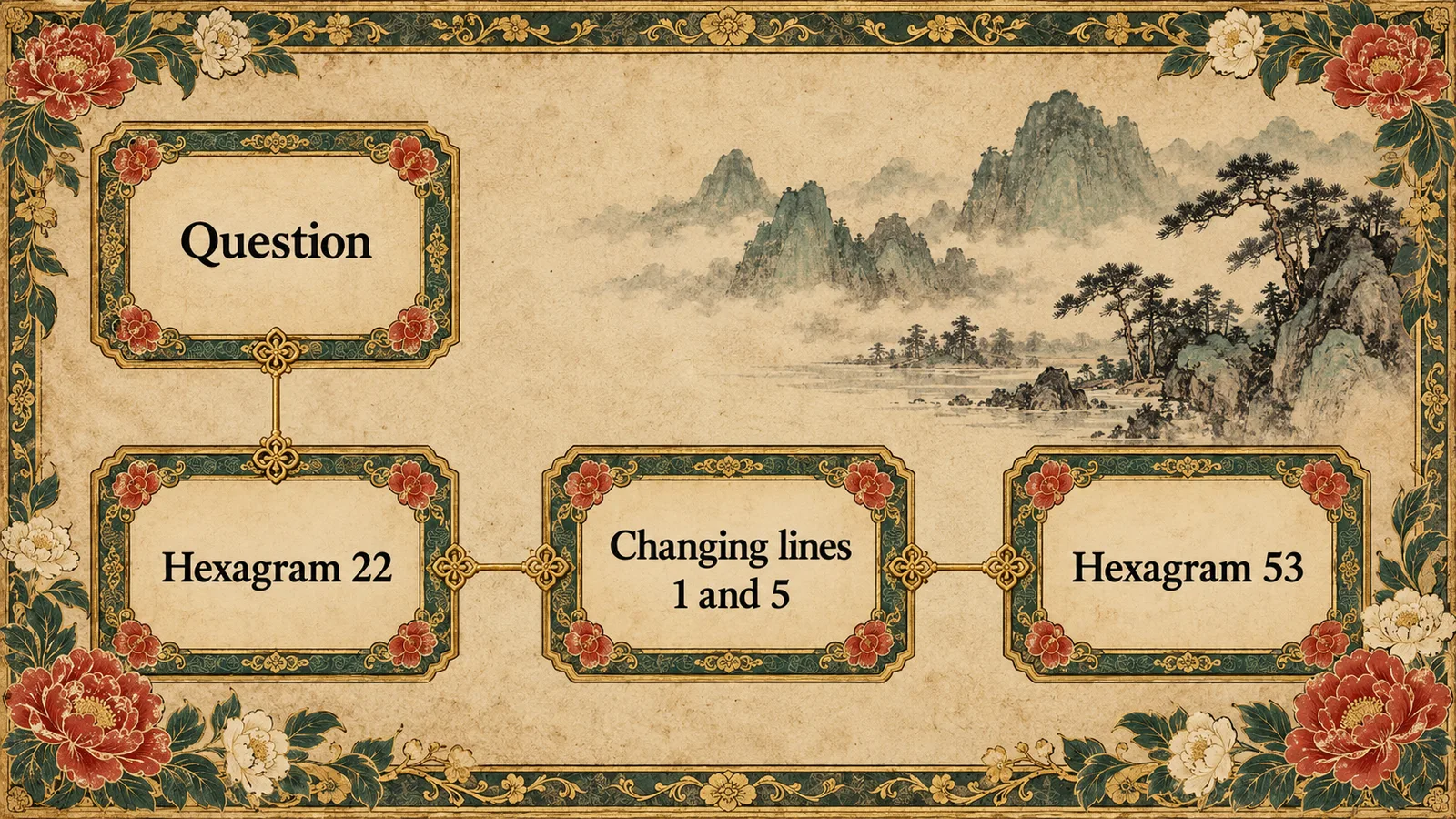
The calculation below is real and reproducible, but its input is a fictional teaching example. We use 9, 8, 7, 8, 6, 7, recorded from the bottom upward. It produces Hexagram 22, Grace, changing at lines 1 and 5 to Hexagram 53, Development.
Keep the four line values distinct
A line’s shape and its changing status are different pieces of information. Both 6 and 8 look broken in the original hexagram, but only 6 changes. Both 7 and 9 look solid, but only 9 changes.
| Value | Original line | Changing? | Relating line |
|---|---|---|---|
| 6 | Yin, broken | Yes | Yang, solid |
| 7 | Yang, solid | No | Yang, solid |
| 8 | Yin, broken | No | Yin, broken |
| 9 | Yang, solid | Yes | Yin, broken |
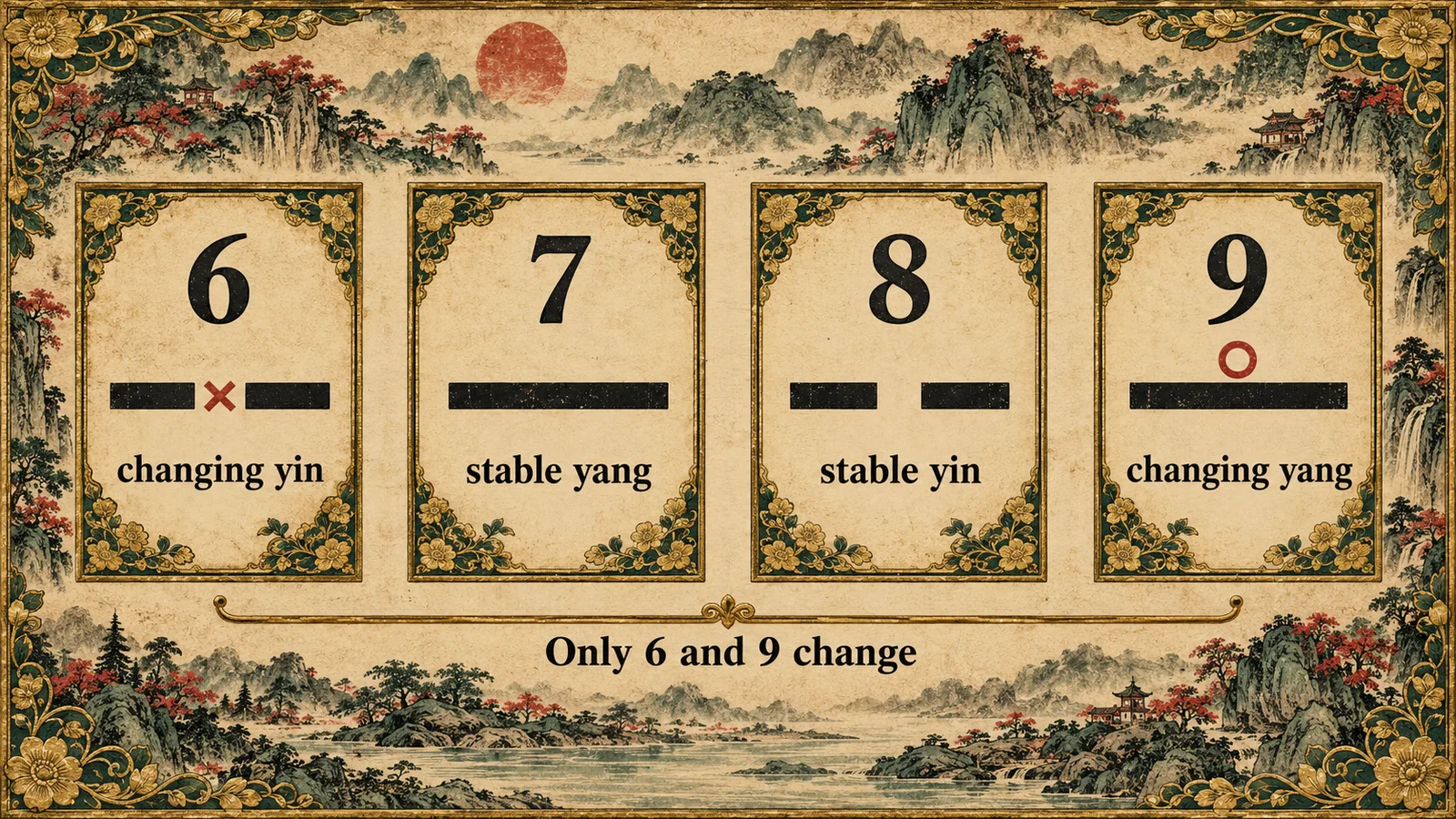
This is the familiar coin convention described in this Columbia-hosted teaching text. If you need the six-throw procedure first, start with our three-coin tutorial. This article begins after the values have been recorded.
Calculate the change from 22 to 53
Read the following table from line 1 upward when building the figure. A page may display the completed hexagram with line 6 at the top; that does not change the casting order.
| Line, bottom to top | Recorded value | Original | Relating |
|---|---|---|---|
| 1 | 9 | Yang, moving | Yin |
| 2 | 8 | Yin, stable | Yin |
| 3 | 7 | Yang, stable | Yang |
| 4 | 8 | Yin, stable | Yin |
| 5 | 6 | Yin, moving | Yang |
| 6 | 7 | Yang, stable | Yang |
The original lower trigram is Li, Fire and the upper is Gen, Mountain: Mountain over Fire, Hexagram 22. After reversing only lines 1 and 5, the lower trigram becomes Gen, Mountain, and the upper becomes Xun, Wind: Wind over Mountain, Hexagram 53.
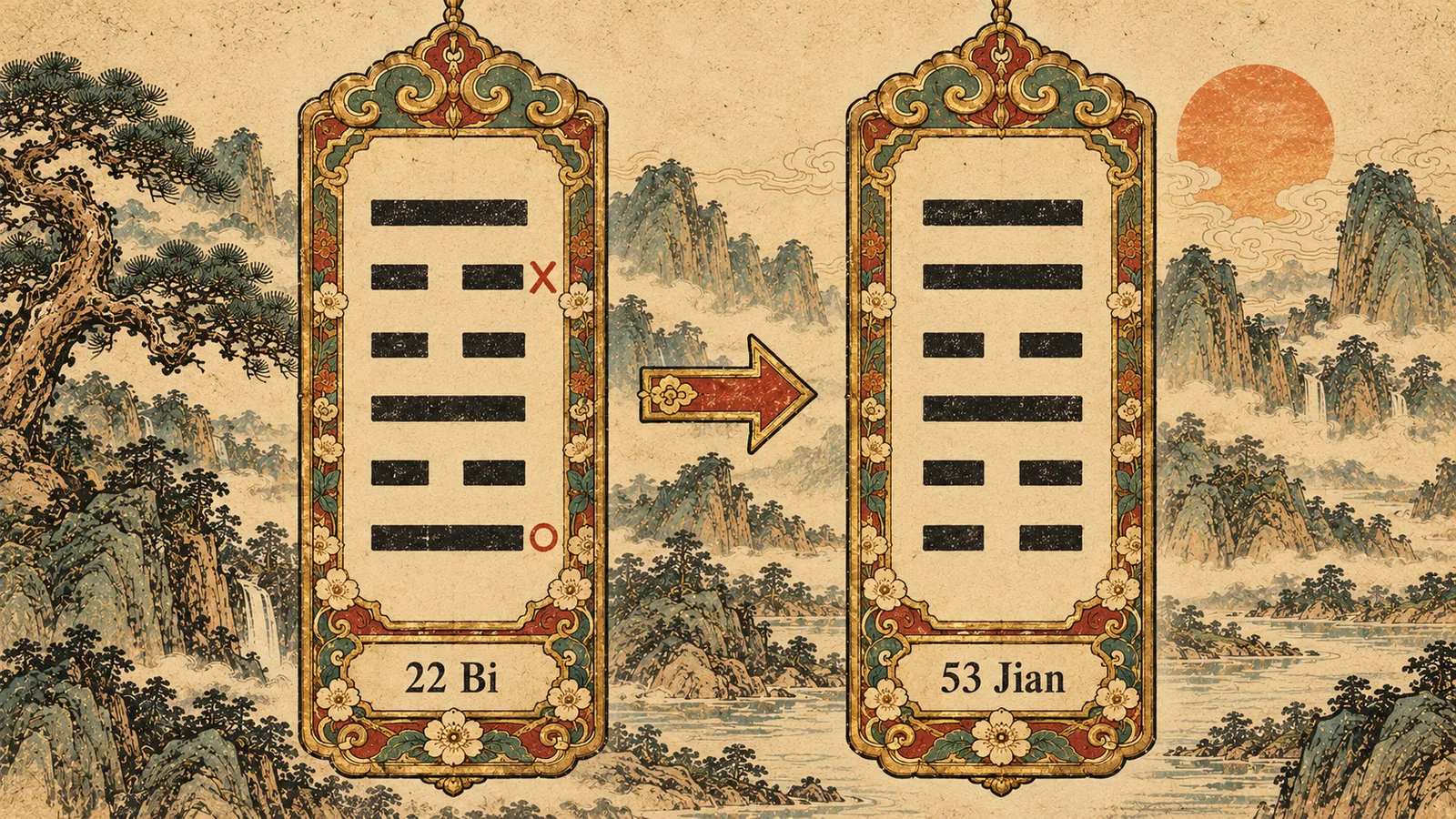
The transformation is also independently listed as 22.1.5 → 53 by iFate. That checks the mapping, not the truth of a future prediction.
Notice what did not happen: we did not reverse every yin line, change the top line just because it is last, or toss three more coins for a new result. The relating figure is fully determined by the first six values.
What do you read when two lines change?
There is no single selection rule accepted by every Yijing tradition. Some practices read all the marked line texts in relation to the two hexagrams; other systems use selection rules depending on the number of moving lines. Clarity’s discussion of multiple moving lines is one practitioner’s treatment of this variation.
For this tutorial, use a transparent reading sequence: understand the original hexagram, examine both marked lines, and consider the relating hexagram as another dimension of the situation. This is our stated teaching approach, not a claim that all schools must do it.
In received interpretations, 22 concerns adornment or presentation. Its first line associates adornment with the feet and choosing to walk rather than ride; its fifth brings a modest offering into view. Instead of reproducing a modern translation, we use those images as prompts to compare appearance, simplicity and substance. Consult your chosen edition for the full line texts; translations and commentaries differ.
An original question-and-reading example
Suppose the question is: “How might presenting this small project to a new collaborator develop?”
A plausible reading of 22.1.5 → 53 would place less weight on an impressive display and more on a modest, credible beginning. The first-line image can suggest proceeding on one’s own footing; the fifth can make a small offering meaningful without dressing it up as something larger. Development then supplies a gradual relational context: a connection built in stages rather than a spectacular instant agreement.
This is a symbolic interpretation, not a claim that the project will definitely be accepted. Nor do lines 1 and 5 identify the first and fifth weeks. Their positions belong to the hexagram, not a ready-made calendar.
No moving lines, many moving lines, and other systems
With no 6 or 9, the hexagram remains unchanged. Do not invent a second figure to make the reading feel complete.
With several moving lines, distinguish the mechanical transformation from the chosen interpretive convention. The transformation always reverses the marked lines in this method; the debate concerns which texts to emphasize. Special rules for particular casts should be named and attributed, not silently mixed.
Liu Yao Na Jia adds other technical relationships to a cast. It is not just the same paragraph with more changing lines. Our I Ching versus Liu Yao guide explains the distinction.
Keep the evidence when you continue
Record the question, six values, original number, moving positions and relating number together. A follow-up should use that same record unless you intentionally make a new cast. GOOD TIMING’s I Ching reading supplies the calculated hexagram evidence; the separate Liu Yao tool also offers a manual-line path for entering physical coin results.
A changed hexagram is a relationship within the reading, not a promise that reality must finish in one particular state. The useful question is how the original situation, its changing points and the relating figure illuminate the matter you actually asked about.