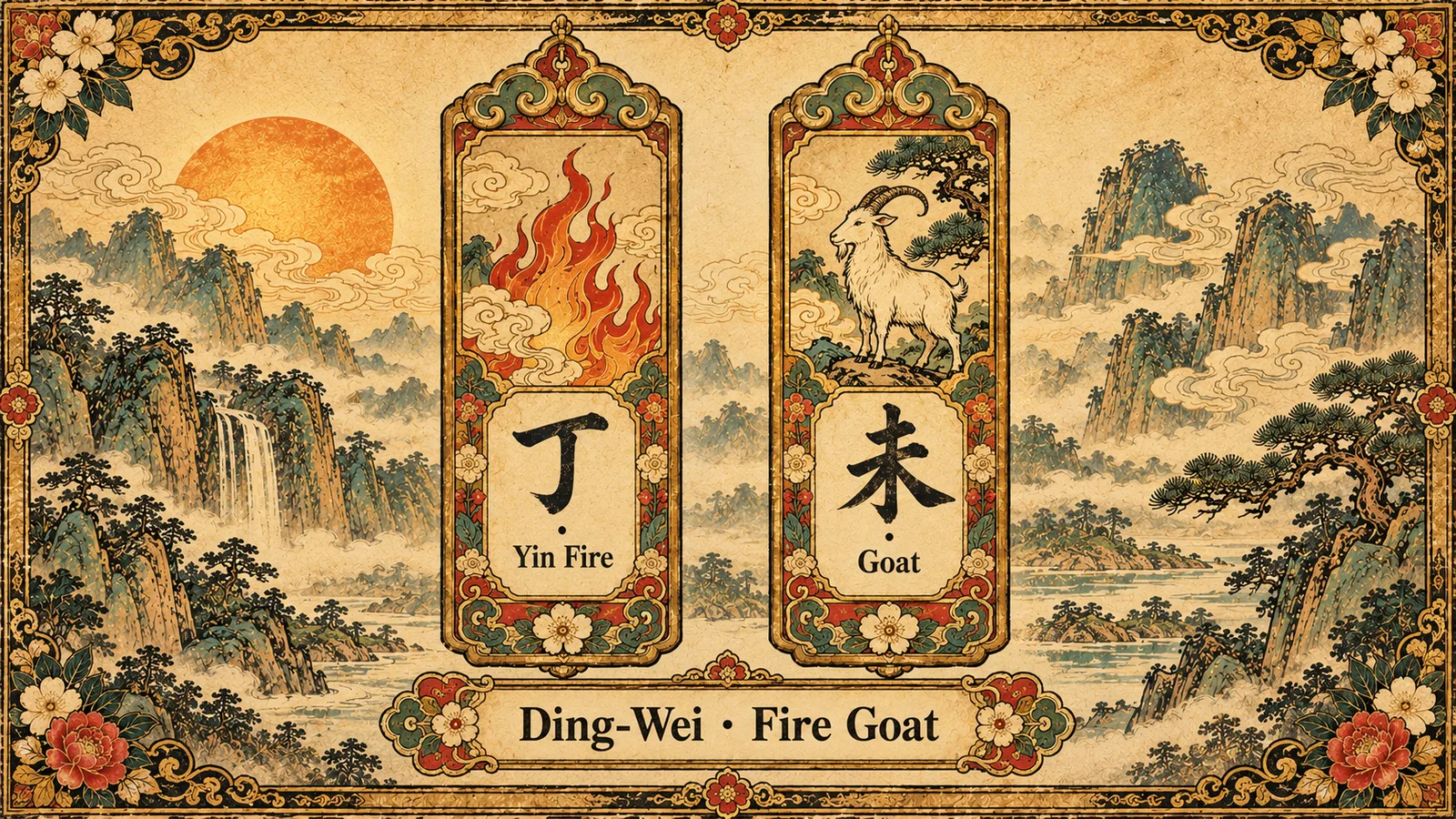
2027 is the Year of the Goat, a Ding-Wei (丁未, "Fire Goat") year, running from Chinese New Year on February 6, 2027 to January 25, 2028. People born in Goat years (1991, 2003, 2015) are in their Ben Ming Nian, the year your zodiac animal comes round again, which custom marks with red accessories and extra care.
Is 2027 the Year of the Goat, the Sheep or the Ram?
All three English names are used for the same sign. The Chinese character 羊 (yáng) covers goats, sheep and rams, and different cultures pick differently: the Japanese and Korean zodiacs say Sheep, the Filipino one says Ram or Sheep, and the Vietnamese one says Goat. We use "Goat" here, in line with our Chinese New Year 2027 guide. Whichever animal you like better, it is the same sign.
When does the Year of the Goat start and end?
The zodiac year changes at Chinese New Year, so the Goat year runs from February 6, 2027 to January 25, 2028. The next Chinese New Year, the start of the Monkey year, falls on January 26, 2028. Everything before February 6, 2027 is still the Horse year (丙午).
Some Chinese astrology traditions, and BaZi (Four Pillars) in particular, change the year at Lichun instead, which is February 4, 2027 at 09:46 Beijing time. That is two days before Chinese New Year. This article uses Chinese New Year for your zodiac animal and for Ben Ming Nian, and Lichun for BaZi. If you were born between those dates, or in January or early February of any year, the section below on boundary birthdays walks through an example, and our Lichun explainer shows how the two rules differ. What BaZi is explains why it uses solar terms.
What does "Fire Goat" (丁未, Ding-Wei) mean?
Fire Goat is the English nickname for the stem-branch year 丁未: the stem 丁 (Ding) is yin Fire and the branch 未 (Wei) is the Goat. Chinese years are named from a list of sixty stem-branch pairs, and 丁未 is number 44. A pair only repeats every sixty years, which is why the last Ding-Wei year was 1967 and the one before that was 1907.
A few more layers, for readers who already use BaZi:
- Branch 未 and the Goat: in the usual table the Goat branch is yin Earth and holds three hidden stems, 己 (the main one), 丁 and 乙. The classical verse puts it as "未宫乙己丁共宗", roughly "in the Wei palace, Yi, Ji and Ding gather together." Schools weigh the hidden stems differently, so this is the common table, not the only one.
- Nayin: the classical sound-element name for 丙午 and 丁未 is 天河水, "Heavenly River Water." This is a separate naming layer from the Fire stem.
- Fire Goat is not Fire Horse: 2026 is 丙午, the Fire Horse, and 2027 has a different stem and a different branch. The nickname only says which stem and which animal are paired.
To see how stems and branches sit in a whole chart, see our Day Master guide.
Which birth years are Goat years?
A Goat year always runs from Chinese New Year to the day before the next one, so the Gregorian year alone is not enough. Goat years come every twelve years, and these are the ones people alive today were born in:
| Birth year | Stem-branch | Goat year starts (Chinese New Year) | Last day of the Goat year | Year difference in 2027 (2027 minus birth year) |
|---|---|---|---|---|
| 1931 | 辛未 Xin-Wei | Feb 17, 1931 | Feb 5, 1932 | 96 |
| 1943 | 癸未 Gui-Wei | Feb 5, 1943 | Jan 24, 1944 | 84 |
| 1955 | 乙未 Yi-Wei | Jan 24, 1955 | Feb 11, 1956 | 72 |
| 1967 | 丁未 Ding-Wei | Feb 9, 1967 | Jan 29, 1968 | 60 |
| 1979 | 己未 Ji-Wei | Jan 28, 1979 | Feb 15, 1980 | 48 |
| 1991 | 辛未 Xin-Wei | Feb 15, 1991 | Feb 3, 1992 | 36 |
| 2003 | 癸未 Gui-Wei | Feb 1, 2003 | Jan 21, 2004 | 24 |
| 2015 | 乙未 Yi-Wei | Feb 19, 2015 | Feb 7, 2016 | 12 |
| 2027 | 丁未 Ding-Wei | Feb 6, 2027 | Jan 25, 2028 | 0 |
The last column is simply 2027 minus the birth year, the count the Ben Ming Nian tradition uses. It is not the age you have completed on your birthday, which can be one year lower, and the traditional "nominal age" (虚岁) is one year higher.
Dates follow the Chinese calendar's own day count (UTC+8). Korea, which counts in UTC+9, celebrates Seollal 2027 one day later, on February 7.
Some examples show why January and February births need care:
- Born January 20, 1991: a Horse, because Chinese New Year 1991 was February 15, so the Horse year (庚午) was still running. A 1992 birthday on January 20 is a Goat.
- Born February 3, 1992: a Goat. Chinese New Year 1992 was February 4, so the Monkey year starts one day later.
- Born January 10, 1956: a Goat (乙未), because the 1955 Goat year did not end until February 11, 1956.
- Born January 31, 2003: a Horse. February 1, 2003 is the first day of the Goat year.
- Born January 21, 2004: still a Goat; Chinese New Year 2004 was January 22.
If your birthday falls between about January 21 and February 20, check the date for your specific year. Many "zodiac by birth year" tables on the web ignore this.
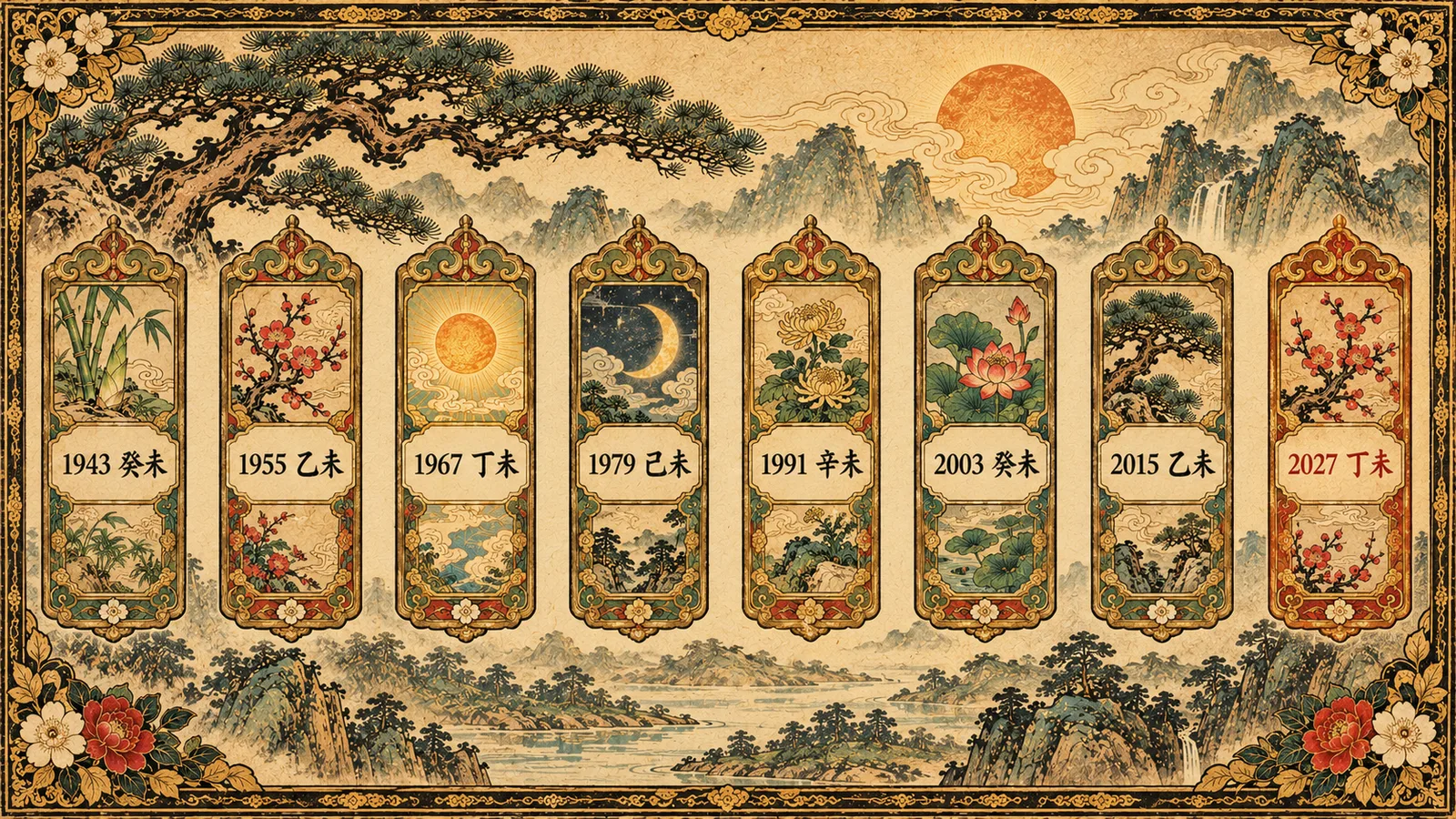
Notice the 1967 row. People born in the 1967 Goat year are 60 years on from it in 2027, and their year is also Ding-Wei, the same stem and branch as 2027. Chinese tradition celebrates this full sixty-year return, called 花甲 (huājiǎ), as a milestone birthday.
What if your birthday falls between Lichun and Chinese New Year?
This is the case that confuses people most. Take someone born on February 10, 2015. Chinese New Year 2015 was February 19, so by the zodiac they are still a Horse (the Horse year, 甲午, ran until February 18). But Lichun 2015 fell on February 4, so in BaZi their year pillar is already 乙未, the Goat year. The same person is a Horse for zodiac and Ben Ming Nian purposes and a Goat in their Four Pillars.
The same thing happens in 2027 itself. A baby born on February 5, 2027 is a Horse by the zodiac, because Chinese New Year is February 6, and a Goat (丁未) in BaZi, because Lichun was February 4 at 09:46 Beijing time. For births on February 4 itself, the hour decides, so use the exact birth time.
So the rule of thumb is: for the zodiac animal, the Ben Ming Nian and the red-belt custom, use Chinese New Year; for the Four Pillars, use Lichun. Many people with a birthday in this window feel a connection to both animals, and that is a perfectly traditional way to hold it.
What is Ben Ming Nian?
"Goat year" means three different things in practice, and they answer different questions: a folk custom (red, Tai Sui, taking care), a zodiac layer (which animals clash or harmonise with the Goat), and a BaZi layer (how the year meets your own chart). Start with the custom.
Ben Ming Nian (本命年, "birth-sign year") is the year your own zodiac animal comes round again, every twelve years: 12, 24, 36, 48, 60 and so on, counting the year minus the birth year. In 2027 that means everyone born in a Goat year. In folk belief it is sometimes called a kǎn'er nián (槛儿年, a "threshold year"), and the saying goes that this is a year to take care.
The reason given is Tai Sui (太岁, "Grand Duke Jupiter"), a personified year-governing figure. Tai Sui grew out of ancient year-counting by Jupiter's roughly twelve-year orbit, and a person whose birth branch matches the year branch is said to "Zhi Tai Sui" (值太岁), which is commonly linked with Ben Ming Nian. A folk saying sums up the traditional concern: "本命年犯太岁,太岁当头坐,无喜必有祸" ("in your Ben Ming Nian you offend Tai Sui; Tai Sui sits on your head, and without joy there is trouble"). Families keep this saying as a loving reminder to look after one another, and the good-luck customs below are the other half of it.
As for how old the custom is, traditions differ. Some say the twelve-year version took its present form in the Qing dynasty, others trace it back to the Western Han. Either way, it is a long-lived custom.
Why do people wear red in a Ben Ming Nian?
People wear red because it is a protective, auspicious colour in Chinese folk culture. The usual customs are a red belt tied on New Year's Eve, red underwear, socks, bracelets or cords, and in some places red clothes for children. The common explanation is that red is the colour of fire, the sun and blood, and so stands for vitality and keeping bad influences away.
The details differ widely:
- When to start: some families tie the red belt on New Year's Eve (除夕), others begin at Lichun, and some at the first day of the first lunar month.
- How much: it may be one red item, or red worn throughout the year.
- Who gives it: many families say red items work best when given by a parent, partner or friend, not bought for yourself.
- Where: the red belt (扎红) is described in northern Han Chinese regions; other regions and Chinese-speaking communities have their own versions, including temple rites such as an Tai Sui (安太岁, registering a Tai Sui tablet or lamp).
Follow the version your family keeps. For many people the red item is a way of saying "take care this year", and that is a good reason in itself.
Which zodiac signs clash with the Goat?
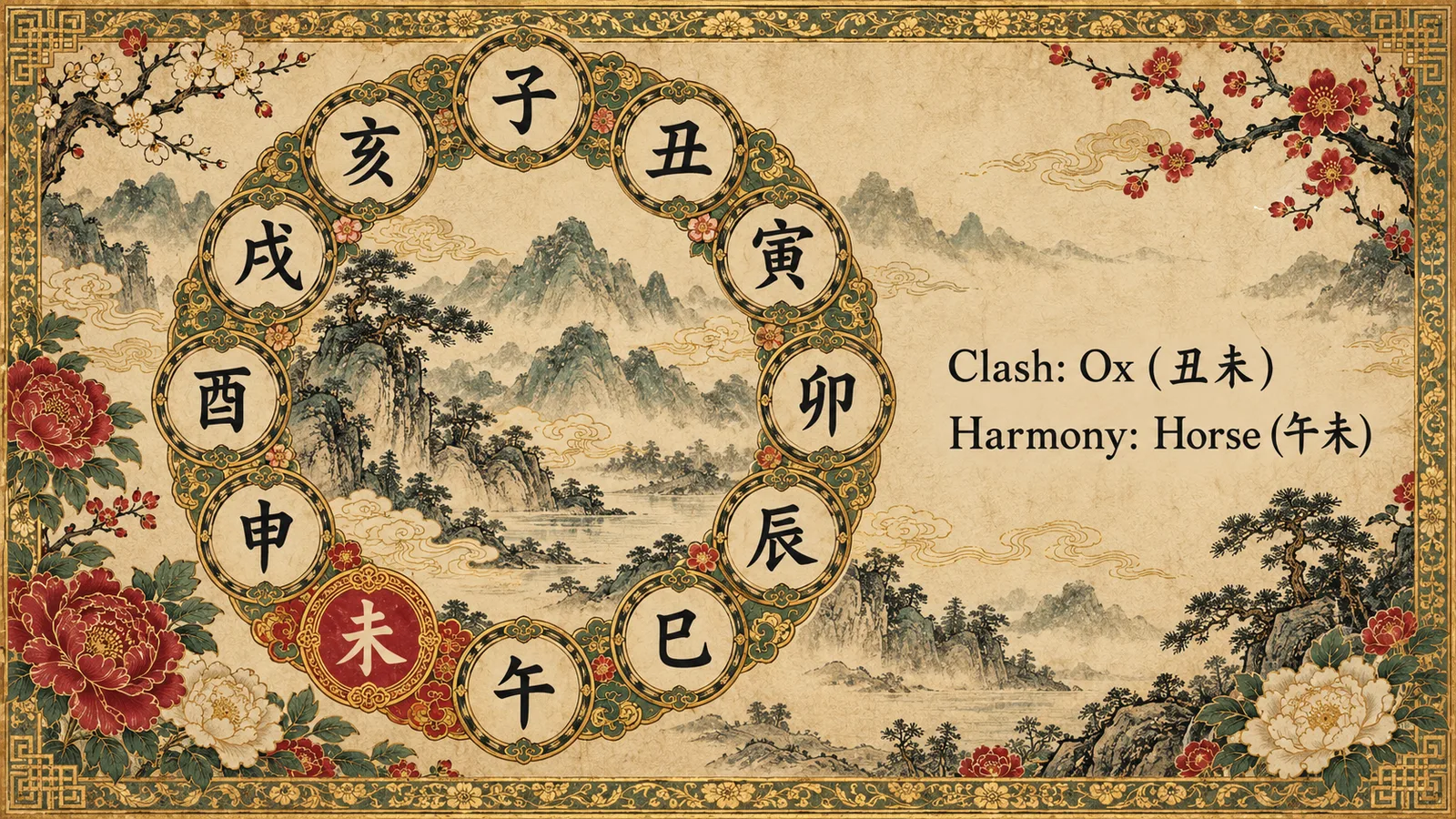
This is the zodiac layer. The Ox clashes with the Goat; the Horse is its six-harmony partner. These relations come from the Earthly Branch table (丑未 clash, 午未 harmony). For 未 the full set is:
- Clash 冲 (chōng): Ox (丑未)
- Harm 害 (hài): Rat (子未)
- Break 破 (pò): Dog (戌未)
- Punishment 刑 (xíng): Ox and Dog (丑戌未, the "relying on power" punishment group)
- Six harmony 合 (hé): Horse (午未)
- Three harmony 三合 (sānhé): Pig and Rabbit (亥卯未)
- Directional combination 三会 (sānhuì): Snake and Horse (巳午未)
When people say someone "offends Tai Sui" (犯太岁) in 2027, they usually mean the Goat itself, the Ox who clashes, and sometimes also the Rat or the Dog. Lists differ between schools, and some stress only the same-sign and clash relations, so read any annual list as belonging to the tradition that wrote it. These pairings describe how two branches interact in a calendar year, and a real friendship or partnership has many more threads: plenty of Ox and Goat people get along well.
What does BaZi add for the Goat year?
This is the personal layer. In BaZi the year 丁未 is read against your own four pillars, and three things usually matter most:
- The stem 丁 against your Day Master. The relationship between 丁 (yin Fire) and your Day Master decides which of the ten gods the year brings. For a Day Master of 乙 (yin Wood), for example, 丁 is the Eating God (食神), which is traditionally read as ease of expression, talent and output.
- The branch 未 against your four branches. A clash, harm, break, punishment or combination between 未 and the branches in your chart shows where the year moves things. If your day branch is 丑, for instance, the 丑未 clash touches the home and partnership palace, and BaZi readers would watch changes there.
- Your current ten-year luck pillar (大运). The year is always read together with the longer cycle you are in.
Schools weigh these differently, which is why a good BaZi reading starts from your exact birth date and time. Our BaZi versus Western astrology and BaZi without a birth time guides cover the basics.
What can you actually do in a Ben Ming Nian?
You can treat it as a prompt to be a little more careful, and enjoy the custom if you like it. Some practical responses are good in any year: keep routine health checks, leave financial room for surprises, double-check contracts and travel plans, and avoid unnecessary conflict.
If your family has a red-belt, red-socks or temple tradition, you can follow it. If you find the "threshold year" talk stressful, you can also set it aside. A custom should help, not weigh on you.
Good to know
Customs around Ben Ming Nian, Tai Sui and BaZi differ by region, family and school, so follow the version that feels right to you and keep your regular check-ups and sensible plans in any year.
Frequently asked questions
Is 2027 the Year of the Goat, Sheep or Ram?
All three names are used for the same Chinese sign, 羊 (yáng). 2027 is the Year of the Goat in this guide and the stem-branch year is 丁未 (Ding-Wei), from February 6, 2027 to January 25, 2028.
Which birth years are Goat years?
1931, 1943, 1955, 1967, 1979, 1991, 2003, 2015 and 2027, counted from each year's Chinese New Year date. A January or early-February birth often belongs to the previous animal, so check the date in the table above.
What if I was born between Lichun and Chinese New Year?
For the zodiac animal and Ben Ming Nian, use Chinese New Year; for BaZi, use Lichun. A baby born on February 5, 2027 is a Horse by the zodiac and a Goat (丁未) in BaZi.
What is Ben Ming Nian and why do people wear red?
It is the year your zodiac animal returns, every twelve years, and in Chinese folk belief it calls for extra care. People wear red because the colour is thought to be protective and lucky, but the habits vary by region and family.
Which zodiac clashes with the Goat?
The Ox, through the 丑未 clash. The Horse is its six-harmony partner (午未), and the Rat, Dog, Pig and Rabbit also have named relationships with the Goat. Lists vary by tradition.
What does "Fire Goat" mean?
It means the year is 丁未 (Ding-Wei): 丁 is the yin Fire stem and 未 is the Goat branch. It is the name of one of the sixty stem-branch years.