Xiao Liu Ren is a Chinese quick-divination method that counts the lunar month, day and hour through six palaces in a fixed order: Da An, Liu Lian, Su Xi, Chi Kou, Xiao Ji and Kong Wang. The palace where the count stops gives the answer's tone: supportive, mixed or challenging. For a yes-or-no question, Da An, Su Xi and Xiao Ji lean yes, and Chi Kou and Kong Wang lean no or not yet.
What are the six palaces of Xiao Liu Ren, and what does each mean?
The six palaces are 大安 Da An, 留连 Liu Lian, 速喜 Su Xi, 赤口 Chi Kou, 小吉 Xiao Ji and 空亡 Kong Wang, always in that order, and the order loops back to Da An after Kong Wang. The table gives a useful starting meaning for each one and the tone it usually carries.
| Palace | Literal name | A useful starting meaning | Tone |
|---|---|---|---|
| 大安 Da An | Great Peace | Settled conditions, steadiness, remaining in place | Supportive |
| 留连 Liu Lian | Lingering | Lingering, delay, entanglement | Mixed |
| 速喜 Su Xi | Swift Joy | Quicker movement or welcome news | Supportive |
| 赤口 Chi Kou | Red Mouth | Friction, dispute, difficult communication | Challenging |
| 小吉 Xiao Ji | Small Fortune | Modest support, workable progress | Supportive |
| 空亡 Kong Wang | Emptiness | Absence, uncertainty, something not taking form | Challenging |
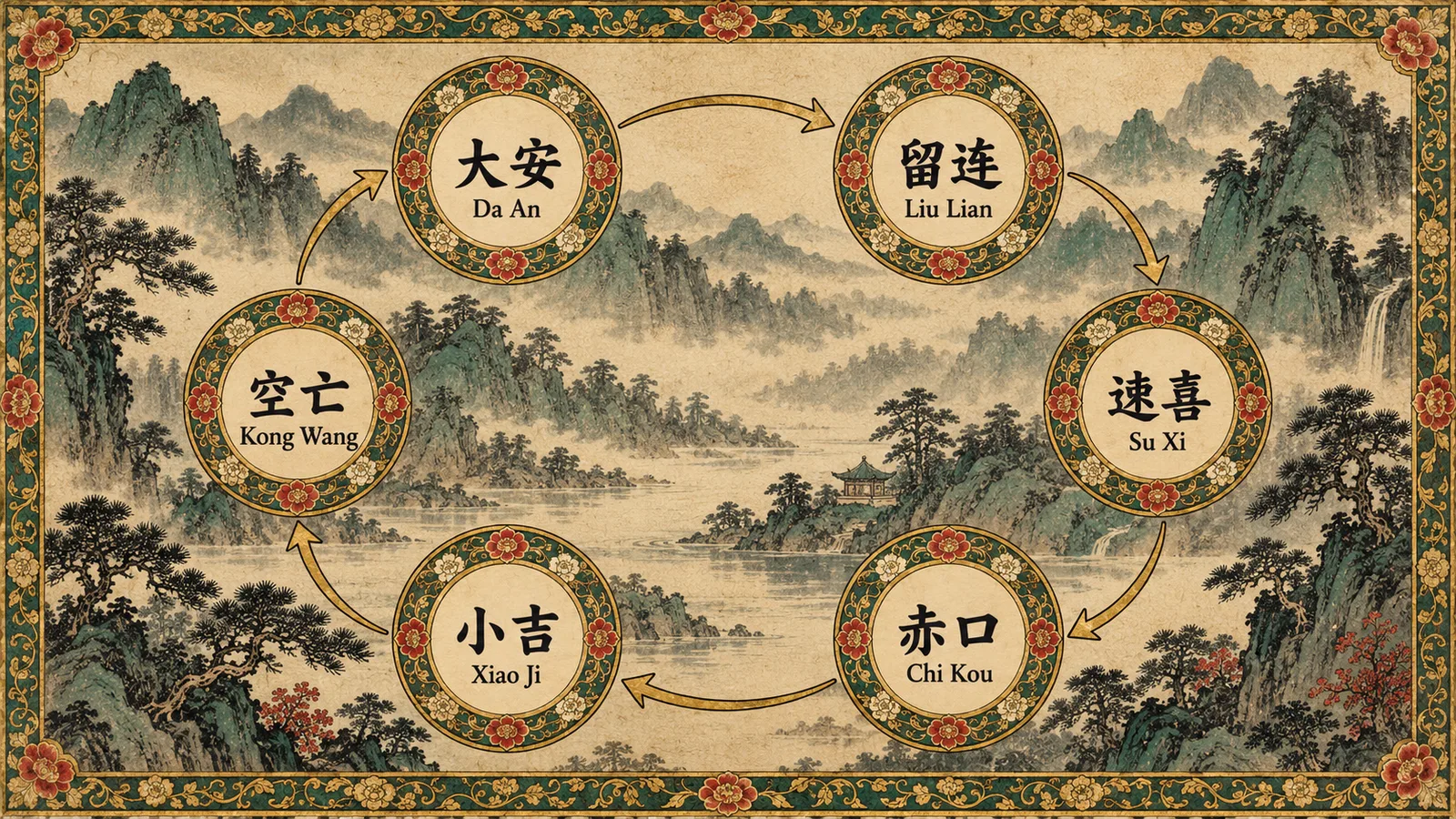
The meanings are starting points. The same palace reads differently for a job message, a delayed parcel and a family conversation, which is why the question has to stay attached to the result. On GOOD TIMING's Xiao Liu Ren reading the short labels for the palaces are "stable foundation" (Da An), "delay and entanglement" (Liu Lian), "a favorable turn" (Su Xi), "friction and direct words" (Chi Kou), "helpful, gradual progress" (Xiao Ji) and "missing conditions" (Kong Wang).
What do the old texts add?
A classic hand-method text, the section called 李淳风六壬时课 ("Li Chunfeng's Six Ren Hour Lesson") in the Yuxia ji (玉匣记), pairs each palace with one of the six spirits used in Da Liu Ren and a Five Phases element:
- 大安 Da An: Azure Dragon (青龙), Wood
- 留连 Liu Lian: Black Tortoise (玄武), Water
- 速喜 Su Xi: Vermilion Bird (朱雀), Fire
- 赤口 Chi Kou: White Tiger (白虎), Metal
- 小吉 Xiao Ji: Six Harmonies (六合), Wood
- 空亡 Kong Wang: Gou Chen (勾陈), Earth
These spirits are probably why the method is called Xiao Liu Ren, "small Liu Ren." Teachers differ on some of the finer details, such as compass directions and element assignments in modern tables, so treat any one table as a convenient version, not the only one.
How do you count a Xiao Liu Ren reading?
Start at Da An for the lunar month, count on from the month result for the day, and count on from the day result for the hour. The Yuxia ji puts it as "每从大安上起正月,月上起日,日上起时": begin the first month at Da An, begin the day from the month, begin the hour from the day.
Two counting rules matter. The starting palace counts as 1, and the hour number is the position of the traditional two-hour period among the twelve branches: Zi (23:00–01:00) is 1 and Chen (07:00–09:00) is 5. The method also uses the lunar month and day, not the Gregorian ones.
Worked example: the text's own case
The Yuxia ji gives a sample of the third month, fifth day, Chen hour, and ends at Xiao Ji. Counting it through:
- Month 3 from Da An: Da An 1, Liu Lian 2, Su Xi 3.
- Day 5 from Su Xi: Su Xi 1, Chi Kou 2, Xiao Ji 3, Kong Wang 4, Da An 5.
- Hour 5 (Chen) from Da An: Da An 1, Liu Lian 2, Su Xi 3, Chi Kou 4, Xiao Ji 5.
The result is Su Xi, Da An, Xiao Ji, which ends at Xiao Ji, just as the text says.
Worked example: lunar month 9, day 16, Chen hour
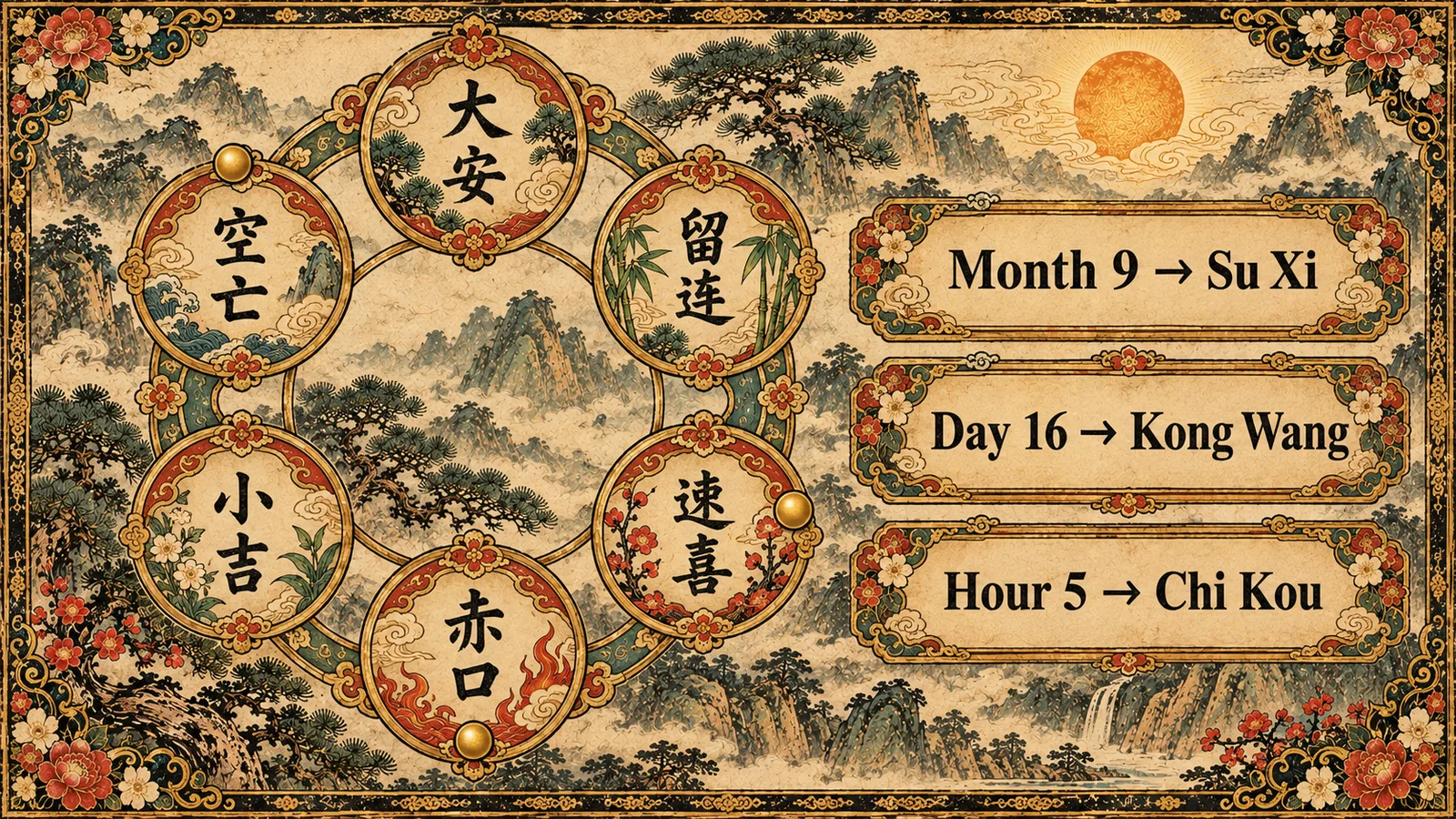
Our Xiao Liu Ren guide walks through October 25, 2026 at 08:00, which falls on lunar month 9, day 16, in the Chen hour.
- Month 9 from Da An: the cycle returns to Da An on 7, reaches Liu Lian on 8 and Su Xi on 9.
- Day 16 from Su Xi: Su Xi is 1, and 16 lands on Kong Wang.
- Hour 5 from Kong Wang: Kong Wang 1, Da An 2, Liu Lian 3, Su Xi 4, Chi Kou 5.
If you number the palaces 0 to 5 in order, the step is (start + count − 1) modulo 6. For this example that gives 2, then 5, then 3, which are Su Xi, Kong Wang and Chi Kou.
Where do the fingers come in?
The traditional version counts on the index, middle and ring fingers, called 掐指, taking the month, day and hour in turn. Popular guides draw particular joint-by-joint layouts of the hand, and they do not all match. That is fine: counting on the cycle above gives the same palace as any consistent layout.
Which Xiao Liu Ren palace is best or worst?
No palace is "best" or "worst" in an absolute sense. Each describes a tone, and the tone becomes concrete once you attach a question.
- Supportive: Da An, Su Xi and Xiao Ji. Conditions are steady, news moves faster, or progress is modest but workable.
- Mixed: Liu Lian. Things continue, but with delay, repetition or something still tied up.
- Challenging: Chi Kou and Kong Wang. Friction in communication, or conditions that are missing or not yet formed.
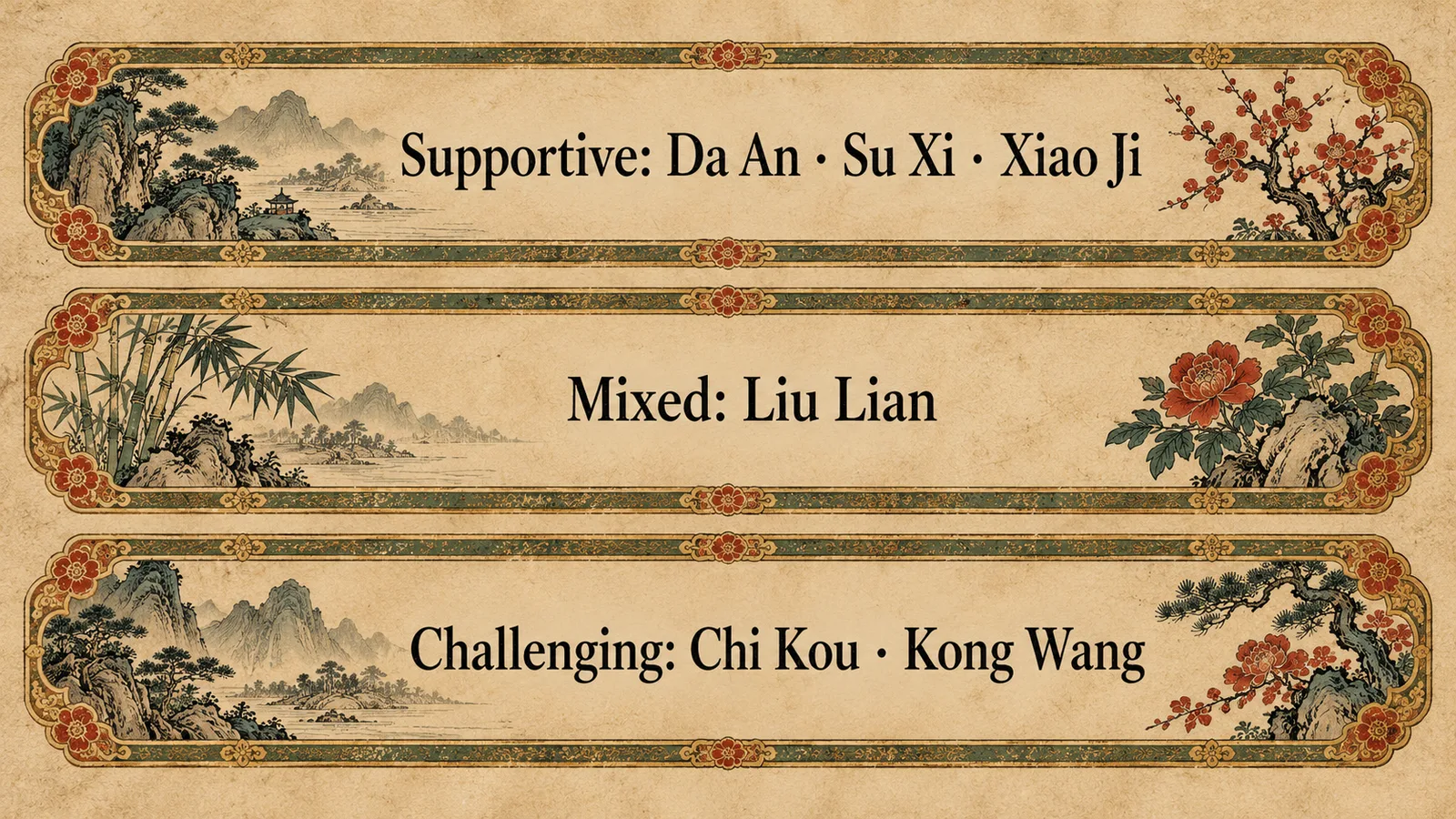
The simplest traditional rule counts Da An, Su Xi and Xiao Ji as auspicious and the other three as inauspicious. Here Liu Lian is treated as mixed, because "delay" is not the same as "bad", so you will see it differently in different places.
How might each palace read for a real question?
These show how the question gives a palace its shape.
- Da An on a question about a job: stay with the current plan and keep conditions steady.
- Liu Lian on a question about a reply: expect delay or a loop of back-and-forth before it settles.
- Su Xi on a question about a message: movement or a welcome answer may come sooner than expected.
- Chi Kou on a question about a conversation: expect sharper words, or a mismatch in expectations.
- Xiao Ji on a question about a project: a small, steady step is available. It is not a leap.
- Kong Wang on a question about a plan: something needed is not in place yet, so check what is missing.
How do you read a full yes-or-no question?
Read the three palaces as a short story. A common reading takes the month palace as the background of the matter, the day palace as how it develops, and the hour palace as where it ends up. The final palace carries the most weight for a yes-or-no judgment: Da An, Su Xi and Xiao Ji lean yes, Liu Lian leans "yes, but later or with strings attached", and Chi Kou and Kong Wang lean no or not yet. Schools differ here: some teachers read only the hour palace and treat the month and day as the route, and others weight all three equally. Pick one way and keep it.
Reading 1: "Will my application go through?"
Using the text's own case from above, Su Xi, Da An, Xiao Ji:
- Background, Su Xi: news is already moving, and a welcome answer is possible.
- Development, Da An: the middle stretch is steady, with nothing dramatic and nothing missing.
- Outcome, Xiao Ji: modest, workable progress.
Judgment: yes, leaning favourable. Expect a calm, fairly quick path and a moderate result, a clear step forward rather than a big breakthrough. All three palaces are supportive, so even a reader who weighs only the last palace arrives at the same place.
Reading 2: "Should I send the proposal this week?"
Using our lunar month 9, day 16, Chen-hour example, Su Xi, Kong Wang, Chi Kou:
- Background, Su Xi: there is momentum, and people are open to hearing from you.
- Development, Kong Wang: something needed is not in place yet, such as a figure, a sign-off or a missing document.
- Outcome, Chi Kou: if it goes out as it is, expect sharper words or a mismatch in expectations.
Judgment: not yet. The beginning is promising, but the middle and the end say the proposal is not ready. The practical reading is to use the week to fill the gap Kong Wang points to, then send it once the missing piece is in place and you have thought through what the other side is likely to push back on. A reader who takes only the final palace would also say "lean no for now", and for the same reason.
Notice what both readings do. They keep the question narrow, they name each palace's role, and they end with a clear lean plus what to do next.
Is Kong Wang in Xiao Liu Ren the same as Kong Wang in BaZi?
No. The two share a name and the idea of emptiness, but they are calculated differently and answer different questions. In Xiao Liu Ren, Kong Wang is the sixth palace in a six-step loop, reached by counting.
In the traditional Chinese calendar, the ten heavenly stems and twelve earthly branches pair up in groups of ten. Each group of ten leaves two branches unpaired, and those are the 空亡, also called 旬空. The 甲子 group has Xu and Hai, 甲戌 has Shen and You, 甲申 has Wu and Wei, 甲午 has Chen and Si, 甲辰 has Yin and Mao, and 甲寅 has Zi and Chou. BaZi, Zi Wei Dou Shu and Qi Men Dun Jia each use this idea in their own way. If you want to see how a BaZi chart is built, what is BaZi covers the basics. Do not substitute one Kong Wang for the other.
Where does Xiao Liu Ren come from?
It is a folk method, and nobody knows exactly who first set it down. The Yuxia ji section is titled after Li Chunfeng, an astronomer and calendar official of the early Tang dynasty, and the Chinese name 孔明六曜星 links the related six-label day calendar to Zhuge Liang (Kongming). Both are traditional attributions rather than recorded history. The hand-counting method also turns up in Ming and Qing novels such as Xingshi yinyuan zhuan and Sui Tang yanyi, where a character counts on the fingers and names the result "Su Xi."
It is also not the Japanese rokuyō. The 六曜 is a calendar annotation marking lucky and unlucky days, which later spread to Japan, where its names and order changed. The Japanese calendar and the hand-counting divination are different tools, so a rokuyō calendar cannot be used to check a Xiao Liu Ren result. If you are deciding which kind of method suits a question, our comparison of divination methods is a good start, and I Ching vs Liu Yao contrasts two other Chinese systems.
Good to know
Teachers differ on details such as which palace carries the most weight, so choose one way of reading and let your own question give each palace its meaning.
Frequently asked questions
What are the six palaces of Xiao Liu Ren?
Da An (大安), Liu Lian (留连), Su Xi (速喜), Chi Kou (赤口), Xiao Ji (小吉) and Kong Wang (空亡), in that fixed order, looping back to Da An. Their starting meanings are steadiness, delay, welcome movement, friction, modest progress and absence.
Which Xiao Liu Ren palace is the best or the worst?
None is best or worst by itself. Da An, Su Xi and Xiao Ji are usually grouped as supportive, Liu Lian as mixed, and Chi Kou and Kong Wang as challenging. How they apply depends on the question.
How do you count in Xiao Liu Ren?
Start at Da An and count the lunar month, then count the day from that result and the hour from the day's result. Count the start as 1 and use the hour's branch number, where Zi is 1 and Chen is 5. The palace after the hour count is the final result.
Is Kong Wang here the same as Kong Wang in BaZi?
No. Xiao Liu Ren's Kong Wang is the sixth palace in a six-step loop. BaZi's 空亡 (旬空) means the two earthly branches left unpaired in each ten-day group, so the two are calculated differently and answer different questions.
Can Xiao Liu Ren answer yes or no?
Yes, and it is one of its most common uses. Look at the final palace: Da An, Su Xi and Xiao Ji lean yes, Liu Lian leans "yes, later or with strings", and Chi Kou and Kong Wang lean no or not yet. Then read the month and day palaces for the route, as in the two readings above. A specific question such as "should I send this proposal this week?" gets a sharper answer than a broad one. For a structured yes-or-no framing, see our yes or no tarot guide. If your real question is "when?", see our tarot timing guide.