Xiao Liu Ren is a Chinese folk divination method that works through six repeating positions. In the month–day–hour version explained here, a lunar month, lunar day and traditional two-hour period determine three successive positions. The final position provides a symbolic starting point for answering a question; it is not a measured probability of success.
The name does not identify one universally standardized algorithm. This guide states the convention used by GOOD TIMING’s time-based calculation and works it through completely. That way, a disagreement between tools can be investigated rather than dismissed as mysterious.
The six positions, in order
The order matters because the calculation moves around a cycle:
| Position | Chinese name | A useful starting meaning | What the label does not guarantee |
|---|---|---|---|
| 1 | 大安 Da An | Settled conditions, steadiness, remaining in place | Physical safety or freedom from injury |
| 2 | 留连 Liu Lian | Lingering, delay, entanglement | That nothing will ever happen |
| 3 | 速喜 Su Xi | Quicker movement or welcome news | A particular message at a precise minute |
| 4 | 赤口 Chi Kou | Friction, dispute, difficult communication | That somebody is dishonest or will attack |
| 5 | 小吉 Xiao Ji | Modest support, workable progress | Effortless success |
| 6 | 空亡 Kong Wang | Absence, uncertainty, something not taking form | Catastrophe or a medical diagnosis |
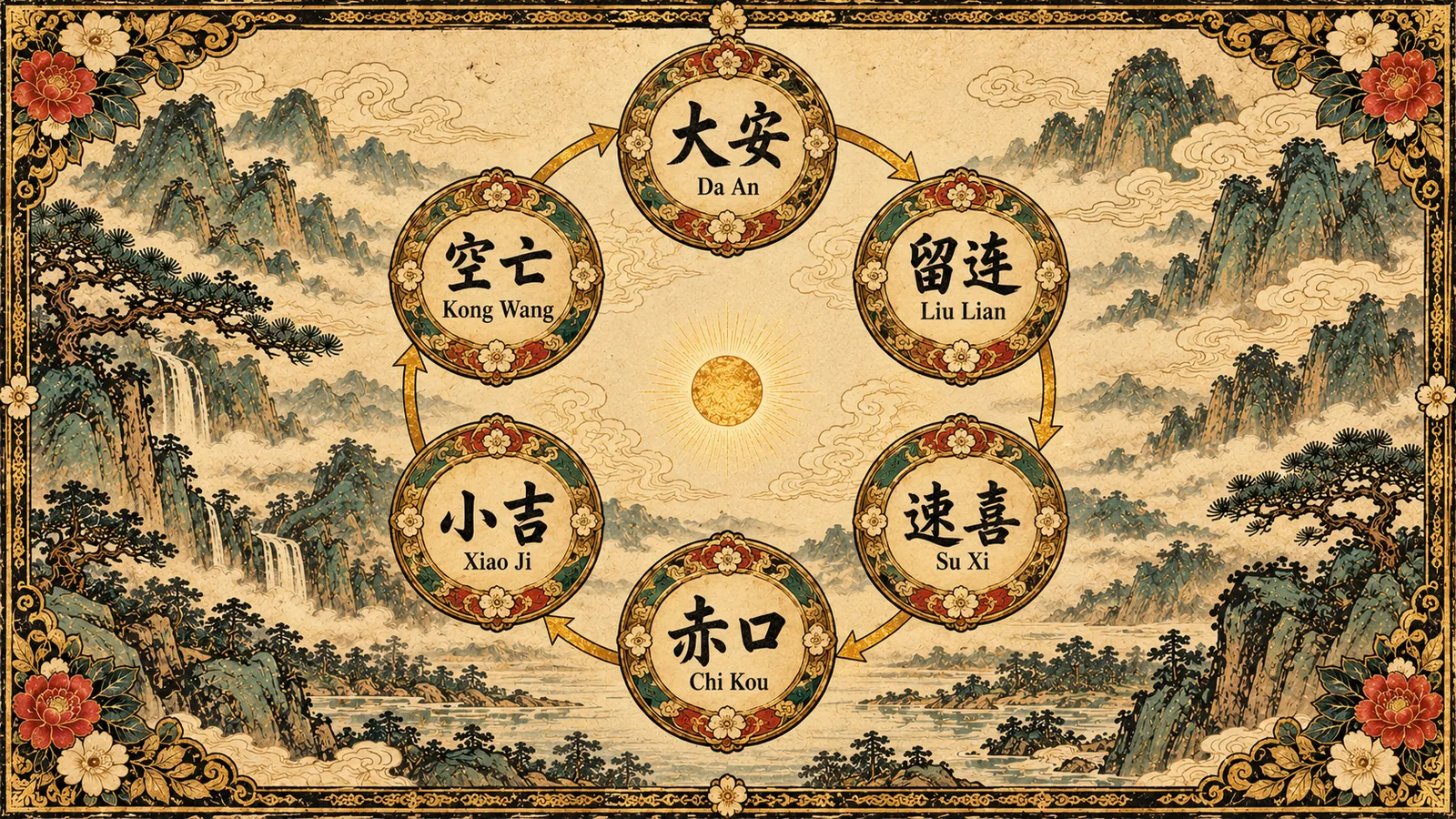
These are traditional interpretive starting points, not six interchangeable yes-or-no buttons. A delayed document, an uncertain meeting and a difficult conversation give the same position different practical meanings. The question still matters after the arithmetic is finished.
Contemporary calendar tools show the continued use of month–day–hour Xiao Liu Ren. They do not establish a single ancient author or prove that every practitioner counts the same way. We do not present the popular attribution to Zhuge Liang as documented history.
Fix the inputs before counting
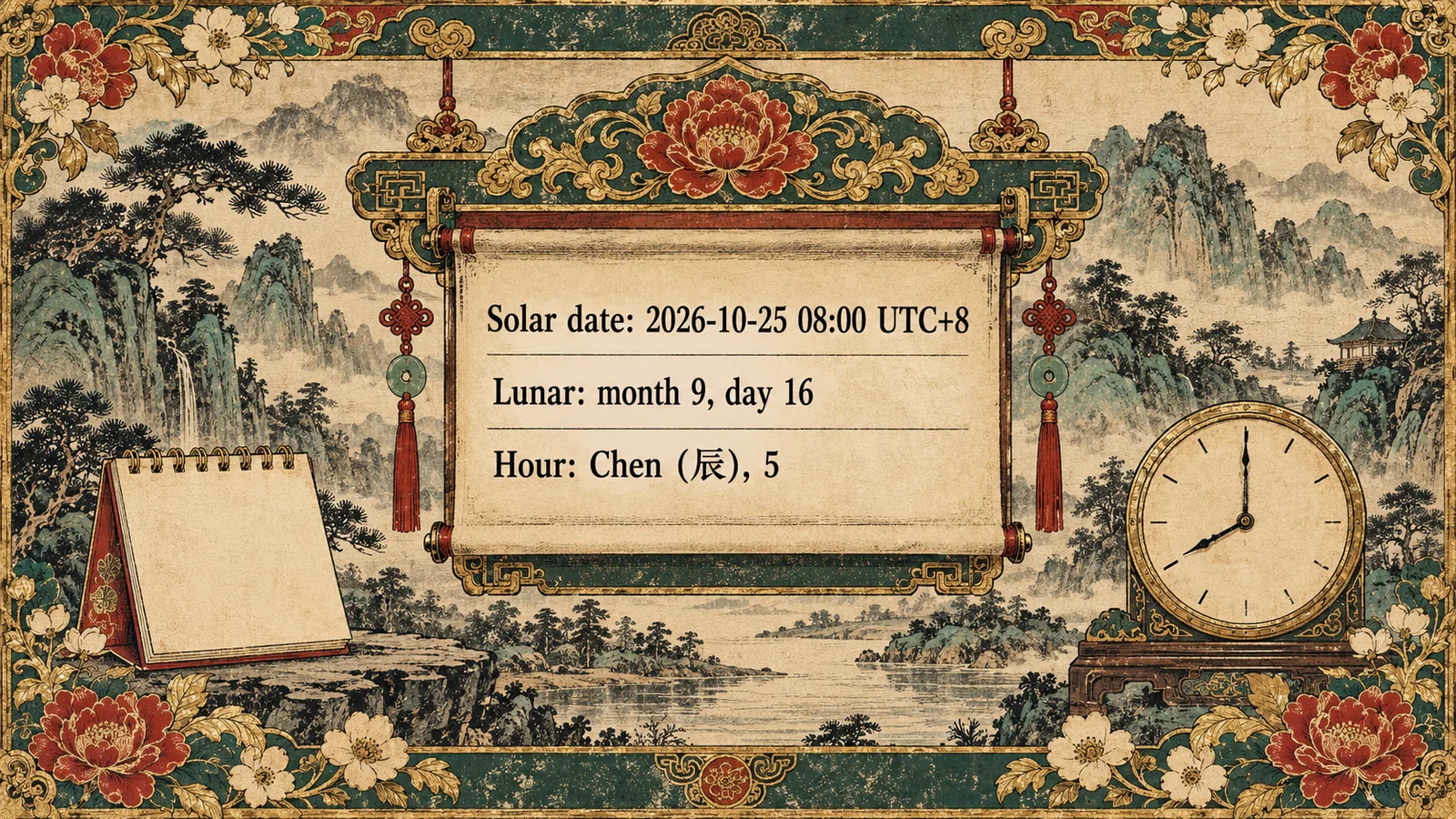
For this example we use the fictional local date and time October 25, 2026, at 08:00, UTC+8. The Hong Kong Observatory’s 2026 conversion table places that date on lunar month 9, day 16. At 08:00, the traditional hour is Chen, the fifth of the twelve hour branches.
The Observatory’s hour table places Chen between 07:00 and 09:00. In an implementation, 09:00 belongs to the next interval, not both. This example stays away from the boundary.
| Input | Value used |
|---|---|
| Civil date | 2026-10-25 |
| Local time | 08:00, UTC+8 |
| Lunar month | 9 |
| Lunar day | 16 |
| Traditional hour | Chen 辰 |
| Hour’s counting number | 5 |
The lunar date is not the Gregorian month and day. Feeding 10 and 25 into the month and day stages would calculate a different result.
Count inclusively: the starting position is one
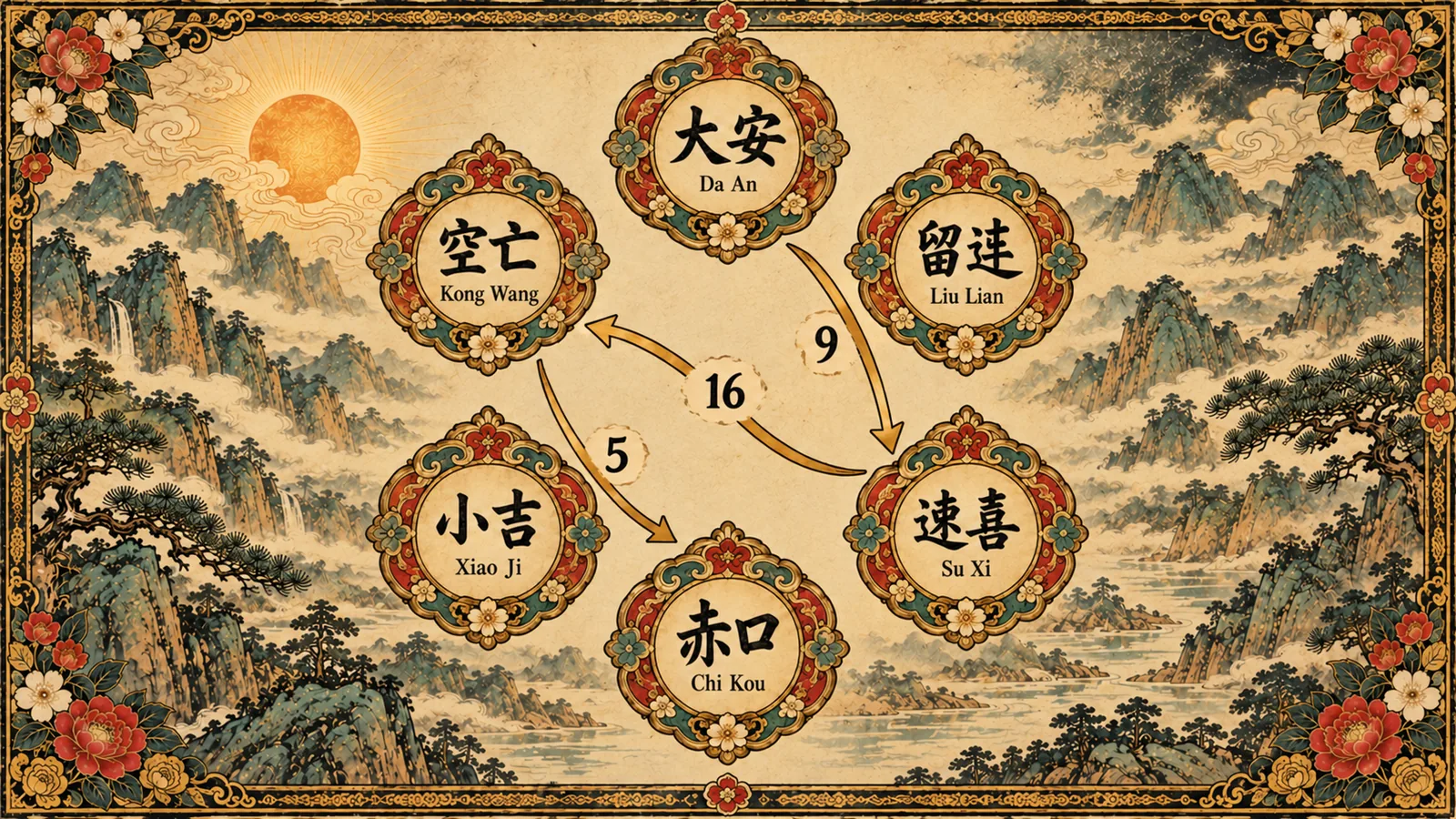
This convention begins the month count at Da An. The day count begins on the month result, and the hour count begins on the day result. At every stage, the starting position counts as 1.
Month: count nine from Da An
The six-position cycle returns to Da An on count 7, reaches Liu Lian on 8, then Su Xi on 9. The month result is Su Xi.
Day: count sixteen from Su Xi
Su Xi is count 1, not count 0. The position repeats on counts 7 and 13; count 14 is Chi Kou, count 15 is Xiao Ji, and count 16 is Kong Wang. The day result is Kong Wang.
Hour: count five from Kong Wang
Count 1 is Kong Wang, 2 Da An, 3 Liu Lian, 4 Su Xi and 5 Chi Kou. That is the final position.
For an arithmetic check, number the six positions from 0 to 5. Starting at index s and counting n gives (s + n − 1) modulo 6. The three steps are:
- Month: (0 + 9 − 1) modulo 6 = 2 → Su Xi.
- Day: (2 + 16 − 1) modulo 6 = 5 → Kong Wang.
- Hour: (5 + 5 − 1) modulo 6 = 3 → Chi Kou.
The subtraction of 1 is not a decorative detail. Omitting it changes the counting convention.
Turn the result into a reading, not a verdict about a person
Suppose our fictional question is, “How might a conversation about a shared project go this morning?” Chi Kou gives a reason to examine friction in the exchange: competing descriptions of the task, a sharp response or disagreement about what was understood.
An example interpretation might be: The discussion looks less straightforward than hoped. A difference in expectations could become audible before agreement is reached, so the exchange may feel more argumentative than productive at first. That is a symbolic reading of the question and result—not a record of an event that happened.
It would go beyond the evidence to announce that the other person is lying, invent an unpaid invoice, or predict a physical confrontation. Equally, simply saying “communicate positively” would skip the divination judgment the user asked for.
For a question about an item arriving, Chi Kou could direct attention toward a dispute or mixed communication about delivery rather than automatically describing an argument between partners. Context selects among plausible applications; it does not change the calculation.
Which conventions can produce different answers?
GOOD TIMING’s time-based path uses the six-position order and inclusive count stated above. Its current leap-month treatment uses the corresponding lunar month number. Some practitioners handle leap months differently; that difference should be stated, not quietly mixed into a worked example.
Midnight, time zones and the Zi-hour boundary also require a declared convention. If a tool starts from a chosen number instead of the time, it is using a different input method. Compare methods and inputs before comparing their final palace names.
Xiao Liu Ren is also not the same technique as Da Liu Ren, and its six positions are not I Ching hexagram lines. Similar names or the number six do not make the systems interchangeable.
Try the actual time-based method
GOOD TIMING’s Xiao Liu Ren tool lets you choose an existing input path and supplies the calculated evidence for the AI reading. To reproduce this tutorial, use the manual-time path with the stated local date and time, then check the displayed lunar inputs and each stage. Do not choose the current-time path and expect an old example to repeat.
Keep the question and calculation together when following up. You can ask which part of the original result bears on a specific concern without silently treating a new time as the same cast.
For a different kind of six-part structure, see the three-coin I Ching tutorial. It explains six yin–yang lines, which are a different calculation and should be read through their own method.