The Lenormand 9-card spread, also called the 3×3 box or portrait, lays nine cards in a square. Read the center card first as the heart of the situation, then read the rows, columns and diagonals as lines of three. Teachers read the lines a little differently, so pick one method before you draw and stick with it.
What is the Lenormand 9-card spread?
The Lenormand 9-card spread is a square of three rows of three cards, numbered 1 to 9 from left to right and top to bottom:
```
1 2 3
4 5 6
7 8 9
```
It is a short-to-medium-term spread. Most readers use it for the next few weeks to a few months, and the time frame really comes from your question. It works best for describing a situation rather than answering yes/no, and it can also appear as one section of a larger layout. The full 36-card Grand Tableau uses the whole deck, and the 9-card box is a good stepping stone toward it.
If you are new to reading Lenormand cards in lines, start with the three-card Lenormand spread and the Lenormand combinations guide first. The box uses the same skill, with more lines. On GOOD TIMING this layout is called the Nine-Card Portrait, and you can cast it in the Lenormand reading.
What is the center card in a 9-card Lenormand spread?
The center card, position 5, is read as the core or underlying theme of the question. Many readers also treat card 1 as a key card.
There are two common ways to get the center. You can draw all nine cards blind, so the center is whatever lands there. Or you can choose a key card for the topic, place it in the center, and draw the other eight. Either works. Just be honest with yourself about which one you used, and don't treat a chosen center as if it had been drawn.
How do I read rows, columns and diagonals?
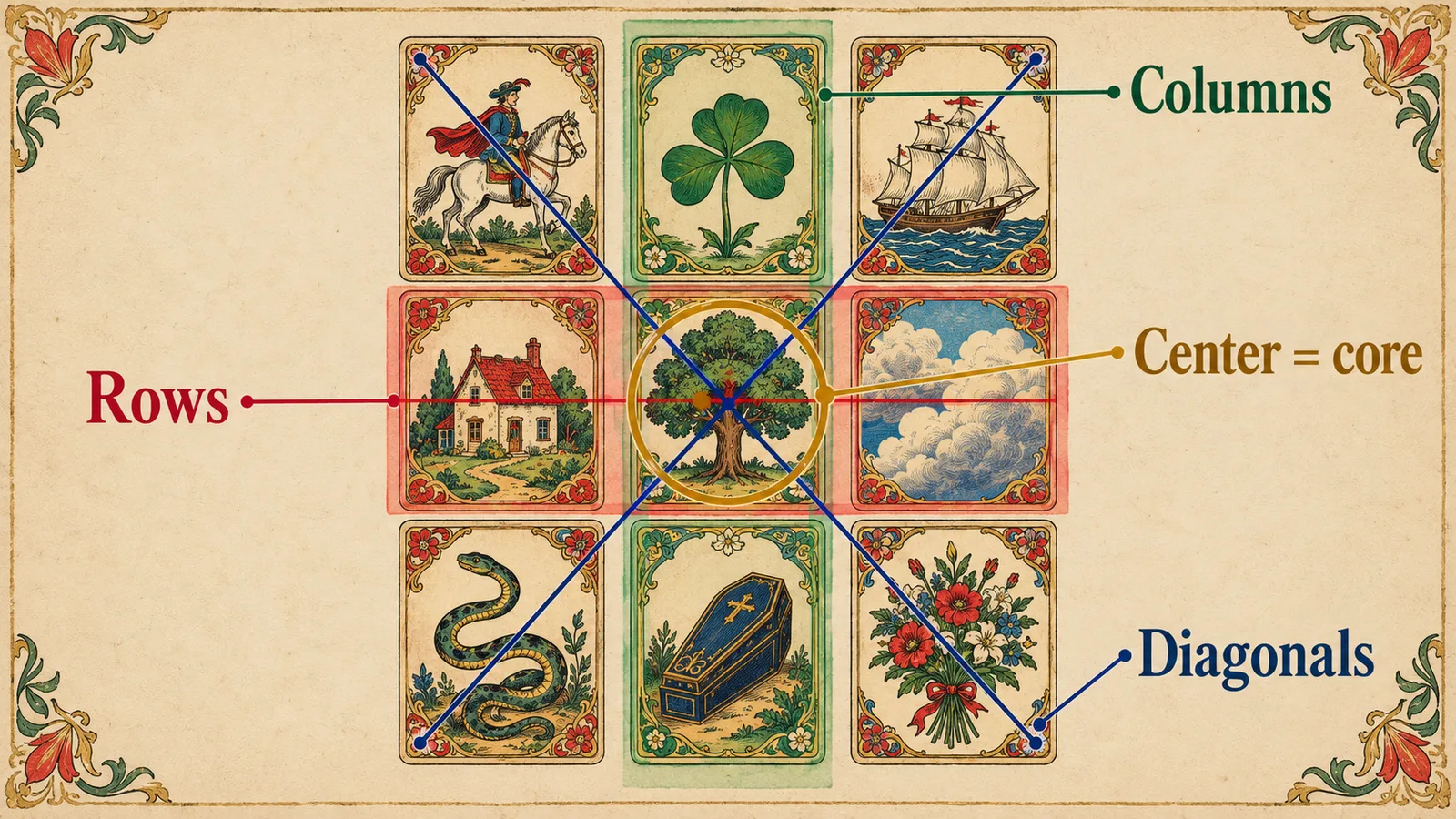
The box contains eight lines of three cards: three rows, three columns and two diagonals. Here is the most popular way to read them.
| Line | What it shows |
|---|---|
| Center (5) | The core of the situation, or your key card |
| Rows (1-2-3, 4-5-6, 7-8-9) | Top: thoughts, the conscious level. Middle: reality. Bottom: the undercurrent, or what is underneath |
| Columns (1-4-7, 2-5-8, 3-6-9) | Left: recent past. Middle: present. Right: near future |
| Diagonals (1-5-9, 7-5-3) | Direction, movement, development from past toward future |
| Corners and mirrors | Corners 1, 3, 7, 9 frame the situation. Mirror pairs are 1-3, 4-6 and 7-9 |
Other readers do it a little differently: some call the rows "the issue, the answer and additional information", some see the columns as optional, and some add the vertical mirrors 1+7, 2+8 and 3+9 or treat 1-5-9 as the most important line. Pick the way that feels natural and stay consistent. Columns suggest an order of events but give no exact date. You can also read the diamond of cards 2, 4, 6 and 8 first, as an overview.
You don't need to use every technique. Add one at a time, and you will avoid reading in only what you hoped to see.
Worked example: a freelance project
The question is "How will the next three weeks go on my freelance project?" The "three weeks" comes from the question, not from the cards. The nine cards were drawn blind, so the center is chance. We decide the lines up front: rows are thought, reality and undercurrent; columns are recent past, present and near future.
```
2 Clover 3 Ship 4 House
21 Mountain 14 Fox 34 Fish
27 Letter 12 Birds 33 Key
```
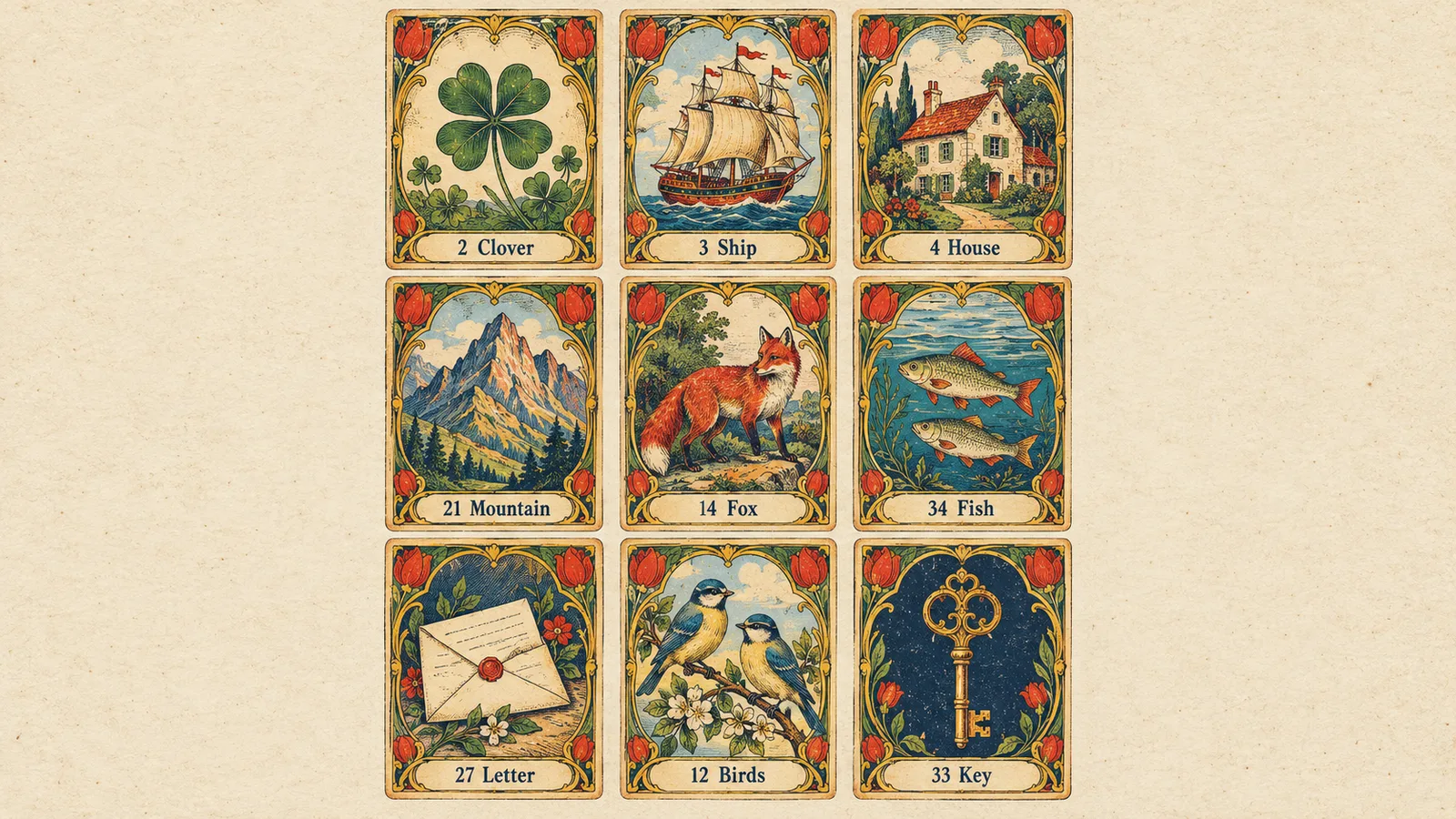
Card keywords below come from our Lenormand card meanings guide.
Step 1: the center. The Fox (14) points to work, strategy and caution. For a freelance question that fits, so the situation is about the work itself, handled carefully.
Step 2: row 2, the reality line. Mountain, Fox and Fish read as an obstacle or delay (Mountain) around the work (Fox) and money (Fish). A reasonable reading is a slowdown on the money side, such as approval or payment timing. It is a delay, not necessarily a failure.
Step 3: column 2, the present line. Ship, Fox and Birds suggest work at a distance (Ship) with a lot of conversation (Birds). Expect calls and messages, and perhaps some nerves about them.
Step 4: diagonal 1-5-9. Clover, Fox and Key read as a small opening (Clover) around the work (Fox) that could unlock a solution (Key). It is a chance worth acting on with care, not a guarantee.
Putting it together. The box describes a slow money side and plenty of remote conversation, plus one small opening that may help if handled carefully. A practical takeaway: follow up on the pending approval in writing, then use the conversation to open the Clover.
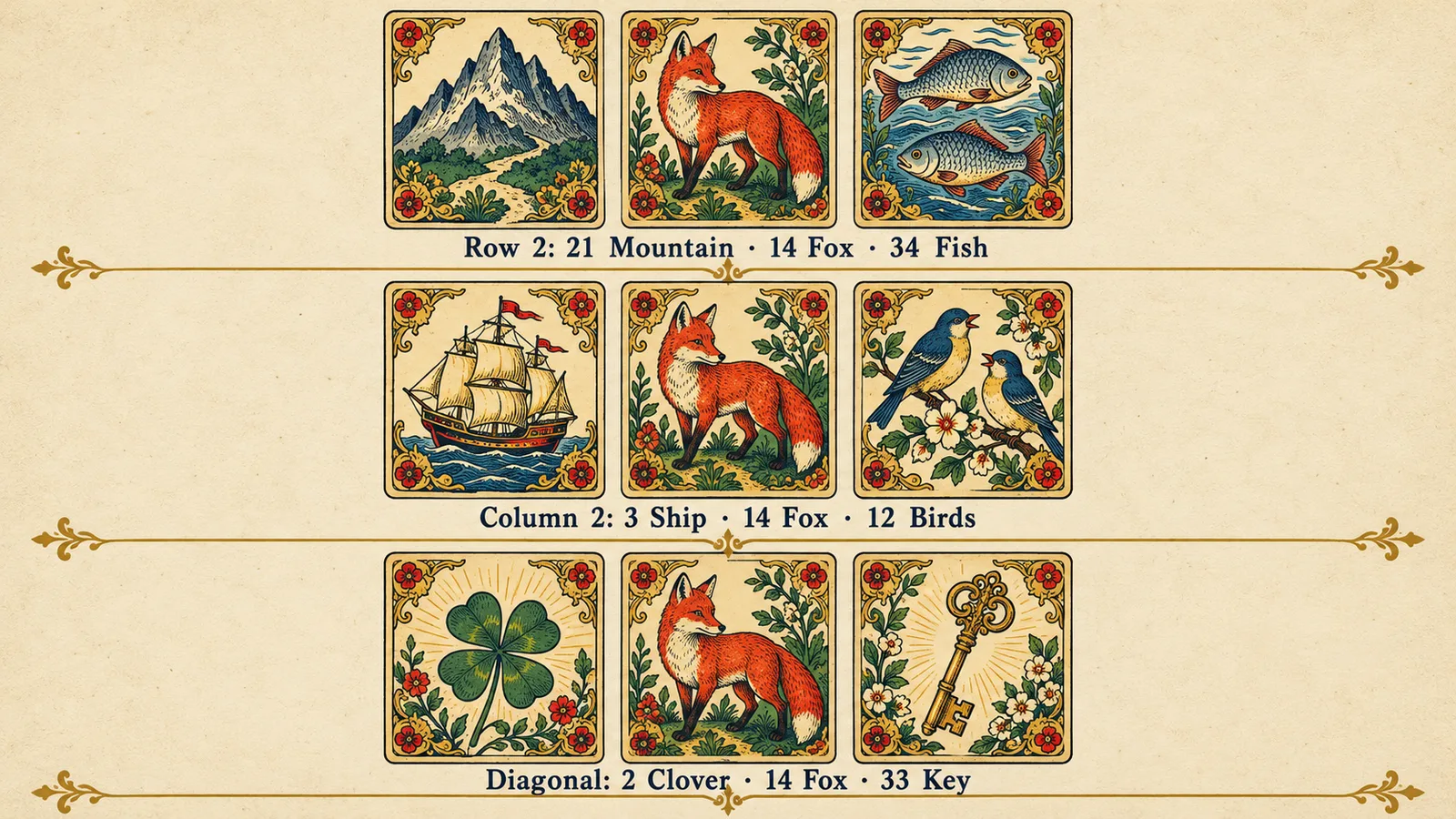
Optional checks. Row 3 (Letter, Birds, Key) reads as a message and a conversation leading to a solution, which supports Step 4. The diagonal 7-5-3 (Letter, Fox, House) suggests a written agreement worth reading closely. The mirror pair 4 and 6 (Mountain and Fish) repeats the delay-and-money theme. We stopped there on purpose. If three lines already tell a consistent story, more lines are more likely to add noise than clarity.
For a work-specific guide to these cards, see Lenormand career reading. If you compare Lenormand with tarot for this kind of practical question, tarot vs Lenormand explains the difference.
Do I have to read every line?
No. Start with the center, then pick two or three lines that match the question, such as a row for the situation, a column for timing and the main diagonal for direction. Choose your lines before you look at the cards, not after seeing which one gives the nicest answer.
How is the 9-card box different from three 3-card lines?
In the box, each card sits on several lines at once. The center card is on four lines (a row, a column and both diagonals), each corner is on three, and each edge card is on two. In three separate 3-card lines, each card belongs to one line only. This crossing is what lets the box show a theme from several angles, and it is also why it is easy to over-read, so keep it simple.
How does GOOD TIMING's Nine-Card Portrait work?
The Nine-Card Portrait in the Lenormand reading shows nine cards in a 3×3 grid with the center highlighted. It uses its own position names, so you read each card by what its place means. The positions, numbered like the grid above, are:
| 1 Background | 2 Developing | 3 Visible Direction |
|---|---|---|
| 4 Underlying Factor | 5 Core Situation | 6 Active Influence |
| 7 Near Development | 8 Practical Focus | 9 Likely Direction |
These names differ from the plain rows and columns taught above, and both work on the same nine cards. Follow the tool's names for a quick read, or use the box method in this article for the lines, rows and diagonals. The reading tool also offers Quick Look (1 card), Three-Card Line (3) and Five-Card Line (5) if you want something shorter.
Good to know
A line is a way of looking at the cards, and the box describes a situation better than it gives an exact date or a yes/no verdict. Research has not shown that cards predict events, and teachers read lines differently, so treat a reading as guidance for your choices.
Other worked examples include what he thinks about me and finding lost objects.
Frequently asked questions
What is the center card in a 9-card Lenormand spread?
The center card (position 5) is read as the core theme of the question. You can draw it blind or choose a key card for the topic and place it there. Just remember which you did.
How do I read rows, columns and diagonals?
A popular way is rows for thought, reality and undercurrent, columns for recent past, present and near future, and diagonals for direction. Other readers do it a little differently, so choose one and stay consistent.
What is the difference between the 3×3 box and the Grand Tableau?
The box uses nine cards for a short-term question. The Grand Tableau uses all 36 cards of the deck. The box is the simpler building block.
Do I have to read every line?
No. Start with the center and two or three lines that fit your question. Adding one technique at a time keeps the reading clear.
How does the 9-card box differ from three 3-card lines?
In the box, every card sits on several crossing lines, so you can read a theme from multiple angles. Three separate lines keep each card in a single sequence. See the three-card spread guide for the simpler format.