Meta Description Explore all 36 Lenormand card meanings and learn how pairs, combinations, context, and position turn individual cards into clear messages about real-life situations. Primary keyword lenormand card meanings
Secondary keywords
- Lenormand meanings
- 36 Lenormand cards
- Lenormand cards meaning
- Lenormand combinations
- how to read Lenormand cards
- Lenormand card combinations
- Lenormand for beginners Lenormand Card Meanings: What All 36 Cards Mean
Lenormand can look deceptively simple. A Rider means news. A Heart means love. A Ring means commitment. A Fox can mean work, strategy, or something that deserves suspicion.
Learn 36 cards and you are done, right? Not quite. The individual meanings matter, but Lenormand really begins when the cards start talking to each other. A Rider beside a Heart is not the same message as a Rider beside a Coffin. A Ring beside the Sun feels very different from a Ring beside the Cross.
The cards create context for one another. That is why Lenormand is often easier to understand when you stop treating each card as a separate symbol and begin reading them more like words in a sentence. If you already have a concrete question in mind, you can start a Lenormand reading and use this guide alongside the cards you draw.
What Is Lenormand?
A standard Lenormand deck contains 36 cards. Compared with Tarot's 78-card system, Lenormand uses a smaller symbolic vocabulary. But that smaller vocabulary does not necessarily make the system less detailed. The detail comes from combination.
Lenormand is often used for practical, real-world questions: communication, relationships, work, money, travel, obstacles, decisions, commitments, changes, and events that may be developing around you. Tarot often gives more room to psychology, motivations, archetypes, and inner experience. Lenormand tends to feel more concrete and event-oriented. A useful shorthand is:
Tarot often asks: Why is this happening? Lenormand often asks: What is happening around this situation, and how are the pieces connecting? That is a simplification, not a hard rule. But it explains why the two systems can feel so different in practice. Lenormand reference guides likewise describe the system as especially practical and emphasize reading cards together rather than relying on isolated meanings.
The Most Important Thing to Know About Lenormand Meanings
Do not stop at the first card. Imagine you draw: Heart Its core meaning is straightforward: love, affection, emotional connection.
Now add: Ring Heart + Ring can suggest an emotional commitment, romantic agreement, or relationship bond. Now change the second card:
Heart + Coffin The same Heart is now interacting with an ending, closure, loss, or something becoming inactive. Change it again: Heart + Clouds
Now the message may involve uncertainty in love, confused feelings, or a relationship that is difficult to understand clearly. The Heart itself did not lose its meaning. The neighboring card changed the sentence. That is Lenormand.
Question First, Cards Second
Lenormand benefits enormously from a clear question. A question such as: “What is going to happen to me?” covers almost your entire life.
Work, money, relationships, friends, messages, travel, family, decisions, and dozens of smaller events could all legitimately appear. If what you actually care about is one particular relationship, say so. Instead of: “What happens next?”
try: “What is likely to develop between this person and me over the next four weeks?” Instead of: “How does she see me?”
try: “How does my manager currently see my role at work?” or: “How does the woman I speak with regularly currently view our connection?”
You do not need an elaborate question. You need to tell the cards which situation you want them to describe. For more examples, see How to Ask Tarot Questions for a Better Reading. The same principle—being clear about the person, situation, and timeframe—is especially useful in Lenormand.
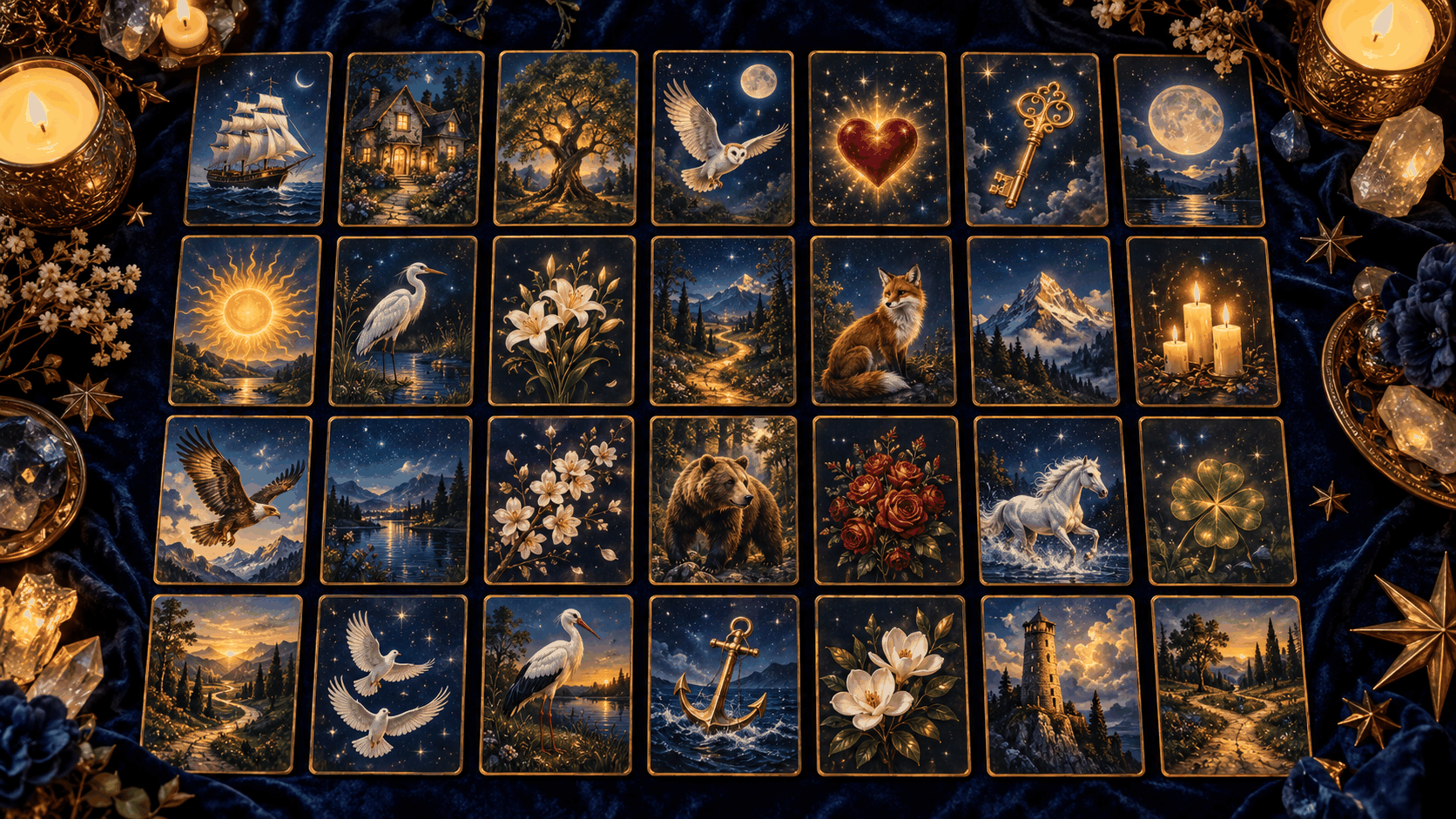
All 36 Lenormand Card Meanings
1 — Rider
Core meanings: News, message, arrival, visitor, movement, something approaching. The Rider often signals something coming toward you: information, a person, an opportunity, or movement that breaks a period of stillness. With positive cards, it can indicate welcome news. With difficult cards, what arrives may be less comfortable.
2 — Clover
Core meanings: Small luck, opportunity, chance, lightness, brief opening. The Clover usually describes something fortunate but often temporary. It is less like winning the lottery and more like noticing a door that happens to be open. Opportunity matters because it may not stay open forever.
3 — Ship
Core meanings: Travel, distance, exploration, movement, foreign places, expansion. The Ship can describe literal travel, long distance, something overseas, or moving beyond what is familiar. In work or money questions, it can also suggest expansion into new territory.
4 — House
Core meanings: Home, family, security, stability, privacy, established structures. The House may describe your literal home, family environment, or something established and familiar. Depending on surrounding cards, that stability can feel protective—or restrictive.
5 — Tree
Core meanings: Health, roots, growth, longevity, gradual development, stability. The Tree tends to slow things down. It often describes something developing over time rather than producing an immediate result. In health-related readings, it can point directly toward physical wellbeing, though divination should not replace medical care.
6 — Clouds
Core meanings: Confusion, uncertainty, obscurity, doubt, lack of clarity. The Clouds suggest that something cannot currently be seen clearly. That does not always mean deception. Sometimes the information simply is not available yet.
7 — Snake
Core meanings: Complexity, complications, desire, strategy, rivalry, deception. The Snake is one of the cards that requires context. It may describe manipulation or dishonesty, but it can also represent a complicated route, strategic behavior, temptation, or a person with strong desires. Avoid turning every Snake into “someone is cheating.”
Look at what surrounds it.
8 — Coffin
Core meanings: Ending, closure, loss, inactivity, conclusion, something being put to rest. The Coffin often marks the end of a phase. It can describe something stopping, becoming unavailable, or needing to be released before another stage begins.
9 — Bouquet
Core meanings: Gift, invitation, appreciation, charm, pleasure, compliment. The Bouquet is generally pleasant. It can describe an invitation, social gesture, recognition, beauty, kindness, or something offered to you.
10 — Scythe
Core meanings: Sudden cut, decision, separation, risk, sharp change. The Scythe acts quickly. It can indicate cutting something away, a sudden decision, abrupt separation, or an event requiring immediate attention. Direction and nearby cards can matter significantly with this card.
11 — Whip
Core meanings: Repetition, argument, tension, debate, conflict, recurring pattern. The Whip can show something happening repeatedly. That might be repeated conversations, recurring conflict, practice, physical intensity, or a pattern that keeps returning.
12 — Birds
Core meanings: Conversation, nervousness, chatter, discussion, calls, temporary anxiety. The Birds often points toward communication between people. It can also describe mental agitation, gossip, nervous anticipation, or a lot of talking around a situation.
13 — Child
Core meanings: Beginning, something small, innocence, simplicity, child, inexperience. The Child frequently describes something new or still in its early stages. It can also literally represent a child depending on the question.
14 — Fox
Core meanings: Work, strategy, caution, self-interest, cleverness, suspicion. The Fox is another context-sensitive card. In many readings it can point directly toward a job or work environment. In other situations it asks you to look more carefully because someone may be acting primarily in their own interest.
15 — Bear
Core meanings: Power, authority, protection, resources, influence, boss. The Bear often represents strength or someone with more authority or resources. In a career question it can describe a boss or senior figure. In money questions it may relate to financial strength or control.
It can protect. It can also dominate.
16 — Stars
Core meanings: Direction, hope, guidance, clarity, vision, connection. The Stars often indicate a clearer direction, aspiration, inspiration, or alignment. In modern readings, they can also interact naturally with topics involving networks, digital environments, or things connected across distance.
17 — Stork
Core meanings: Change, transition, improvement, relocation, movement from one state to another. The Stork says something is changing. What kind of change depends on the cards around it. Stork + House, for example, can naturally point toward a change in the home environment or moving.
18 — Dog
Core meanings: Friend, loyalty, support, trust, companion. The Dog commonly represents a trusted person, friendship, dependable support, or someone standing by you. Difficult surrounding cards may complicate that trust.
19 — Tower
Core meanings: Institution, authority, distance, independence, corporation, isolation. The Tower in Lenormand is not the Tarot Tower. It can describe institutions, large organizations, official systems, corporations, government, professional environments, or emotional/social distance. This is one of the clearest examples of why Tarot meanings should not simply be transferred into Lenormand.
20 — Garden
Core meanings: Public life, society, community, network, gathering, social environment. The Garden describes the world outside private life. It can point toward events, communities, social circles, public visibility, audiences, networking, or spaces where people gather.
21 — Mountain
Core meanings: Obstacle, delay, blockage, difficulty, something hard to move. The Mountain usually describes resistance. It does not necessarily mean permanent failure. It means something stands between you and the result.
22 — Crossroads
Core meanings: Choice, options, alternative paths, decision, separation of directions. The Crossroads appears when more than one path is possible. It may indicate a decision you need to make or a situation that has not settled into one direction yet.
23 — Mice
Core meanings: Loss, erosion, stress, worry, gradual depletion. The Mice tends to describe something being slowly eaten away. That could be money, energy, confidence, time, trust, or peace of mind. Unlike the Scythe, the Mice often works gradually.
24 — Heart
Core meanings: Love, affection, emotion, desire, warmth, compassion. The Heart is strongly associated with love and emotional connection. But it does not automatically guarantee a relationship outcome. It tells you emotion matters.
The surrounding cards tell you what is happening to that emotion.
25 — Ring
Core meanings: Commitment, agreement, contract, partnership, promise, cycle. The Ring can describe romantic commitment, but also business agreements, contracts, promises, or repeated cycles. Its meaning is broader than marriage. With Fish, for example, it can naturally describe a financial or business agreement; Lenormand combination references commonly treat Ring in this wider contractual sense.
26 — Book
Core meanings: Knowledge, secret, study, information not yet revealed, education. The Book frequently represents something unknown or not yet disclosed. It can also represent study, expertise, research, or literal information.

A Book does not automatically mean someone is hiding something maliciously. Sometimes the answer simply has not been revealed yet.
27 — Letter
Core meanings: Written communication, message, document, email, paperwork. The Letter is more specific than general communication. Think texts, emails, documents, contracts, forms, notices, or information recorded in writing. Lenormand references commonly associate it with communication and documents, with combinations determining the subject of that communication.
28 — Man
Core meanings: A significant man or masculine-coded person in the reading. Traditionally this is one of the significator cards. Who it represents depends on the querent, question, and reading method. Do not automatically assume it means a romantic partner.
29 — Woman
Core meanings: A significant woman or feminine-coded person in the reading. Like the Man, this is traditionally used as a significator. Its role depends entirely on who the question concerns.
30 — Lily
Core meanings: Maturity, peace, sensuality, experience, calm, morality. The Lily can describe peace and maturity, but depending on the question it can also relate to sensuality, sexuality, age, experience, or established values. Context matters considerably here.
31 — Sun
Core meanings: Success, clarity, energy, confidence, achievement, positive outcome. The Sun tends to strengthen whatever it touches. It often brings visibility, vitality, confidence, or success into the combination.
32 — Moon
Core meanings: Emotion, recognition, intuition, reputation, cycles. The Moon can describe emotional experience and intuition, but traditional Lenormand reading also connects it strongly with recognition and reputation. In career readings, that second meaning can be particularly important.
33 — Key
Core meanings: Solution, certainty, significance, opening, breakthrough. The Key indicates that something matters. It can show a solution, something becoming accessible, a breakthrough, or an answer that unlocks the situation. Lenormand references commonly connect the Key with revelation and opening a path forward.
34 — Fish
Core meanings: Money, business, commerce, resources, abundance, flow. The Fish is strongly connected with finances and commercial activity. It can also describe abundance, independence, or things that move freely.
35 — Anchor
Core meanings: Stability, work, career, persistence, security, something staying in place. The Anchor can be reassuring when you want stability. But if the question is about movement, it can also show that something is not changing quickly. Context determines whether staying put is helpful or restrictive.
36 — Cross
Core meanings: Burden, responsibility, difficulty, duty, suffering, something that must be carried. The Cross is usually a heavier card. It can point toward responsibility, hardship, obligation, or something that feels unavoidable. But it does not mean your entire future is doomed.
It describes the weight attached to the situation being asked about.
Positive, Negative, and Neutral Cards
You may see Lenormand cards classified as positive, negative, or neutral. That can be useful as a shortcut. But do not let it replace interpretation. The Scythe may look negative if you are asking about keeping a relationship.
But if you ask: “What helps me finally leave an unhealthy situation?” a decisive cut may be exactly what needs to happen. Likewise, the Anchor is comforting if the question is about stability.
Less so if the question is: “Why is nothing changing?” The question determines whether a quality is useful.
Lenormand Combinations: Where the Reading Really Begins
Suppose you draw two cards: Rider + Letter Both relate to communication. Together, they strongly reinforce the idea of incoming written news, a message, email, notice, or document.
Now try: Rider + Clouds Something is arriving, but the information may be confusing or unclear. Or:
Rider + Bouquet Now the arrival may look more like an invitation, pleasant announcement, or welcome message. Traditional Lenormand references likewise read combinations such as Rider + Ship as distant news, Rider + Bouquet as an invitation, and Rider + Clouds as confusing communication. The cards modify one another.
This is why memorizing 36 isolated meanings is only step one.
Read Lenormand Like a Sentence
A useful beginner approach is to imagine cards performing different grammatical jobs. For example: Fox + Letter could describe work-related communication, a strategic message, or a document that deserves careful inspection.
Heart + Ring could describe emotional commitment. Mice + Fish could describe financial resources being gradually depleted.
Mountain + Rider could describe news that is delayed or blocked. The goal is not to memorize every possible pair. With 36 cards, there are already hundreds of two-card combinations.
Instead, learn how the concepts interact. Ask: What happens when Card A touches Card B?
Does Card Order Matter?
Often, yes. Different Lenormand traditions handle direction and syntax somewhat differently, so there is not one universal grammar used by everyone. But order can help establish which idea is being described and which idea modifies it. For example:
Heart + Clouds may emphasize love becoming uncertain or confused. Clouds + Heart may emphasize an unclear situation whose subject is emotion or love.
The overall themes overlap, but the emphasis can shift. This is especially important once you move from pairs into three-, five-, or nine-card readings.
How to Read Three Lenormand Cards
A three-card spread is one of the easiest ways to begin reading combinations. Instead of treating it as: Card 1 meaning Card 2 meaning
Card 3 meaning read the relationship between them. For example: Heart — Clouds — Ring
You have love, uncertainty, and commitment. Depending on the question, that might describe uncertainty about commitment in a relationship, feelings that exist but whose future status is unclear, or confusion that needs to be resolved before commitment becomes stable. Now compare: Heart — Sun — Ring
The structure is similar. But the center card completely changes the direction. Love is now moving through clarity, confidence, or success toward commitment. In GOOD TIMING's three-card Lenormand reading, the cards are intentionally interpreted according to their roles in the spread rather than being treated as three unrelated definitions.
That distinction matters.
Specific Questions Make Lenormand Much Stronger
Lenormand is especially good at answering questions grounded in a real situation. Compare: “What is coming?” with:
“What is likely to develop around my current job over the next four weeks?” Or: “How does she see me?” with:
“How does my manager currently see my role on the team?” Or: “What will happen between us?” with:
“What is likely to develop between the person I speak with every day and me over the next month?” When you define the subject and timeframe, it becomes much easier to connect the symbols to the situation. The cards no longer have to guess which area of your life you secretly meant.
Lenormand vs. Tarot Card Meanings
If you already know Tarot, there is one habit worth breaking early: Do not translate Lenormand into Tarot. The Tower is an obvious example. In Tarot, The Tower is associated with disruption, collapse, revelation, and sudden change.
In Lenormand, Tower more commonly points toward institutions, organizations, authority, isolation, or distance. Likewise, Lenormand's Moon is not simply the Tarot Moon. The systems have different vocabularies. If you are learning both, see our complete guide to all 78 Tarot card meanings separately rather than combining the two dictionaries.
How Far Ahead Does Lenormand Read?
There is no single universal timeframe for every Lenormand spread.

The timeframe should usually come from the question and the spread being used. A short reading may focus on the next few days or weeks. A 3×3 can be used for a defined near-term period. A larger spread can cover a broader horizon.
In one commonly taught Grand Tableau approach, the final “cards of fate” are interpreted across approximately the next 8–12 weeks. The important thing is not memorizing “Lenormand equals X weeks.” It is defining the timeframe before interpreting the cards.
What Is the Grand Tableau?
The Grand Tableau is Lenormand's full 36-card spread. Every card in the deck is laid out. Instead of answering one narrow piece of the situation, the spread can be used to examine multiple areas of life and the relationships between them. Readers may look at:
- cards around the significator
- horizontal and vertical relationships
- diagonals
- distance
- direction
- houses
- topic cards
- central cards
- combinations across the tableau The technique can become very sophisticated.
But beginners do not need to start there. If you can read two cards together, then three, then a small line, you are already building the skill required for larger Lenormand spreads. Labyrinthos likewise teaches the Grand Tableau as an extension of smaller pair/string techniques rather than an entirely separate language.
What Are Lenormand Houses?
In the Grand Tableau, every position can correspond to one of the 36 cards. Those positions are called houses. For example, a card landing in the House house adds a layer involving home, family, stability, or established structures. A card in the Letter house can bring communication or documents into the interpretation.
This creates a second layer: the card itself + the house it occupies It is one reason the same 36-card deck can support very detailed readings. You do not need Houses to read Lenormand successfully, though.
They are an additional technique, not a prerequisite.
What If Two Lenormand Cards Seem to Contradict Each Other?
Do not assume one of them is wrong. Suppose you draw: Heart + Mountain Love exists.
But something blocks it. That is not contradictory. It is a sentence. Or:
Ring + Crossroads There may be a commitment and a choice around that commitment. Or a decision about whether to enter, leave, or redefine an agreement. Likewise:
Dog + Snake does not force one single interpretation. Depending on the question, it could point toward a complicated friendship, strategic behavior involving a friend, mistrust, or someone whose loyalty needs closer examination. The question tells you which interpretation makes sense.
Do You Need to Memorize Every Lenormand Combination?
No. Trying to memorize every possible two-card combination would quickly become absurd. And once you move into three-card combinations, the number grows dramatically. Instead, learn the core meaning of each card well enough that you can combine concepts.
If: Letter = written communication and: Fish = money / business
then: Letter + Fish can naturally suggest a financial document, money-related communication, invoice, tax communication, or business correspondence depending on the question. That is much more useful than memorizing a phrasebook.
A Simple Formula for Reading Any Lenormand Combination
When you get stuck, use this:
- What was the question?
Do not interpret without returning to it.
- What does each card fundamentally represent?
Keep the meanings simple first.
- What happens when those ideas touch?
Does one describe, block, strengthen, end, confuse, or change the other?
- What is the order?
Which idea is the subject and which seems to modify it?
- What does the real situation allow?
A combination should fit the question. If you asked about work, look for the work expression of the cards before inventing an unrelated romantic story. That last step matters enormously.
Start Reading Lenormand in Context
The 36 meanings are the foundation. But they are not the finished reading. Rider means news. Heart means love.
Ring means commitment. Clouds mean uncertainty. Knowing those definitions matters. But reading Lenormand means understanding why:
Rider + Heart does not say the same thing as: Rider + Clouds and why:
Heart + Ring does not say the same thing as: Heart + Coffin. The cards become clearer when the question is clear and the combinations are allowed to create the message.
If you have a concrete situation you want to explore, you can start a Lenormand reading and read the cards in the context of your own question.
When You Are Not Sure What the Combination Means
Sometimes two or three cards make immediate sense. Sometimes they absolutely do not. That is normal. Before redrawing, go back to:
- the exact question
- the relationship between the cards
- the role of each position
- the timeframe
- what is actually happening in the real situation If you still see several plausible interpretations, comparing approaches can help.
You can discuss difficult combinations in the GOOD TIMING Lenormand Community and see how other readers would connect the same symbols. The goal is not to find a stranger who tells you the “correct” answer. It is to understand why one interpretation fits the question better than another.
Final Thought
Lenormand only has 36 cards. That simplicity is deceptive. The system becomes rich not because every card has dozens of unrelated definitions, but because a small symbolic vocabulary can be combined in thousands of ways. A Heart is still a Heart.
A Mountain is still an obstacle. A Ring is still a commitment or agreement. But: Heart + Mountain
Mountain + Ring and: Heart + Ring are three different messages.
That is the key to learning Lenormand. Learn the cards. Then learn what happens between them.
FAQ
How many Lenormand cards are there?
A standard Lenormand deck contains 36 cards. Larger systems such as the Grand Tableau use all 36 cards at once.
Is Lenormand easier than Tarot?
It has fewer cards, but that does not necessarily make it easier. Lenormand relies heavily on combinations, position, and context, while Tarot uses a larger symbolic and archetypal vocabulary.
Should I read Lenormand cards individually?
You can use one card for a simple focus, but Lenormand generally becomes more informative when cards are read in pairs or sequences.
Do Lenormand card combinations have fixed meanings?
There are traditional and commonly used combinations, but context still matters. Learning how the core meanings interact is more useful than trying to memorize every possible pair.
Is Lenormand good for love questions?
Yes. It can be especially useful when the question is concrete—for example, asking what is likely to develop in a particular relationship over a defined period.
Is Lenormand good for timing?
It can be. The question should ideally define the timeframe, and different spreads can cover different horizons. Some Grand Tableau techniques use an approximately 8–12 week predictive window.
What is the difference between Tarot and Lenormand?
Tarot often provides more room for psychological, archetypal, and reflective interpretation. Lenormand often emphasizes concrete circumstances, events, people, and card combinations.
What is the most important Lenormand card?
There is no single most important card in every reading. The question, spread, significator, card positions, and combinations determine which cards carry the most weight.
What is the best Lenormand spread for beginners?
Two-card pairs and simple three-card readings are good places to begin because they teach the most important Lenormand skill: combining meanings.
Where can I try a Lenormand reading?
You can start a Lenormand reading with your own question and interpret the cards in context.