Learning the 36 Lenormand cards is the easy part.
The moment it really clicks is when you put two of them side by side and they start to speak.
Heart on its own is love. Heart next to Mountain is love that is blocked. Heart next to Ring is love with commitment. Heart next to Fox is… something you might want to look at twice.
That is the heart of reading Lenormand combinations. Unlike tarot, where each card often carries a whole scene, Lenormand works more like a language: short, concrete words that join together into sentences.
In this guide we'll walk through how a Lenormand combo is built, the simple "noun + adjective" rule most readers use, and a large set of Lenormand card combinations meanings you can start using today, including pairs with the Man and the Woman, love, career and money combinations, and the cards people use for timing.
What Are Lenormand Combinations?
A Lenormand combination is two or more cards read together as one message.
The Petit Lenormand deck has 36 cards. It is named after Marie Anne Lenormand (1772–1843), a famous French fortune-teller, although the deck itself was published after her death and is generally traced to an earlier German card game, Das Spiel der Hoffnung (The Game of Hope), by Johann Kaspar Hechtel.
Each card has a fairly short, practical core meaning: the Rider is news or movement, the Ship is travel or distance, the House is home and stability, the Coffin is an ending, and so on. If you want a refresher on all 36, our Lenormand card meanings guide covers every card.
On their own, those meanings can feel a little flat. Combined, they become specific:
- Rider = news
- Rider + Letter = a message arriving, often in writing
- Rider + Letter + Heart = a message about feelings
That is why most Lenormand readers say the cards are read in pairs and lines, not alone.
How Lenormand Pair Reading Works
The most widely taught method is beautifully simple:
The first card is the subject. The second card describes it.
Think of it as noun + adjective:
- House + Clouds: a home (House) that is unclear or unsettled (Clouds). Perhaps uncertainty about where you'll live.
- Clouds + House: confusion (Clouds) that is domestic or familiar (House). Perhaps worry that sits at home with you.
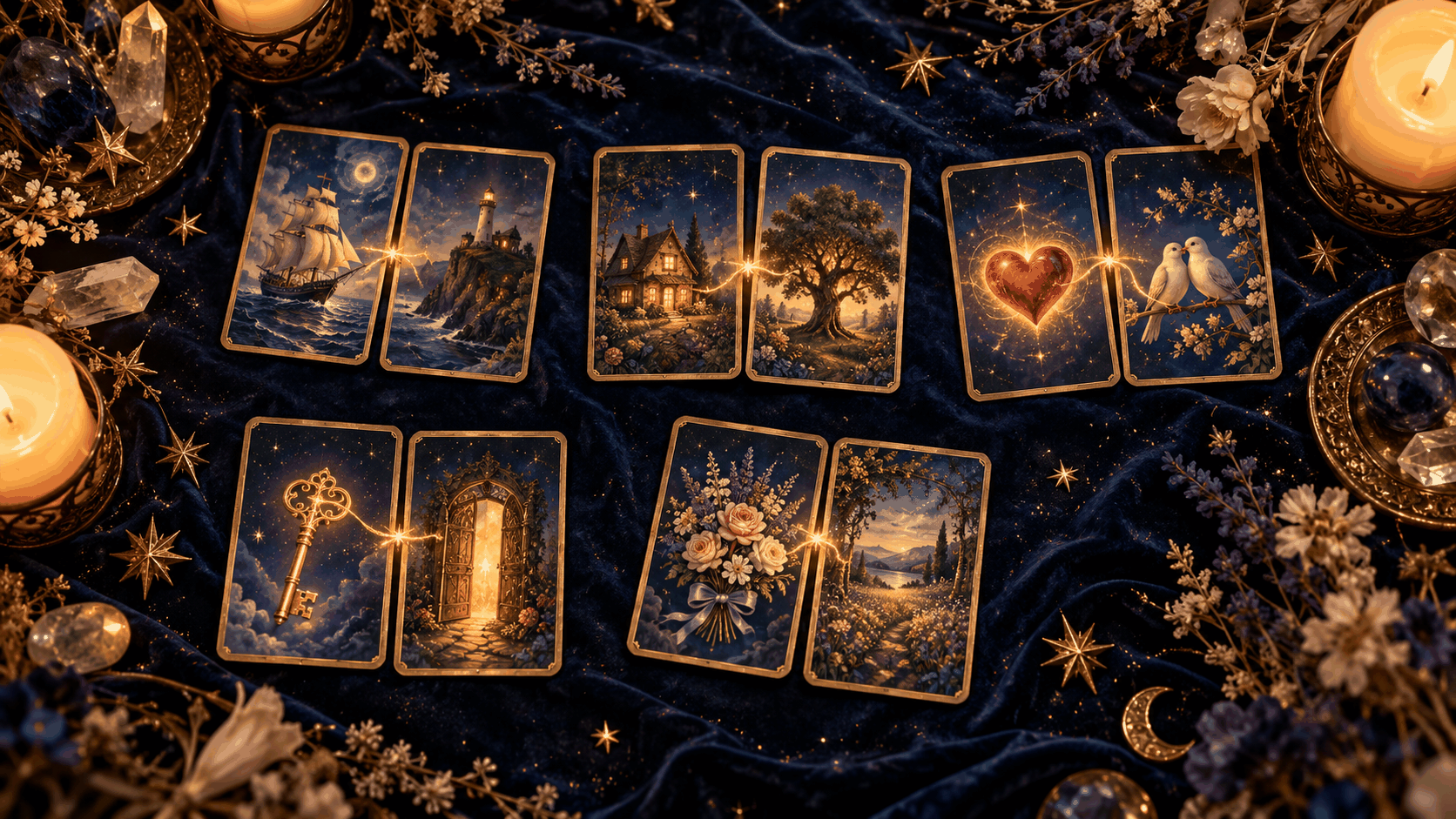
The same two cards, in a different order, shift the emphasis. That is the first habit to build.
A few practical rules
- Read left to right. In a line of three or five cards, read the pairs in order: 1+2, 2+3, 3+4 and so on, then sum up the line as a sentence.
- Let the question set the context. Heart + Bouquet in a love question is a sweet, affectionate gesture. In a question about a gift for a friend, it can simply mean a heartfelt present.
- Some cards modify more than they describe. Small cards such as Mice (reduction, worry), Clouds (uncertainty), Bear (strength, size) and Child (small, new) often act like adjectives wherever they land.
- Not every reader uses the same order. A minority read the second card as the subject. Choose one method and stay consistent; consistency is what makes your readings clear.
A quick worked example
Question: "How will my new job go?"
Cards: Tree + Garden + Sun
- Tree + Garden: slow, steady growth (Tree) in a public or social setting (Garden).
- Garden + Sun: the social side is successful and warm.
- Line: a job that grows gradually, with good connections and visible success.
Notice how no single card says all of that. The combination does.
The Man and the Woman: Reading Combinations With Significators
In Lenormand, card 28 is the Man (Gentleman) and card 29 is the Woman (Lady). Traditionally, one of them represents the person asking (the querent), and the other represents a partner or another important person.
Many readers also look at which way the figures face. The card in front of the face is what the person is looking at or focused on; the cards behind can be what they're leaving behind or not seeing. Different decks draw the figures facing different directions, so check your own deck.
Man combinations
These are some of the most common man Lenormand combinations:
| Combination | Common meaning |
|---|---|
| Man + Heart | a loving man; his feelings are involved |
| Man + Ring | a committed or married man; a man in a contract |
| Man + Fox | a man who is cunning, or who works in a tactical role; read the context carefully |
| Man + Dog | a loyal friend; a trustworthy man |
| Man + Tower | a distant or reserved man; a man linked to an institution or authority |
| Man + Rider | a man arriving, or a man who moves quickly |
| Man + Clouds | a confused or moody man; he is unsure |
| Man + Bear | a strong, protective or powerful man; a boss |
| Man + Ship | a man far away or traveling; a foreign man |
| Man + Book | a secretive man, or one who is studying |
| Man + Lily | an older man; a calm, mature man |
| Man + Child | a younger man; a man with a child |
Woman combinations
| Combination | Common meaning |
|---|---|
| Woman + Heart | a loving woman; her feelings are open |
| Woman + Ring | a committed woman; she wants commitment |
| Woman + Bouquet | a charming, kind woman; a gift for her |
| Woman + Snake | a complicated woman; a rival; a woman with a winding plan |
| Woman + Stars | a woman with hopes and clarity; a spiritual woman |
| Woman + Moon | a recognized or emotional woman; she is in her feelings |
| Woman + Key | an important woman; she holds the answer |
| Woman + Garden | a social woman; she is out in public |
Man and Woman together
When both appear in a love spread, look at what sits between them:
- Man + Heart + Woman: love connecting them.
- Man + Mountain + Woman: an obstacle or distance between them.
- Man + Ring + Woman: commitment or an agreement linking them.
- Man + Clouds + Woman: misunderstanding or confusion between them.
- Man + Crossroads + Woman: a decision about the relationship.
If you are asking what a particular person feels or thinks about you, our guide What Does He Think About Me? Lenormand shows how to build a full reading around these figures.
Love Lenormand Combinations
Love questions are where Lenormand pairs shine. Here are combinations readers use often:
| Combination | Common meaning in love |
|---|---|
| Heart + Ring | committed love; an engagement or serious relationship |
| Heart + Rider | new feelings arriving; someone approaching |
| Heart + Letter | a love message; feelings put into words |
| Heart + Bouquet | affection, romance, a sweet gesture |
| Heart + Mountain | love that is blocked or delayed |
| Heart + Clouds | mixed or unclear feelings |
| Heart + Coffin | feelings ending; heartbreak, or a pause |
| Heart + Mice | love that is fading or worn down by worry |
| Heart + Tower | feelings held at a distance; guarded love |
| Heart + Anchor | stable, lasting love |
| Ring + Crossroads | a relationship at a decision point; uncertainty about commitment |
| Ring + Scythe | a sudden break in a commitment |
| Ring + Stork | the relationship moving to a new stage |
| Snake + Heart | complicated desire; jealousy or a love triangle only if other cards support it |
| Moon + Heart | romantic, emotional attraction |
| Birds + Heart | lots of talking about feelings; nervous excitement |
| Lily + Heart | mature, peaceful or sensual love |
| Sun + Heart | happy, warm, confident love |

A gentle reminder: no combination is a verdict on a real person. Snake + Heart doesn't prove a third person exists, and Coffin + Heart doesn't sentence a relationship to end. Read them as themes to explore, and weigh them against what you actually know.
For a guided love spread built around these pairs, you can try GOOD TIMING's Love Lenormand reading.
Career and Work Lenormand Combinations
For work questions, look for the Fox (job, work strategy), Bear (boss, authority), Tower (company, institution), Book (study, projects) and Anchor (stability, long-term work).
| Combination | Common meaning at work |
|---|---|
| Fox + Anchor | a stable job; long-term employment |
| Fox + Sun | success at work; a job that suits you |
| Fox + Coffin | a job ending; leaving a role |
| Fox + Stork | a job change; a new position |
| Fox + Rider | news about a job; an interview or offer |
| Fox + Mountain | blocked progress at work |
| Tower + Bear | a big company; senior management |
| Bear + Clouds | an unclear or moody boss |
| Book + Key | learning that unlocks a solution; passing an exam |
| Letter + Ring | a written contract; a signed agreement |
| Garden + Birds | networking; a meeting or conference |
| Crossroads + Fox | a choice between job options |
| Ship + Fox | work abroad; a job involving travel |
| Anchor + Clover | a lucky break in a stable situation |
Money Lenormand Combinations
The Fish is the main money card. The Bear often shows savings or larger sums, and the Mice show loss or slow drain.
| Combination | Common meaning for money |
|---|---|
| Fish + Sun | good income; financial success |
| Fish + Clover | a small, lucky gain |
| Fish + Bear | savings; a substantial amount |
| Fish + Mice | money leaking away; overspending or loss |
| Fish + Mountain | blocked or delayed money |
| Fish + Ring | a financial contract; a regular payment |
| Fish + Anchor | stable, reliable income |
| Fish + Coffin | financial loss, or the end of an income stream |
| Fish + Key | a solution to money problems |
| Fish + Letter | a bill, invoice or payment document |
| Fish + Fox | income from work, or a need to be careful with deals |
| Fish + Stars | money goals; growth through planning |
As with every money reading, cards can point to patterns, but they are not financial advice. Use them to reflect, then make decisions with real numbers.
Timing Cards in Lenormand
People often ask Lenormand "when?" There is no single universal timing system, and different readers use different methods. These are the associations you'll see most often:
Fast cards
- Rider: quick, soon, news on its way
- Scythe: sudden, abrupt
- Whip: repeated, back-and-forth, can be fast
- Birds: short-term, a flurry of activity
Slow cards
- Tree: slow growth; months rather than days
- Mountain: delay, waiting
- Anchor: long-lasting, settled; things stay as they are
- Coffin: a pause before anything new can begin
Seasonal and cyclical cards
- Sun: daytime; summer; a bright, clear period
- Moon: evening; often read as about a month, or a full emotional cycle
- Stars: night; also a sense of the far future
- Stork: a change of season, especially spring for some readers
Timing combinations
- Rider + Sun: good news soon
- Mountain + Tree: a long, slow wait
- Scythe + Letter: a sudden message
- Moon + Ring: a commitment around a month away, or a cyclical agreement
- Anchor + Coffin: a long pause; something staying stuck before it ends
Some readers also use the card numbers (for example, Ship is card 3, so "three days or weeks"), or the playing-card insets in the corners. Treat timing as a rough sense of pace, not a calendar date. If timing is your main question, our Tarot Timing Reading explores pace and windows from another angle.

Lenormand Combinations for Finding Things
Lenormand is also famously practical. Readers use combinations to describe places and objects:
- Key + House: the key is somewhere at home
- Ring + Garden: the ring is in a public space or garden
- Letter + Book: a document tucked inside something else, a folder or drawer
- Mice + Garden: something taken or lost while out
- Rider + Ship: something that has traveled; in a car or bag
We go much deeper on this in How to Use Lenormand Cards to Find a Lost Object, with a step-by-step spread.
Common Mistakes When Reading Lenormand Pairs
Even experienced readers fall into these habits:
- Reading every card alone. If you list 5 separate meanings, you haven't read the combination yet. Join them into one sentence.
- Switching methods mid-reading. If the first card is your subject, keep it that way for the whole spread.
- Ignoring the question. "Ship" in a love question may be emotional distance; in a travel question, it's an actual trip.
- Panicking over "negative" cards. Coffin, Scythe and Cross carry heavy themes, but they often describe endings that make room, sharp decisions, or burdens you can put down.
- Over-reading people. Combinations describe energy and situations. They can't verify what someone is secretly doing.
- Skipping the summary. After reading pairs, step back and say the whole line out loud in plain language.
How to Practice Lenormand Combinations
The fastest way to get comfortable is little and often:
- Daily pair: each morning, draw two cards and write one sentence about the day ahead. In the evening, note what actually fit.
- Flip the order: read the same pair both ways (A+B and B+A) and notice how the emphasis changes.
- Line of three: move on to three-card lines and practice reading them as a story: situation, development, outcome.
- Build your own dictionary: when a pair lands clearly in real life, write it down. Your personal notes will become more useful than any list.
- Read with support: an online spread can help you practice with clear positions.
GOOD TIMING's Lenormand Reading lets you draw a spread online and see how the cards connect, which is a nice way to practice pair reading without shuffling a physical deck. You can also start with a quick free tarot reading if you'd like a different perspective on the same question.
Frequently Asked Questions
How do you read Lenormand combinations?
Most readers treat the first card as the subject (noun) and the second card as its description (adjective). Read pairs left to right, keep the question's context in mind, and then summarize the whole line as one sentence.
Does the order of Lenormand cards matter?
Yes, for most readers. House + Clouds (an uncertain home) feels different from Clouds + House (worry that sits at home). Some readers use the reverse order; the key is to choose one method and use it consistently.
What does the Man card mean in Lenormand combinations?
The Man (card 28) usually represents the querent if he is a man, or an important man in the querent's life, such as a partner. The cards next to him describe his traits, feelings or situation, for example Man + Heart for a loving man or Man + Ship for a man far away.
What are the best love combinations in Lenormand?
Heart + Ring (committed love), Heart + Anchor (stable, lasting love), Heart + Bouquet (affection and romance) and Sun + Heart (happy, confident love) are among the most positive. Always read them in context with the rest of the spread.
How do you tell timing with Lenormand cards?
There is no single official system. Many readers see the Rider and Scythe as fast, the Tree, Mountain and Anchor as slow, and the Sun, Moon and Stars as day, month and night clues. Some also use card numbers. Treat timing as a rough sense of pace.
How many cards should I combine in Lenormand?
Start with pairs. Once that feels natural, move to lines of three or five cards, then the 9-card box, and eventually the full 36-card Grand Tableau.
Can Lenormand combinations predict what someone is doing?
They can describe themes and dynamics, but they can't verify facts about another person. Use them to reflect on the situation and your own choices, not as proof of someone else's actions.
Final Thoughts: Let the Cards Finish Each Other's Sentences
Lenormand rewards patience in a very particular way.
At first, you look up every card. Then, slowly, you begin to hear them: Rider + Letter as a message on its way, Heart + Anchor as something steady, Clouds + Crossroads as a decision you haven't made yet.
No list will ever cover every combination, and it doesn't have to. Once you understand the rule (subject first, description second) and you keep your question clear, the cards start telling their own small, precise stories.
One card is a word. Two cards are a sentence. And your question is what gives the sentence its meaning.