The less defined a connection is, the easier it is to keep circling back to one question: What does he really think about me?
Maybe you are in a situationship where the interaction is clearly there, but nobody has named what the relationship is. Maybe contact has suddenly slowed down and you cannot tell whether he is simply busy, watching from a distance, or actively pulling away. If this is an ex or a no-contact connection, the question may be slightly different: when he looks back at what happened between you, does he still place this connection in the same part of his emotional world?
Lenormand is especially useful for questions like this because its symbols are concrete. People, affection, messages, distance, obstacles, choices and movement can show different layers of the same connection: how he sees you, how he defines the relationship, how emotionally invested he is, whether those thoughts are turning into contact or action, and what direction he appears to be leaning toward next.
Put those layers together, and the answer becomes much more specific than a simple yes or no.
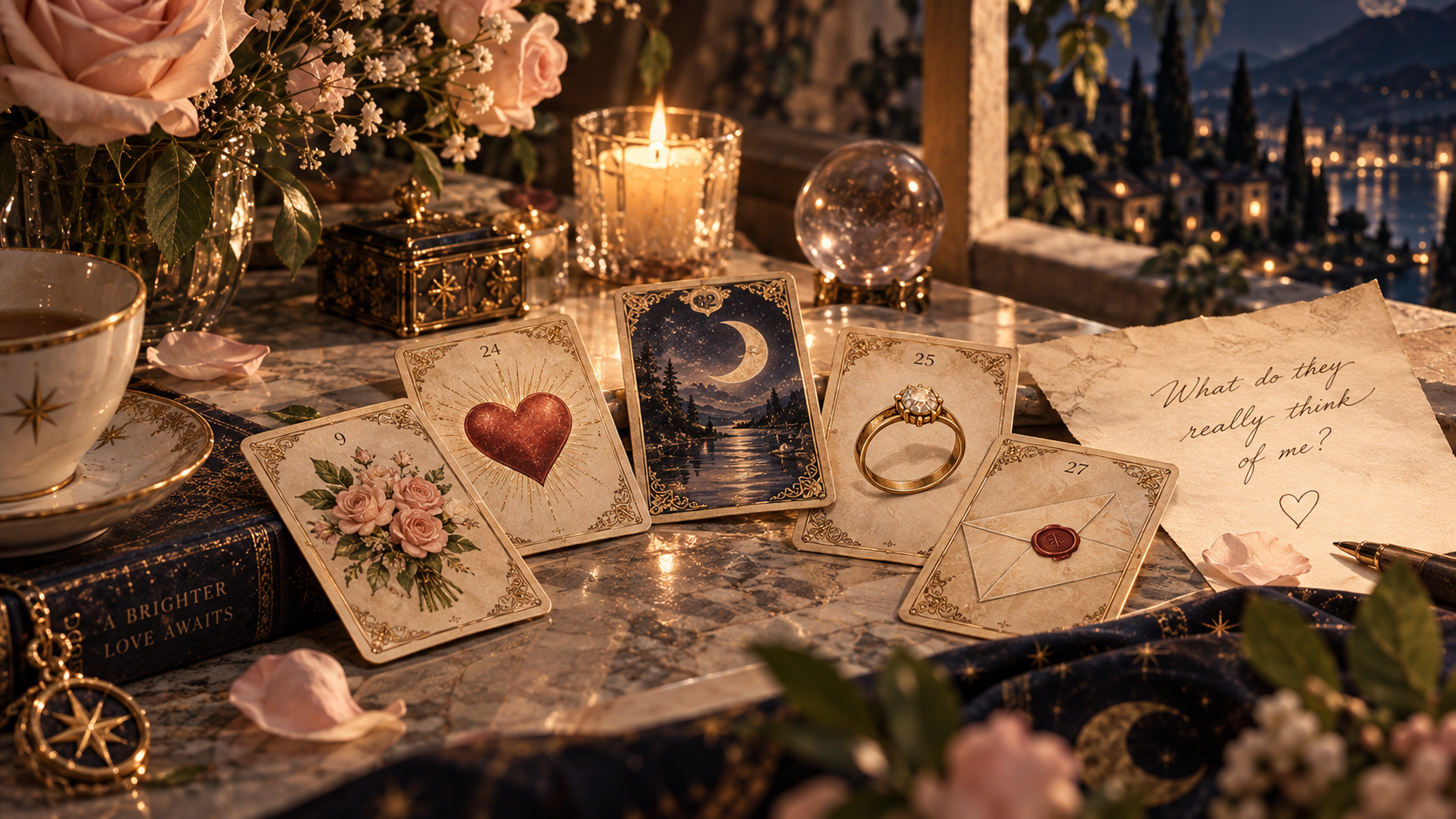
1. What kind of person are you in his eyes?
One of the most direct layers of “What does he think about me?” is the impression you currently make on him.
This is not necessarily your entire personality. It is the side of you that stands out most strongly inside this particular connection.
When Bouquet appears, attraction, charm, liking and ease tend to come forward. He may see you as pleasant to be around, appealing, or simply someone whose presence feels good. With Heart beside it, that appreciation takes on a more clearly emotional tone. With Tower, the mood changes: the attraction may still be there, but it comes with distance or a sense that you are not especially easy to approach.
Moon works well for admiration, emotional projection and being noticed. It can suggest that you occupy more than a casual place in his emotional awareness. With softer cards such as Heart or Bouquet, that admiration may feel warm and natural. With Clouds, it can become more idealized, uncertain, or colored by the sense that he has not fully figured you out yet.
Bear can make strength, competence, presence and resourcefulness stand out. In an impression question, Bear may show that he sees you as capable, self-possessed or difficult to sway. Bear with Tower can amplify independence and power; Bear with Bouquet can look more like someone impressive, substantial and attractive at the same time.
Fox brings intelligence, caution, observation and strategy into the picture. It does not automatically mean deception. In this context, it may simply show that he sees you as someone who does not reveal everything immediately, or that he is still trying to work out what you really think.
Child can bring youthfulness, freshness, directness or simplicity. It can also indicate that his impression of you is still developing because the connection itself is relatively new. Child with Rider or Clover feels lighter and more spontaneous; Child with Clouds can show that his picture of you has not fully formed yet.
So this layer is not about assigning one adjective to one card. The useful question is: Which card describes the dominant impression, and what do the surrounding cards add to it?
2. Where does he place this relationship?
Sometimes “What does he think about me?” is really asking something else:
What does he think we are?
This is about relationship positioning — whether the connection has a relatively clear place in his mind.
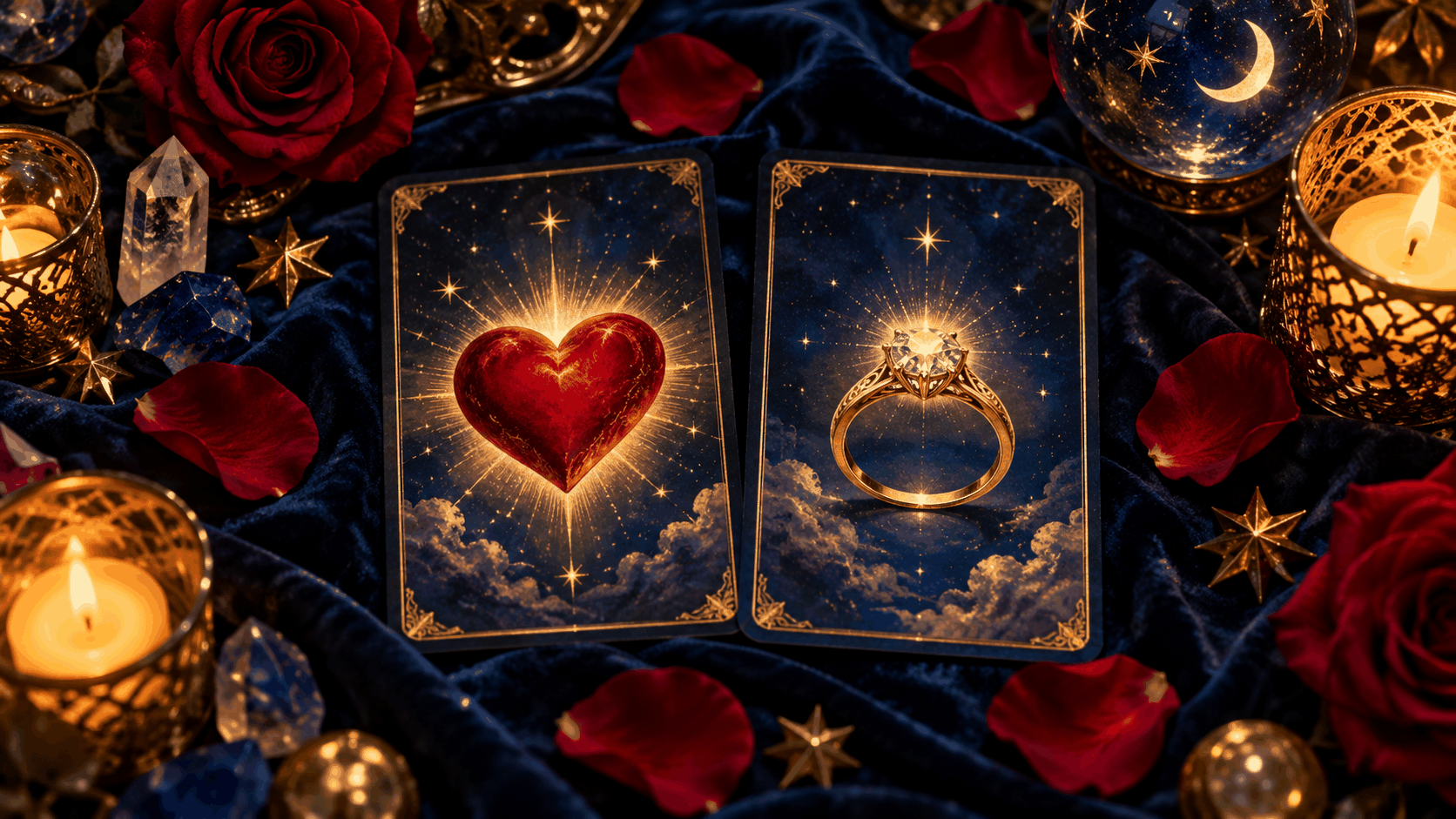
Ring is especially important here because it speaks to connection, agreement, continuity and relationship form. Heart + Ring places feelings and the relationship itself in the same frame, which carries more relational weight than Heart alone. Ring + Anchor strengthens continuity, stability and something that remains in place. Ring + Crossroads can show that the bond exists, but its next definition or direction has not been decided.
Dog brings trust, familiarity, loyalty and steady companionship. In relationship-positioning questions, it can show that you are someone he trusts and expects to remain part of his life. In a situationship, however, Dog raises a useful distinction: is this connection currently functioning more like dependable friendship, or are Heart, Moon and Ring pushing it into a more explicitly romantic space?
House emphasizes familiarity, safety, everyday presence and structure. It can suggest that the connection has moved beyond a passing attraction and started to feel woven into ordinary life. House with Ring strengthens stability and continuity; House with Clouds can mean the familiarity is real, but the definition of the relationship is still unclear.
Tower often adds independence and distance. Two people may care about each other while still standing firmly in separate spaces. It can also show that he currently places the connection behind a boundary rather than inside a fully mutual relationship.
Clouds and Crossroads are both highly informative in undefined relationships. Clouds makes the label itself unclear; Crossroads brings choice and direction into focus. Together they can describe exactly the kind of connection where “there is clearly something here, but nobody has decided what it becomes next.”
This layer helps answer a more practical question than “Does he like me?”:
Does he place you as a friend, a trusted person, a romantic possibility, a developing relationship, or a connection that is still being kept at a distance?
3. How emotionally invested is he?
If the question is very direct:
“What does he feel for me?”
then drawing Heart is already a fairly clear emotional signal.
In dating, romance, a situationship, or any connection where emotional chemistry already exists, Heart usually does not need to be explained away. It speaks directly to affection, liking, emotional investment and closeness. The next question is: What condition are those feelings currently in?
Heart + Ring
Feelings and relationship meaning are emphasized together. This carries more continuity and relational significance than Heart alone.
Heart + Rider
Feeling begins to take on movement. There may be a desire to approach, express something, or move emotion from the internal world into visible action. If the connection has felt stalled, this pair is especially worth noticing.
Heart + Letter
Emotion and communication connect directly. It can suggest wanting to say something, write, reach out, or give feelings a more concrete form.
Heart + Tower
The feeling exists, but so does distance. He may still care while maintaining space, boundaries, or emotional separation.
Heart + Mountain
Emotion and obstruction coexist. Mountain does not erase Heart; it shows that those feelings are meeting delay, practical barriers, timing problems, or something that is difficult to move through quickly.
Heart + Snake
The emotional picture becomes more complicated. Snake can bring desire, temptation, indirectness, jealousy, competition or motives that are not simple or linear. It does not automatically mean a third party. Whether the combination points to intense attraction, a complicated dynamic or something that requires caution depends on the rest of the spread.
Heart + Clouds
Feelings are present, but they are not fully clear or settled. He may still be sorting through them, or liking and doubt may be operating at the same time.
When Moon appears, it can add emotional sensitivity, admiration, attraction or idealization. Moon + Heart can deepen emotional involvement; Moon + Clouds can show that the connection is genuinely affecting him emotionally while the meaning of those feelings remains unstable.
So the real question is not only “Are there feelings?” but:
Are those feelings stable, moving closer, held at a distance, blocked, or traveling through a more complicated path?
4. Are those thoughts turning into contact or action?
Someone can feel something and think about you without actually sending a message, moving closer or advancing the relationship. Action is another layer.

If your real question is:
“Will he contact me?”
communication and movement cards become much more important.
Letter is one of the clearest cards for messages, written communication, notifications and concrete contact. When the question itself is about reaching out, its appearance matters.
Birds leans more toward conversation, back-and-forth exchange, repeated thoughts and sometimes a nervous or unstable communication rhythm. It can describe two people talking a lot, or simply a subject that keeps circling in someone’s mind.
Rider brings movement and incoming news. It often makes something that was previously only a thought feel as though it is beginning to move outward.
Heart + Letter
Feelings are entering the realm of expression. This is closer to “wanting to say something” than Heart alone.
Letter + Rider
Communication and movement reinforce each other. Reaching out, incoming news or renewed contact becomes more active.
Birds + Letter
This can describe chatting, repeated messages, an ongoing exchange, or communication that still feels restless and unsettled.
Rider + Heart
Movement and feeling combine. If the question is whether he is moving toward you, this carries more action than Heart by itself.
Letter + Mountain
Communication faces delay or obstruction. There may be something to say, but actually sending it or opening the conversation does not happen smoothly.
Birds + Clouds
There may be plenty of thoughts or conversation, but the message remains inconsistent or uncertain. One version today, another tomorrow.
Rider + Tower
There is movement, but with distance and restraint. Contact may happen without immediately becoming warm, intimate or fully open.
So a question about contact should not be answered by emotional cards alone. What matters is:
Do communication cards appear? Is movement supported? And are Mountain, Tower or Clouds slowing the action down?
5. What direction is he leaning toward next?
Once you have looked at his impression of you, the relationship position, emotional involvement and communication, the next question is naturally:
Is this connection actually moving?
This is where direction and transition cards become especially useful.
Crossroads brings choice, two directions and the need to decide what happens next.
Stork often points to a change of state, adjustment or movement from one phase into another.
Ship describes a process of movement that unfolds over time — approaching, leaving or progressing across distance.
Anchor adds stability and something that remains fixed, though it can also show a situation staying the same for a long time.
Mountain slows the pace and highlights delays, obstacles and practical conditions.
Coffin can show that a phase is ending, pausing or changing form before anything new can begin.
Rider is a direct movement signal and often gives the sense that something is beginning to stir.
Ring + Stork
The form of the relationship is changing. In a situationship, the connection may be moving toward a new definition; in an established relationship, it may signal the next phase.
Ring + Anchor
Continuity and fixedness are strong. This can be a stable bond, or a relationship that has settled into the same pattern for a long time.
Ring + Mountain
The relationship still exists, but progress is difficult. It fits the feeling of “not over, but not really moving either.”
Crossroads + Rider
Choice and movement sit close together. A decision may be followed by visible action fairly quickly.
Coffin + Stork
An old phase closes and another state begins to form. This does not automatically mean the entire relationship ends; sometimes the old way of relating has simply reached its limit.
Mountain + Rider
Movement wants to happen, but the pace is slow. Something may be shifting, just not as quickly as expected.
For exes or no-contact situations, this layer matters especially because it separates “Are there still feelings?” from “Is the relationship itself actually beginning to move?”
How should you ask about a situationship, no contact, or an ex?
The same question — “What does he think about me?” — can mean something different depending on the stage of the relationship.

Situationship
Situationship readings work especially well when you look at attraction, relationship positioning and movement.
Useful questions include:
- Where does he currently place me in his life?
- Is this situationship moving toward a clearer form?
- Is his current attitude closer to approaching, observing, or keeping distance?
- What is actually preventing this connection from becoming clearer?
If Heart, Bouquet and Moon are strong but Crossroads and Clouds appear too, the pattern can fit “there is attraction, but the label and next step are still unresolved.”
No Contact
With no contact, communication and distance become more important.
You can ask:
- What is currently maintaining the no-contact situation?
- Is there still movement in this connection?
- Is he showing any tendency to reopen communication?
- Is the distance becoming more fixed, or beginning to loosen?
If Heart remains present while Letter and Rider are weak and Mountain or Tower dominate, the spread may show that emotion is still there while action has not caught up.
Ex / Reconciliation
Reconciliation adds another layer: Have the patterns that caused the breakup actually changed?
Useful questions include:
- What is still keeping us connected?
- Has the issue that separated us changed?
- If we reconnect, what are we most likely to run into again?
- Does this connection currently have the conditions needed to rebuild?
Ring, Heart and Stork together can bring connection, feeling and change into the same picture. Ring with Mountain or Clouds can show that the bond remains, while older obstacles are still unresolved.
How can you ask clearer Lenormand relationship questions?
The more focused the question, the easier it is for the cards to form a coherent sentence.
If you want to understand how he sees you, ask:
- How does he currently see me?
- What is his main impression of me right now?
- What place do I hold in this connection from his perspective?
If you want to look at feelings:
- What state is his emotional investment in right now?
- Are these feelings moving closer, staying where they are, or meeting resistance?
If you want to look at contact:
- Is he showing a tendency to initiate communication?
- What is currently blocking contact between us?
- Is there movement around communication in the near term?
If you want to look at what comes next:
- What direction is this connection moving in?
- Where is the next meaningful change likely to appear?
- What is currently shaping the direction of this relationship most strongly?
Questions like these give the spread a clearer frame, so the combinations can do real work instead of trying to compress the entire relationship into “Does he love me or not?”
One Lenormand spread can show several layers of the same relationship
Feelings, thoughts, contact, action and relationship outcomes can all exist at the same time, but they do not always move at the same speed.
Someone may have feelings while keeping distance. He may reach out without being ready for commitment. He may think about you often while the real-world relationship remains unchanged.
That is where Lenormand becomes especially useful: different cards can separate those layers.
Heart shows whether emotion is central. Ring adds continuity and relationship definition. Letter, Birds and Rider make communication and movement more concrete. Tower, Mountain and Clouds reveal distance, obstacles and uncertainty. Crossroads, Stork and Ship show whether the connection is entering a period of choice or change.
When those cards begin to work together, the answer becomes much more complete than:
“He still thinks about you.”
You begin to see:
how he sees you, where he places the connection, whether feelings are present, whether action is beginning, and what direction may be opening next.
Use Lenormand to see how he sees you now
If there is someone on your mind — a situationship, a current relationship, an ex, a no-contact connection, or something that has never been clearly defined — start with the part you most want to understand.
You do not have to ask every question at once. Read how he sees you first, then decide whether you want to explore feelings, contact, or the next stage.