Your ring is missing.
You have checked yesterday's bag, the nightstand, the desk, and the pockets of your jacket. Some places have already been searched twice, yet the object still seems to have disappeared.
This is one of the situations where Lenormand can become surprisingly practical.
In a lost-object reading, the cards do not need to become abstract life lessons. Book may genuinely point toward books, documents, a drawer, or something trapped between other objects. Tower may send you toward shelves, high cabinets, elevated surfaces, or an isolated corner. Mice can suggest a tiny gap, clutter, a low position, or something that is close by but frustratingly easy to overlook.
You also do not need to overcomplicate the question.
If you lost a ring, ask:
Where is my silver ring?
If you lost your AirPods, ask:
Where are my AirPods?
The target is already clear. Let the cards describe the environment, what is nearby, whether the object is high or low, whether it is hidden, how it may have moved, and where you should search first.
Lenormand will not give you GPS coordinates.
What it can give you is a surprisingly useful search map.
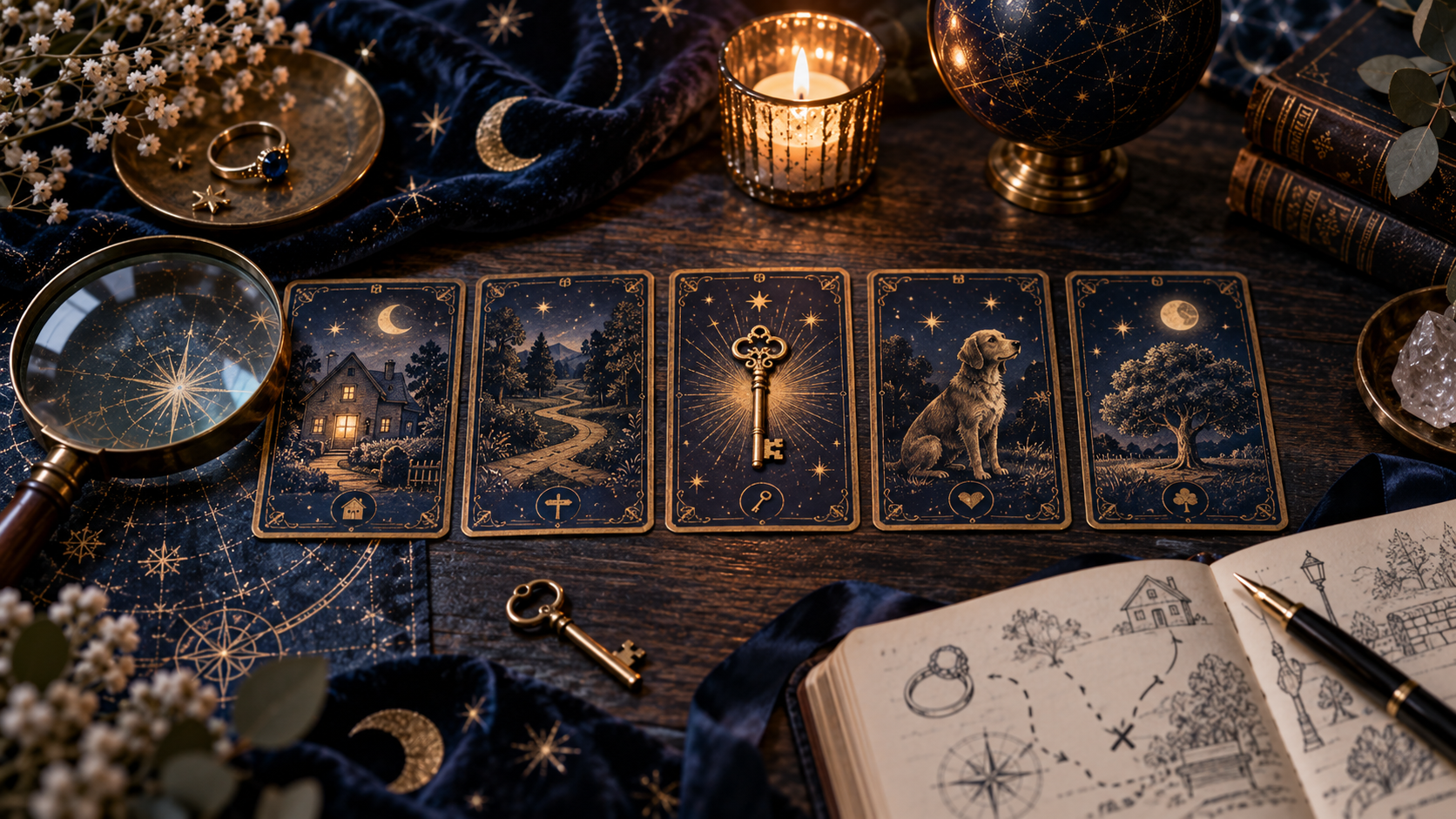
A Practical Five-Card Lenormand Lost Object Spread
For an everyday missing object, you usually do not need a huge spread. Five cards can reduce the search from “somewhere in the house” to a handful of places worth checking.
| Position | What it answers |
|---|---|
| 1 · Environment | What kind of place, room, or setting is it in? |
| 2 · Nearby clue | What noticeable object, material, or feature is close to it? |
| 3 · Physical position | High or low? Inside or outside? Covered, trapped, or visible? |
| 4 · How it got there | Was it carried, dropped, put down absentmindedly, moved with something else, or never moved at all? |
| 5 · Search here first | Where should you physically check first? |
The fourth card is especially useful.
Many lost objects are not well hidden—they have simply moved. You may keep searching the bedroom for your earbuds when the real story is that they traveled with a different bag into the living room. Your keys may not have fallen anywhere; you may simply have put them in an unusual place when you came home.
The fifth card should bring the whole reading back into the physical world.
It should not become another paragraph of symbolism. It should help you reach a sentence like:
Check here first.
That is what makes a lost-object spread useful.
When Searching, Ask: “What Kind of Place Does This Card Look Like?”
In an ordinary Lenormand reading, it is natural to begin with traditional meanings.
Ship can mean distance, travel, or movement. Tree can represent health, roots, or long-term development. Book can represent knowledge, secrecy, or hidden information.
For a lost object, try reversing the order of interpretation.
First ask:
If this card were describing a real physical space, what could it be?
Suppose you are looking for earbuds and draw Ship.
Think literally about movement. Did you take them outside? Could they be in the car? Are they inside yesterday's bag, luggage, a delivery bag, or something that moved from one room to another?
If you draw Tree, do not begin with “long-term growth.” Look for wooden furniture, a desk, cabinet, plants, a planter, a garden, or another area associated with wood and vegetation.

For lost objects, the literal layer often becomes more useful than the philosophical one.
One Card Can Give You Several Physical Clues
A useful lost-object practice is not about assigning one location keyword to all 36 cards.
Instead, read several physical dimensions at once: place, nearby objects, height, concealment, movement, and visibility.
Environment
House naturally keeps the search around the home, a room, furniture, or private indoor space.
Garden can point toward a balcony, yard, lobby, shared space, café, outdoor area, or somewhere semi-public.
Fish may connect with a wallet, handbag, money, kitchen, sink, drinking glass, or places associated with water and liquids.
Ship is particularly useful for checking the car, luggage, travel bags, packages, and anything recently carried out and brought back.
Height and Relative Position
Tower is worth checking against high cabinets, shelves, tops of furniture, and isolated elevated areas.
Mice often suggests lower positions, small spaces, narrow gaps, underneath clothing, or mixed into clutter.
Mountain works well for physical obstruction: the object may be behind something, underneath another item, or somewhere difficult to reach.
Concealment
Sometimes an object is not far away at all—it is simply outside your line of sight.
Book can describe something closed, inserted, covered, or placed inside: drawers, folders, book stacks, underneath paper, or inside a bag.
Coffin can suggest fully enclosed storage such as boxes, cases, drawers, containers, or dark spaces.
Clouds is often more like visual confusion. The object may be right there, but it blends into everything around it and your eyes keep passing over it.
Nearby Objects
Letter can take you toward paperwork, files, notebooks, desks, mail, or office supplies.
Key may indicate an entrance, door, lock, key tray, or a place where important small items are stored.
Tree may point toward wooden furniture or plants.
Anchor can suggest a permanent workstation, heavy furniture, or an area where you repeatedly sit or work.
Once the cards tell you:
low + concealed + near paperwork
you may not need an exact coordinate.
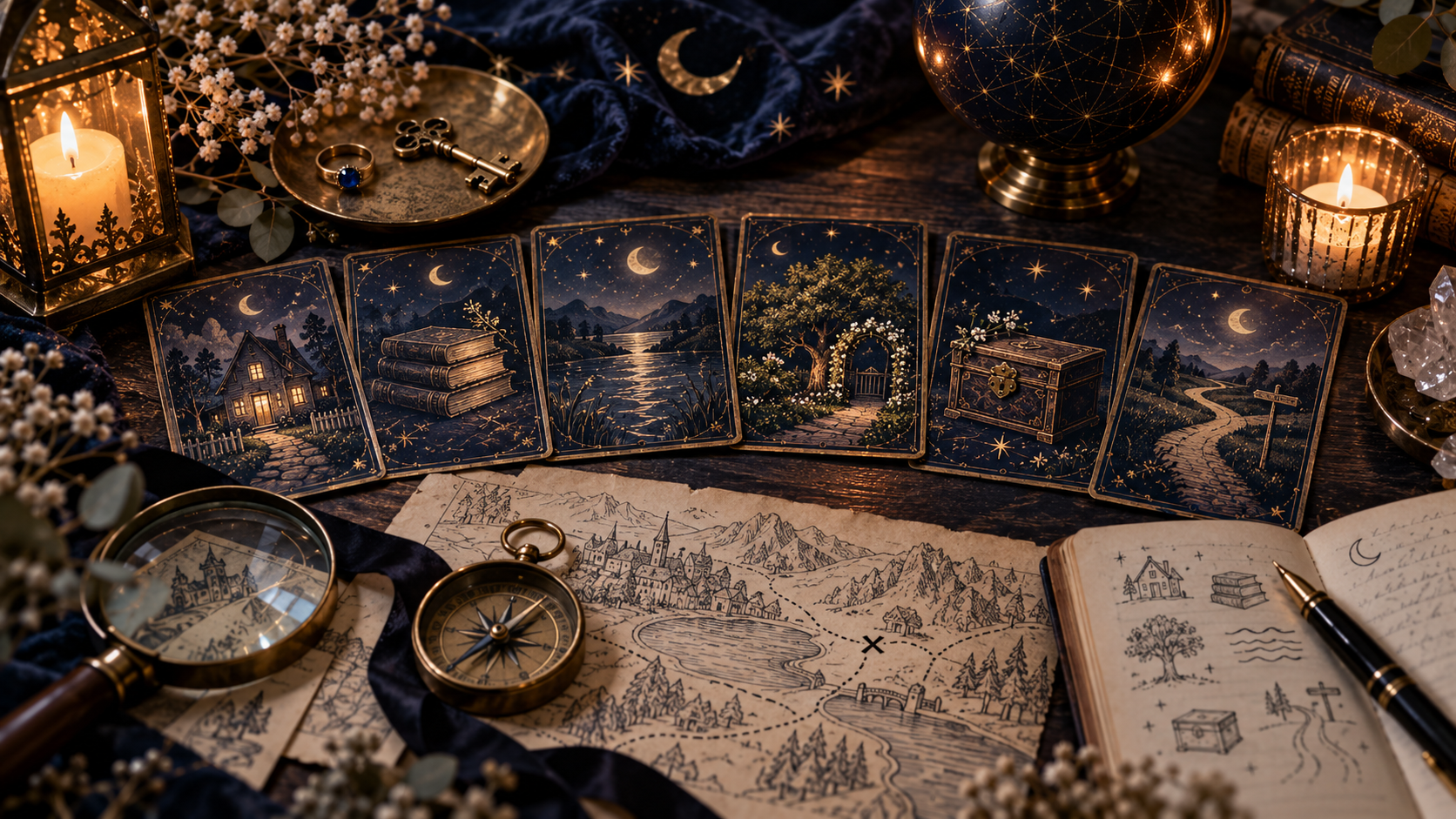
Combinations Are What Make the Search Useful
A single card gives you one piece of the map. Multiple cards can become a physical search instruction.
House + Book + Mice
Read it first as:
indoors + stored/covered + small, low, cluttered
Start with drawers, underneath documents, beside books, small bag compartments, narrow gaps, edges of furniture, and anything hidden under clothing or clutter.
Ship + Letter + Fox
Ship suggests movement. Letter pulls the search toward papers, documents, or a desk. Fox can work well with practical or work-related spaces.
Rather than discussing whether Fox is “clever,” check the work bag, laptop bag, car, desk drawers, recently carried folders, or delivery packaging.
Tower + Clouds + Key
This can read as:
high or isolated + obscured + entrance/important storage area
Check higher storage near the entryway, tall cabinets, a key tray hidden under other objects, or elevated surfaces near a door.
Garden + Crossroads + Rider
This combination strongly suggests movement during arrival or departure.
Think about the building lobby, entrance, parking area, balcony, hallway, or the place where you put things down immediately after coming home.
The goal is not to memorize these combinations.
The real skill is asking:
What space does the first card establish? What physical clue does the second card add? How does the third narrow the search?
Once you understand that process, you can work with any combination.
The Artwork Itself Can Become a Search Clue
Lost-object readings are one of the few situations where details in your specific card artwork can become useful evidence.
If several cards contain strong red elements, do not automatically interpret red as passion, action, or fire. Look around the real search area. Is there a red coat, red bag, red box, red book, or red bedding?
If wooden structures repeat across the cards, check wooden desks, shelves, and cabinets. If water, glass, or blue surfaces keep appearing, consider the kitchen, bathroom, sink, drinking glasses, or another watery area.
You can even look at composition. Is the main object high or low in the image? Is it blocked by another object? Do you repeatedly see doors, windows, fabric, desks, or containers?
You do not need to turn every decorative line into a clue. Pay attention to visual details that repeat and genuinely correspond to your physical environment.
If the First Reading Is Vague, Do Not Immediately Start Over
Suppose your first draw is:
House + Book + Mice
You may think:
“My home is huge. How does that help?”
The temptation is to shuffle again and pull five more cards.
That usually creates more noise.
The first spread already told you something important:
indoors + concealed + small/cluttered
Do not erase that information. Ask only what is still unresolved:
Which part of the home should I search first?
Once the area is narrower, you can ask whether the object is higher or lower, or what nearby object is most distinctive.
Each follow-up should make the search area smaller. If every new draw creates even more possible locations, the question is probably becoming less focused rather than more useful.

A Full Example: Where Is My Silver Bracelet?
Imagine asking:
Where is my silver bracelet?
You draw:
House — Letter — Mice — Mountain — Key
Do not turn the five cards into five separate essays. Follow the search logic.
House keeps the search around your home or another familiar indoor space.
Letter suggests paperwork, notebooks, documents, desk supplies, or a work area nearby.
Mice tells you the bracelet is small and easy to miss. It may be low down, mixed into clutter, inside a narrow gap, underneath fabric, or in a tiny compartment.
Mountain strengthens the idea of obstruction. The bracelet may genuinely be underneath another object, blocked from view, or trapped behind something.
Finally, Key points toward an important, habitual location: the entryway, a door, the area where you keep keys, or a drawer where you usually place valuable small items.
Combined, the reading becomes something actionable:
Check the desk, paperwork, and document area at home first. Pay special attention to low spaces, drawers, underneath clutter, and places blocked by other objects. The entryway, key area, or a regular drawer for important small items is also worth checking early.
The cards are not pretending to know that your bracelet sits under the third receipt in the second drawer.
They have done something more useful: changed your search route.
Direction and Distance Can Come Later—But Use One System Consistently
If you enjoy lost-object work, you can eventually add more advanced spatial techniques: whether a significator appears left or right of another card, relative distance, compass directions, Grand Tableau houses, or the number of cards separating two significators.
There is no single directional system universally accepted by all Lenormand readers.
Instead of memorizing ten different charts, choose one method and test it repeatedly against real outcomes.
You can even ask a friend to hide an object somewhere in your home without telling you where. Read for the direction first, then compare the reading with the actual location.
Repeated experiments will tell you much more about how your deck behaves than another list of correspondences.
Build Your Own Lost-Object Record
If you use Lenormand for finding things often, keep five pieces of information each time:
- what was lost
- how you asked the question
- what you drew
- how you interpreted it before searching
- where the object was actually found
After a few readings, patterns may emerge.
Perhaps Tower repeatedly means your bookshelf or tall cabinet. Fish may point to handbags and wallets far more often than bathrooms. Garden may consistently describe your building lobby. Mice may keep appearing when something is underneath clothing, inside a small compartment, or beside furniture.
At that point, you are no longer relying only on somebody else's location list.
You are learning:
how your deck describes your physical world.
That is much more valuable than memorizing another hundred fixed keywords.
Handle Real-World Risk First
If you have lost a bank card, identification, keys, medication, or anything that creates a practical safety or financial risk, take the obvious real-world action first: freeze the card, report the document, address the security concern, or replace anything urgent.
Lenormand is most useful here when it makes you think:
“I haven't seriously checked that place yet.”
It should not make the rest of reality wait for the cards.
Everyday objects such as earrings, rings, keys, and earbuds are excellent things to practice with.
Want to Try It Now?
If you are currently looking for something, write:
Where is my ______?
Then use GOOD TIMING's Five-Card Lenormand Lost Object Spread.
The cards will help you look at:
environment → nearby clue → physical position → how it got there → where to search first
The goal is not to produce a mysterious answer.
It is to finish the reading knowing:
where to look next.