Read a three-card Lenormand spread by connecting the cards around one question, not by collecting three unrelated definitions. Start with the agreed positions, read the two adjacent pairs, then explain what the complete line suggests. A small spread can give a clear judgment without pretending to contain a complete biography.
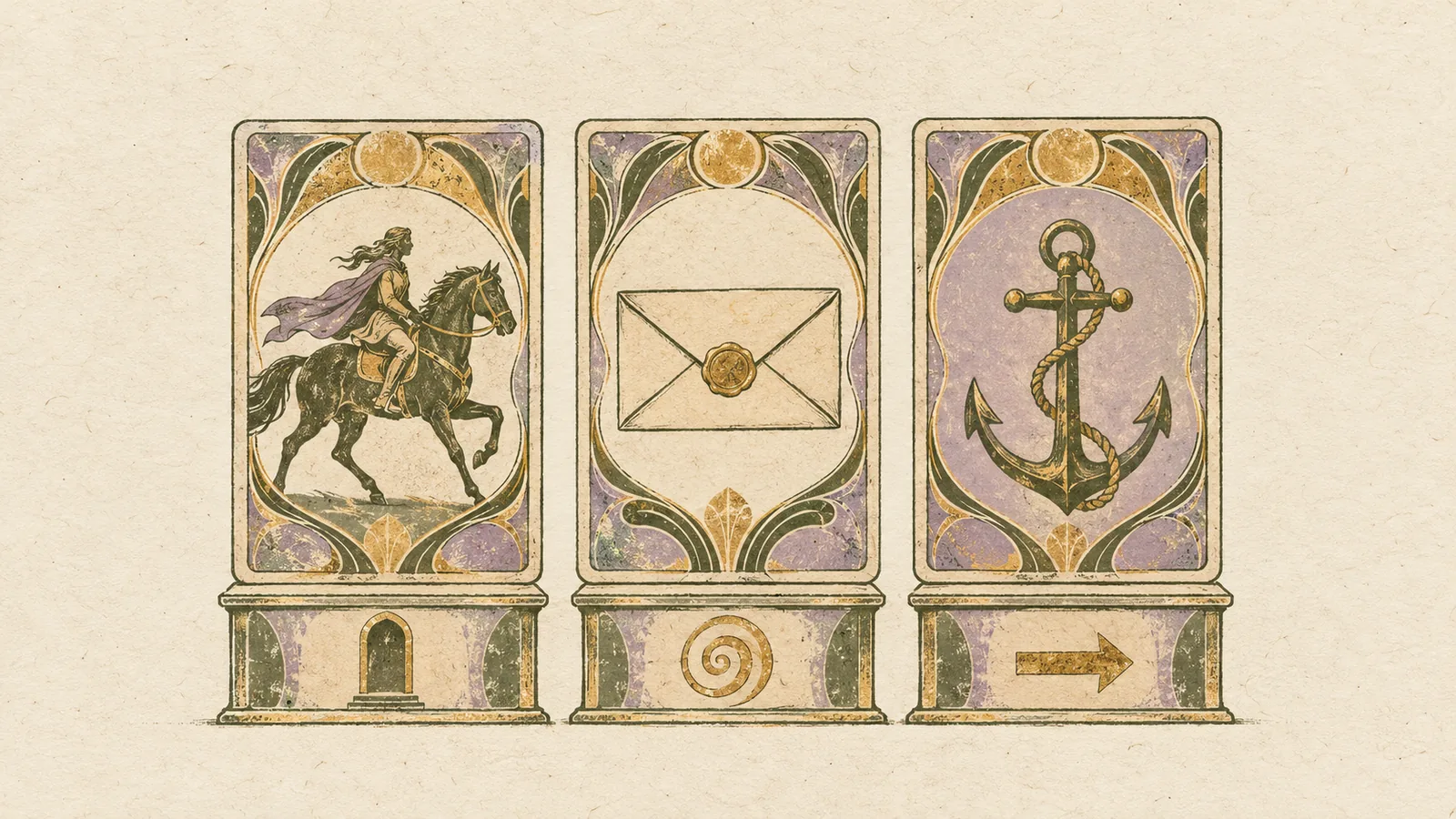
Our original teaching example asks: “How might the application I sent yesterday develop over the next two weeks?” The selected cards are Rider 1 → Letter 27 → Anchor 35. They are chosen to demonstrate the method, not presented as a real user’s draw or a verified prediction.
Decide what the positions mean before reading
GOOD TIMING’s three-card Lenormand layout uses Situation, Influence and Direction. The first card describes the matter in focus, the middle qualifies it, and the last gives the direction suggested by the line. Direction is not an irrevocable outcome.
| Position | Card | Contribution to this question |
|---|---|---|
| Situation | Rider, 1 | An arrival, approach or news that moves the matter |
| Influence | Letter, 27 | Written communication, paperwork or a stated detail |
| Direction | Anchor, 35 | Work, stability, staying power or a matter settling |
Other readers use an unpositioned line, a central theme or a past–present–future spread. Lenormand Reader’s three-card lesson illustrates several approaches. None should be silently substituted for the positions already attached to a saved reading. This example uses adjacent-pair reading within the stated product layout.
Read Rider + Letter: what arrives, and in what form?
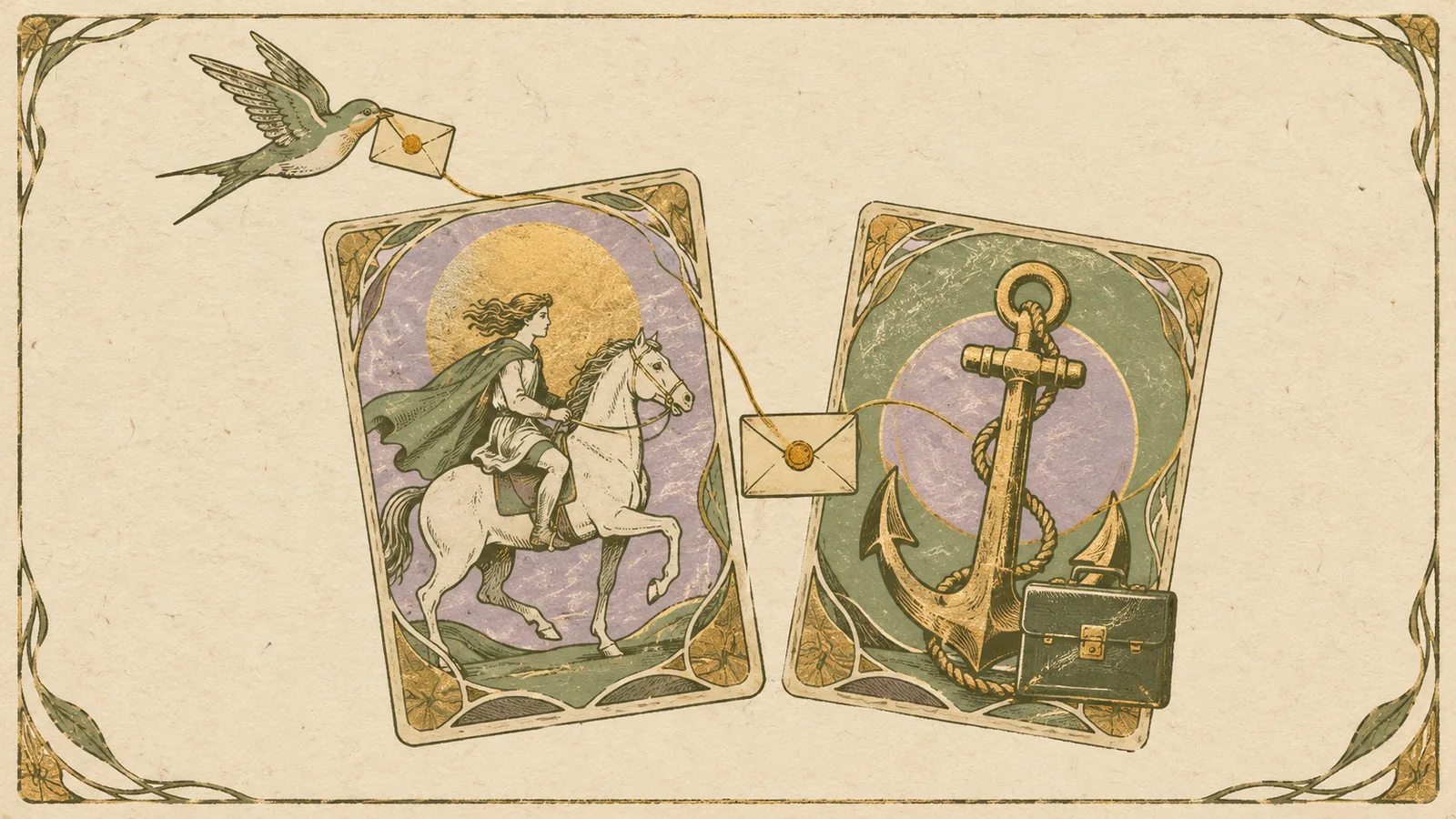
Rider introduces movement or an arrival; Letter makes that movement specifically communicative. In an application question, an email, written update or request for documents is a closer fit than a literal visitor on horseback.
That still leaves alternatives. An acknowledgement, an invitation and an administrative query are all written developments. The pair supports news more clearly than it supports a signed job offer. Choosing the most exciting possibility would add certainty the pair does not provide.
Read Letter + Anchor: what gives the news weight?
Anchor can connect the written exchange with work or a more settled arrangement. In this context it gives the line a practical, continuing quality: the application may move into a concrete employment-related exchange rather than remain an entirely unanswered gesture.
It can also describe something fixed or slow to shift. A written status that remains unchanged is therefore a competing interpretation. The incoming movement of Rider makes “nothing happens at all” less convincing in this particular line, but Anchor does not establish a precise response date.
Combine the line into an answer
An example judgment is:
The line leans toward a written development in the application, with a practical connection to work or a more stable next step. You may receive an update that gives the process something concrete to build on. It is more supportive of progress through communication than of immediate, spectacular change. A final offer and its terms remain unconfirmed.
This answer does four jobs: it answers the application question, connects both pairs, gives a direction and leaves unresolved details unresolved. It does not need a separate paragraph repeating each card’s dictionary entry.
The two-week period belongs to the question. It is not derived by turning card numbers into days. Likewise, Anchor’s work association does not prove a permanent contract; the full line and actual circumstances would need to support that stronger claim.
Change the question, not the cards
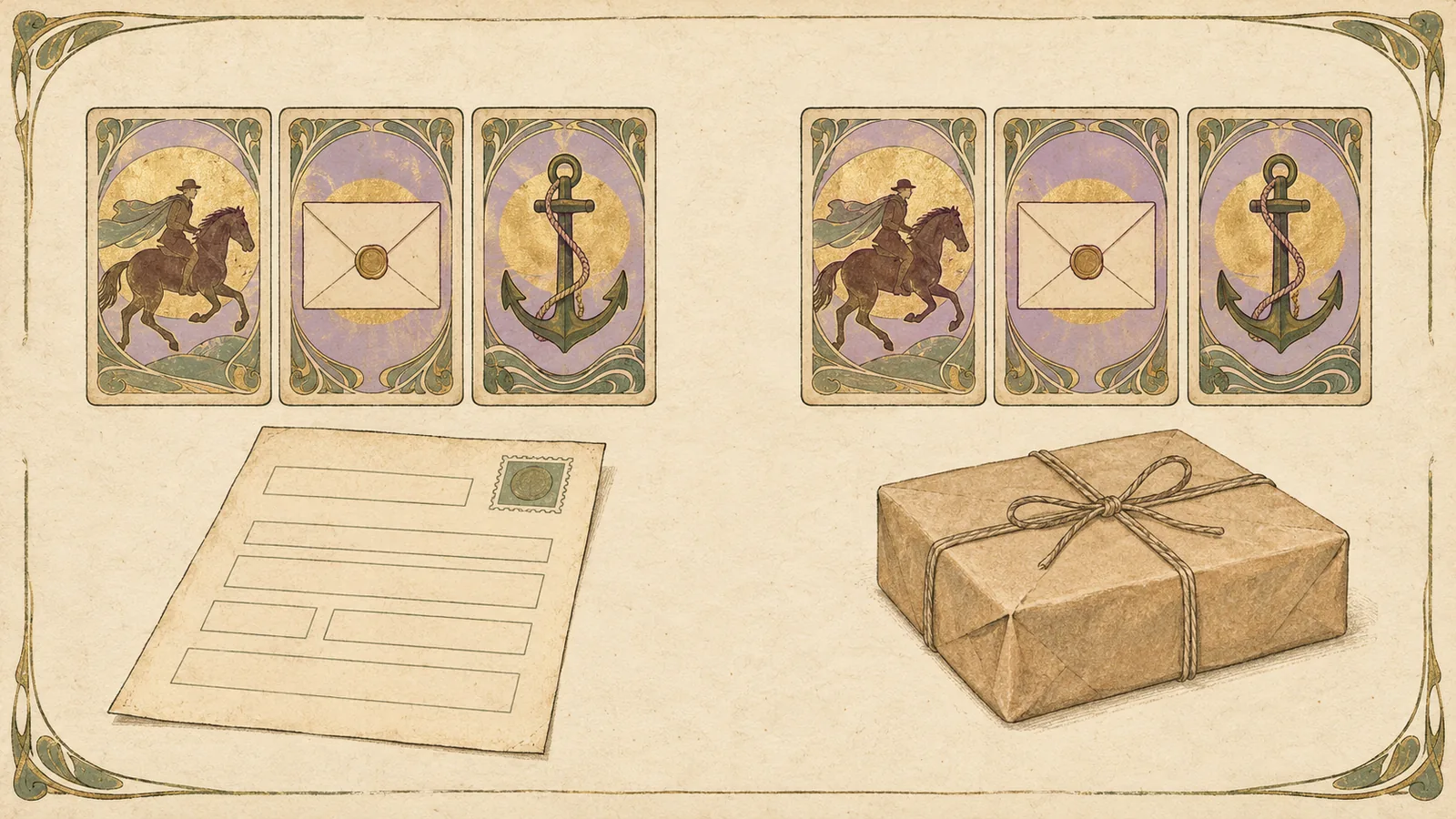
Now keep Rider–Letter–Anchor but ask, “What may happen with a parcel whose tracking has not changed?”
A plausible reading becomes an incoming written update that clarifies the parcel’s status, possibly while the item remains at a fixed location. The same Letter can be a tracking notification rather than a job email. Anchor can be a stationary status rather than employment. The picture is contextual, not arbitrary: each possibility still follows the cards’ recognizable symbolic functions.
This is also a useful test of an interpretation. If replacing the question never changes the answer, the reading may be repeating keywords rather than interpreting them.
Three common mistakes to catch
Inventing a timeline: Situation–Influence–Direction does not automatically mean yesterday–today–tomorrow. A story can develop across a line, but the positions do not require three separate events.
Importing Tarot reversals: This Lenormand layout reads the cards without upright/reversed meanings. A difficult modifier comes from context and combinations, not an invented reversed Rider.
Reading beyond the spread: No card here identifies a named recruiter, a salary or a particular company. Specificity is useful when it describes the kind of development; it becomes fabrication when unsupported facts are supplied.
For the wider card vocabulary, use the 36-card meanings guide. For more pair relationships, see Lenormand combinations.
Try a three-card reading
Open Lenormand Reading, choose the three-card layout and ask one question with a useful time frame. Keep the actual order and position labels when reviewing the answer. A focused follow-up might ask, “Does the Anchor here describe a work agreement or a delay in the written response?” That deepens the same reading rather than quietly replacing its evidence.
You do not need to make the cards agree with an expectation. A useful interpretation explains which possibility the line supports, what changes that judgment and what the small spread cannot settle.