Tarot and Lenormand are different card-reading systems, not long and short editions of the same deck. Standard Tarot has 78 cards and often works through layered imagery, suits, numbers, positions and reversals. Petit Lenormand has 36 cards and places strong emphasis on symbols qualifying one another in combinations.
Neither owns “feelings” or “events.” Tarot can predict developments; Lenormand can explore a relationship’s emotional climate. The better starting point is the style of evidence you want to read, not the claim that one deck is inherently deeper or more accurate.
The important differences
| Feature | Tarot | Petit Lenormand |
|---|---|---|
| Standard deck | 78 cards: 22 Major, 56 Minor | 36 cards |
| Main reading vocabulary | Image, suit, number, archetype and position | Symbol, adjacency, sequence and larger combinations |
| Reversals | Used in some practices, not all | Not used in GOOD TIMING’s Lenormand layouts |
| Imagery | The actual deck can significantly change visual interpretation | Familiar central symbols remain important across designs |
| Common beginner error | Treating one keyword as the whole card | Reading a line as unrelated one-card meanings |

The V&A’s collection overview documents Tarot’s structure and changing imagery. Labyrinthos compares the two reading practices, but its emphasis on psychological versus practical readings should not be turned into an absolute restriction.
The same question, two teaching readings
Our fictional question is: “How might my first meeting with a potential project collaborator go?” Both examples below use deliberately selected cards, not a real model response or an actual client reading.
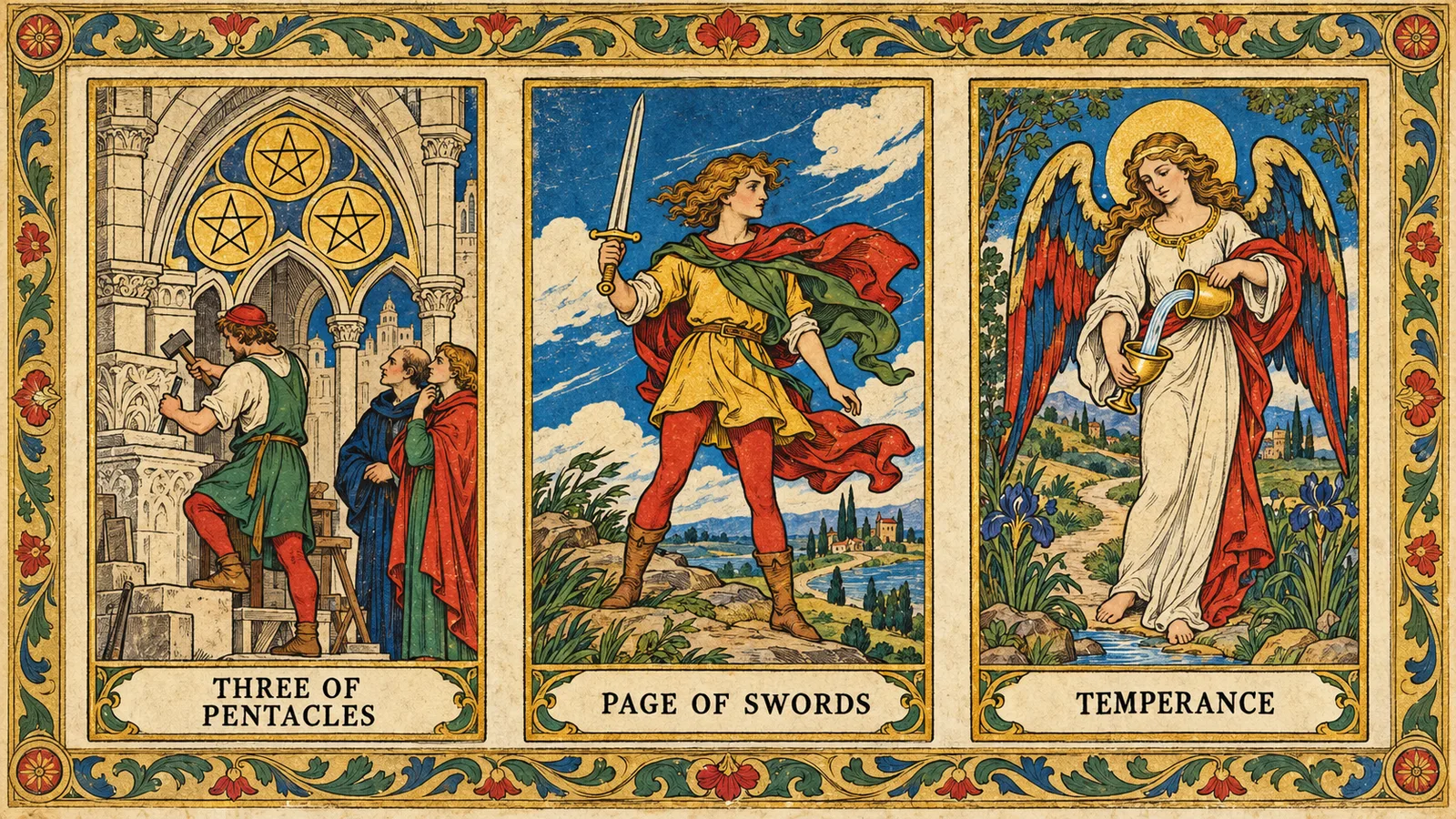
For Tarot, take Three of Pentacles upright, Page of Swords upright and Temperance upright as a simple, unpositioned teaching trio. This is not a claim that GOOD TIMING offers a preset with that name.
In familiar Rider–Waite–Smith imagery, Three of Pentacles places skilled work in a scene of consultation. Page of Swords introduces watchfulness and questions; Temperance contributes adjustment between different elements. Together, an example judgment is: The meeting looks useful for testing how your skills fit together. Expect interested but probing questions, with the best prospect in working out a compatible approach rather than securing instant agreement on everything.
That interpretation follows the visual and relational pattern. It does not infer that the other person is immature because a Page appears, or guarantee the project’s success because Temperance is present. A differently illustrated Tarot deck would require attention to its actual images.
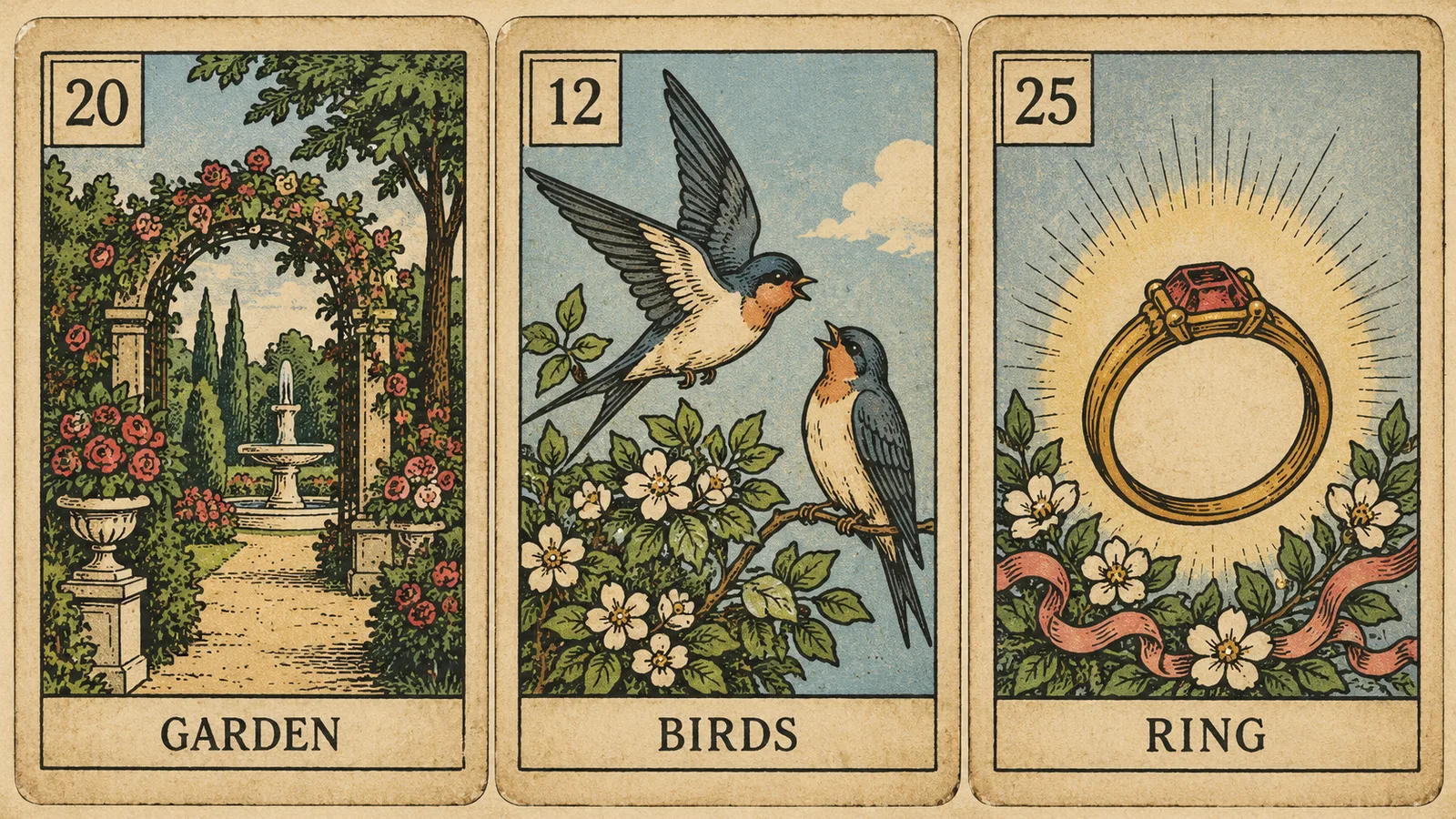
For Lenormand, select Garden 20 → Birds 12 → Ring 25. Garden places the meeting in a shared or social setting, Birds brings conversation and some bustle or nerves, and Ring connects the exchange with an agreement or continuing connection.
An example judgment is: There is a promising line from meeting and conversation toward an ongoing arrangement. The exchange may feel lively or slightly nervous, but it has more potential to establish a connection than to remain a one-off chat. A binding contract is not established by Ring alone.
The answer is not shorter because Lenormand is shallow. It is compact because the chosen line joins a public encounter, exchange and bond into one relevant statement.
What did the comparison actually show?
Both readings answer the meeting question. Tarot’s trio emphasizes how cooperation may take shape: skill, questioning and adjustment. Lenormand’s line emphasizes the connection among the meeting, conversation and a continuing arrangement.
These examples do not demonstrate that the systems independently confirmed an outcome. We selected the cards to teach two reading languages. Different evidence could produce a different judgment; presenting a curated example as an accuracy experiment would be misleading.
Which is easier to learn?
Lenormand’s small set of familiar symbols can make individual cards approachable, but combination reading takes practice. Memorizing 36 definitions is not the same as reading a nine-card layout.
Tarot’s pictures can offer immediate associations, while the wider deck and differing traditions require more study. A newcomer may find visual storytelling easier than concise symbolic grammar, or the reverse. Try explaining one complete reading in your own words rather than counting how many meanings you remember.
For a focused Lenormand exercise, read our three-card worked example. For Tarot positions, see the existing three-card Tarot guide.
Choose a method without mixing its rules
Use Tarot when its visual language interests you; use Lenormand when you want to work with connected everyday symbols. In either tool, check the actual positions before reading and keep the same evidence for a follow-up.
Do not turn Lenormand’s Book into Tarot’s High Priestess, attach Tarot reversals to a Lenormand line, or assign a fixed Tarot meaning to every image in a custom deck. The systems can sit beside each other without losing their own methods.