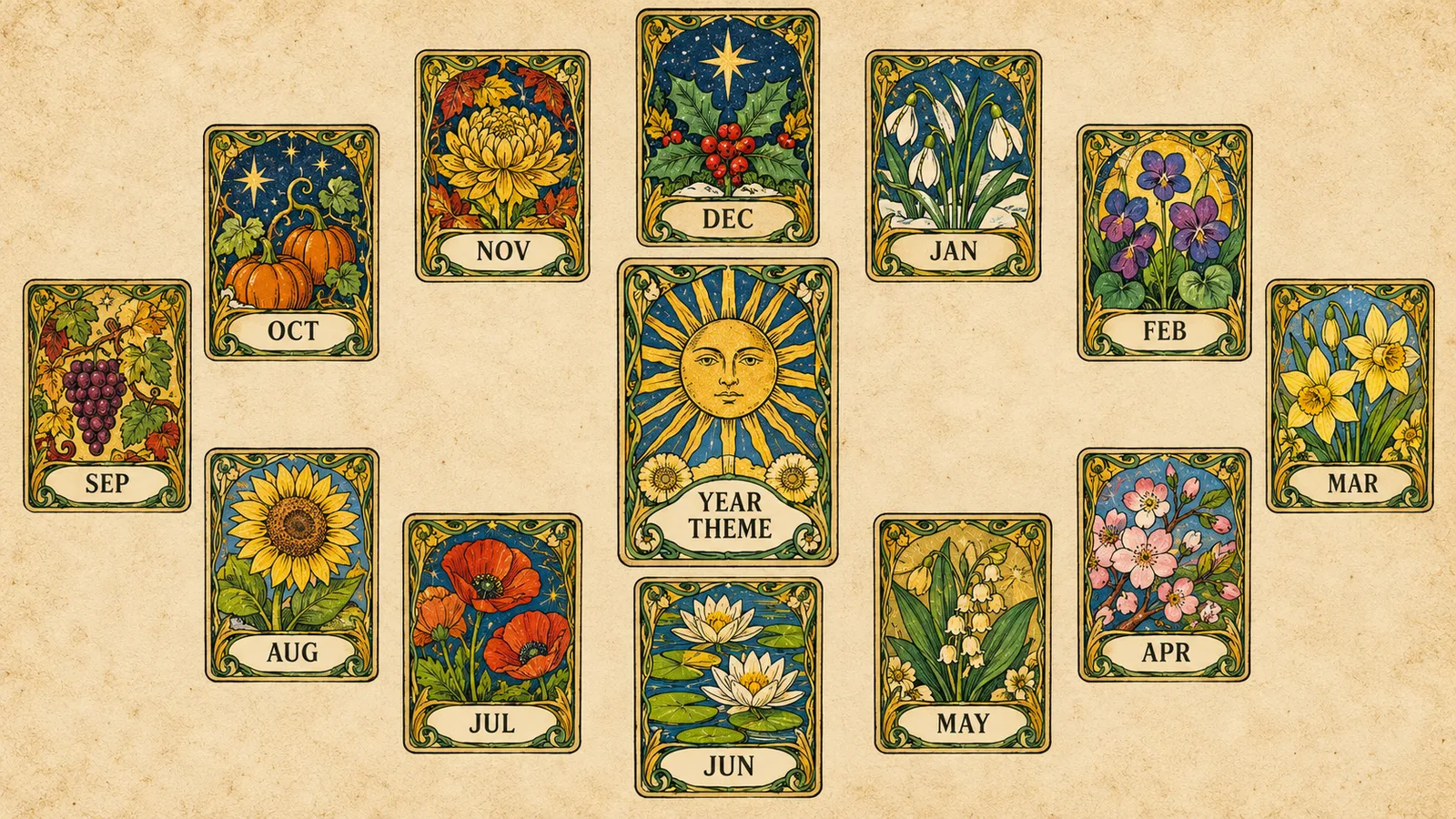
A year-ahead tarot spread uses 13 cards: one for each month of 2027, laid out in a ring, plus a center card for the year's theme. Read the theme card first for the shape of the year, then read each month for what it is likely to bring and ask of you: pressure points, openings and good moments to act. You choose the start date: January 1, your birthday, or Lunar New Year.
A year-ahead reading is a lovely new-season ritual: you sit down with a deck, a notebook and a calendar, and ask what kind of year is coming and how you want to meet it. The spread below is built for exactly that. It gives you one card per month and one for the year as a whole, with fixed positions, an easy way to start small, a complete worked example, and a simple record you can look back on as the year goes by.
A year spread works best as a forecast of climate rather than a list of events: it shows which months are likely to feel busy, tender or decisive, and what each one asks of you. For the bigger picture of how readers think about accuracy, see does tarot work.
What is a New Year tarot spread, and how does the 13-card layout work?
A New Year spread is any layout you draw at the turn of a year to look at the months ahead. There is no single standard version. Some readers use twelve cards for twelve months, some use twelve themes such as relationships, work and health, and a popular version places twelve cards in a clockwise circle, like a clock face, with one extra card in the middle for the year's overall theme.
The 13-card layout in this article follows that last pattern: twelve months in a ring and one theme card in the middle. It is a modern layout that readers adapt freely, so think of it as a handy structure rather than a traditional spread. If you are new to spreads, start with our 3 card tarot spread guide, and if you want a deeper single-question layout, see the Celtic Cross guide.
How do you lay out the 13-card year-ahead spread?
You need a deck you are comfortable with, a flat surface with room for a ring of cards, and a notebook. Allow about an hour for the full reading, or about 20 minutes if you read only the first quarter (see below).
| Position | Where it goes | The question it answers |
|---|---|---|
| Center: Year Theme | In the middle of the ring | What is the main thread of 2027? |
| Months 1 to 12: January to December | Around the ring, clockwise | What is this month likely to bring, and what does it ask of me? |
| Optional clarifier | A card below any month you want to explore | What would help me act on this month's card? |
- Write your question before you shuffle. A good year question is open and about your own choices: "What is the shape of 2027 for me, and where should I put my energy?" works better than "What will happen to me in 2027?" Our guide to asking tarot questions shows how to phrase it.
- Shuffle and draw 13 cards. Draw the first card and set it aside face down: that is the Year Theme. Then deal the next twelve in a circle, starting at the one o'clock position for January (as with the number 1 on a clock) and ending at twelve o'clock for December. Some readers start at twelve instead. Pick one and keep it.
- Decide on reversals before you draw and record cards as they fall. The layout works with or without them. If you do not normally read reversals, keep every card upright.
- Turn the Year Theme over first, in the center. Read the months afterwards.
GOOD TIMING's online tarot reading offers spreads of one to seven cards, including Past / Present / Future, Tarot Timing and relationship spreads. It does not draw this 13-card ring, so lay it out with your own deck.
When should your year start?
You do not have to read on January 1. A year is a human choice of boundary, and the layout works the same way whichever one you choose. The only thing that changes is the label on the first card.
| Year start | Months run from | Months run to | Good if |
|---|---|---|---|
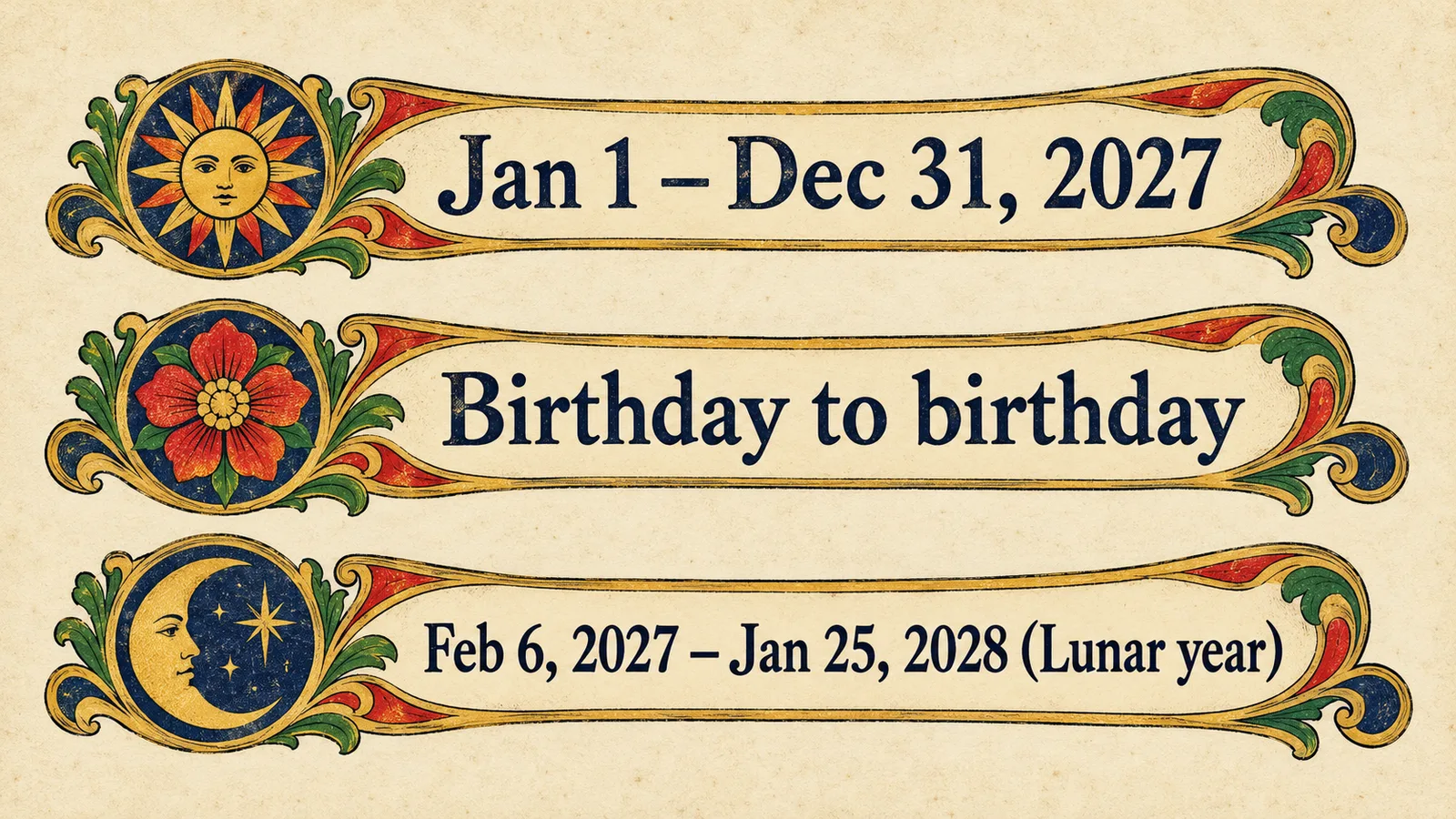
| Calendar year | Friday, January 1, 2027 | Friday, December 31, 2027 | You plan around a normal calendar, school year or fiscal year |
| Birthday to birthday | Your birthday in 2027 | The day before your birthday in 2028 | You prefer a personal new year |
| Lunar New Year | Saturday, February 6, 2027 | Tuesday, January 25, 2028 | You follow the Chinese lunar calendar |
For the lunar option, the first day of the first lunar month is February 6, 2027, and the next lunar year begins on January 26, 2028, so your twelve months end on January 25, 2028. Our guide to Chinese New Year 2027 and Lichun explains how Lunar New Year (February 6, 2027) differs from Lichun (February 4).
If you want a specific moment to do the reading, there is a New Moon in Capricorn on Thursday, January 7, 2027, at 20:24 UTC, at 17°18′ Capricorn (3:24 p.m. U.S. Eastern Standard Time). In Beijing and Taipei that is already January 8, at 04:24. Many people use a new moon as a marker for starting something, and our new moon ritual guide has a simple structure for it. It is a nice touch rather than a requirement.
If you also plan your year around planetary calendars, our Mercury retrograde 2027 guide lists the dates.
How do you read 13 cards without feeling overwhelmed?
Thirteen cards is a lot to hold in your head at once. A few habits keep the reading usable.
- Read the Year Theme first, on its own. Look at what the card pictures, not only its keyword. What is the figure doing? Which suit is it, if it is a suit card? Write one sentence about the thread it suggests.
- Read the first three months first. For the first sitting, turn over the theme and January, February and March. Read the rest in the following quarters, or on the first day of each month, so each card meets the month it is about.
- Read each month as a pair with the theme. Ask how the month card expresses, supports or complicates the year's theme. This is what turns twelve separate cards into one story.
- Notice the arc last. Once all the cards are turned, look at the balance: which quarter feels heaviest, where the openings fall, many Major Arcana cards, a missing suit or repeated numbers. Our tarot card meanings guide is a good reference if you are still learning individual cards.
- Use a follow-up question when a card is unclear. Our guide to tarot follow-up questions lists good ones, such as "What would help me with this?"
If two cards seem to contradict each other, that is normal. Why tarot readings contradict explains how to hold both.
What does a complete 13-card example look like?
Here is an example reading for a reader we will call Mina, who starts her year on January 1 and reads upright cards only. Her question: "What is the shape of 2027 for me, and where should I put my energy?"
| Position | Card | Short reading |
|---|---|---|
| Center: Year Theme | The Hermit | A year to go inward and choose carefully. The lantern lights one step at a time, so the pace is steady, not rushed. |
| January | Three of Pentacles | Collaboration. The year starts well when she asks for help on a project she has been carrying alone. |
| February | Five of Wands | Friction and competing ideas, likely around the busiest stretch at work. Agree who owns which task before it starts. |
| March | Ace of Cups | A new emotional opening. The Hermit's quiet makes room for it, so leave one evening a week free. |
| April | Eight of Swords | Feeling boxed in. The Hermit asks her to look at which walls are real and which are only thoughts, and to take the one open door. |
| May | Temperance | Blending and moderation. This is the way through April: a slower mix of work, rest and people. |
| June | Six of Wands | Visible progress. A good month to share a result or accept thanks. |
| July | Four of Cups | A pause. She may feel flat or overlook an offer, which is the Hermit's retreat in a mild form. Rest, then look again. |
| August | Strength | Quiet courage. She handles a person or habit with patience, not force. |
| September | Eight of Pentacles | Steady craft. Regular practice pays off, in line with the theme of careful choosing. |
| October | Seven of Cups | Many options. The Hermit's lantern is needed: pick one and let the rest go. |
| November | Justice | A decision with consequences. Read agreements carefully and choose what she can stand behind. |
| December | Ten of Pentacles | A stable foundation. The year ends with something solid to build on, the reward of the careful choices. |
Read as a whole, Mina's year has a clear arc. The first quarter is about people and a new feeling, spring brings a squeeze that eases, the summer is a win followed by a rest, and autumn is the season of choosing. That is the forecast her reading gives: when to ask for help (January), when to expect friction (February and April), when to rest (July) and when to decide (October and November). She writes one sentence per card, and each month she revisits the next card and adds a line about how the previous month went.
If you read reversals, the same layout works with a little more nuance. A reversed Five of Wands in February, for example, might point to tension that stays unspoken or settles quickly. Decide before you draw and keep the rule for the whole year.
What if a month's card looks negative?
A hard-looking card describes pressure and a position, and it is best read as a heads-up. Try three steps:
- Describe what the card shows, without the keyword: the Five of Wands shows a scuffle, not a "bad month".
- Ask what you can do about it. Move from "What will go wrong?" to "What could I prepare, say or protect?" Mina's Five of Wands in February becomes an instruction to agree on roles early.
- Draw a clarifier only if you need one. One extra card below the month, read for advice, is enough. Do not keep drawing until you like the answer.
The same goes for a pleasant card: a cheerful month card marks a good window to enjoy and use, such as Mina's Six of Wands in June.
How do you keep a record of the year?
A year-ahead reading is most useful when you can look back at it. Write a short note for every card you read.
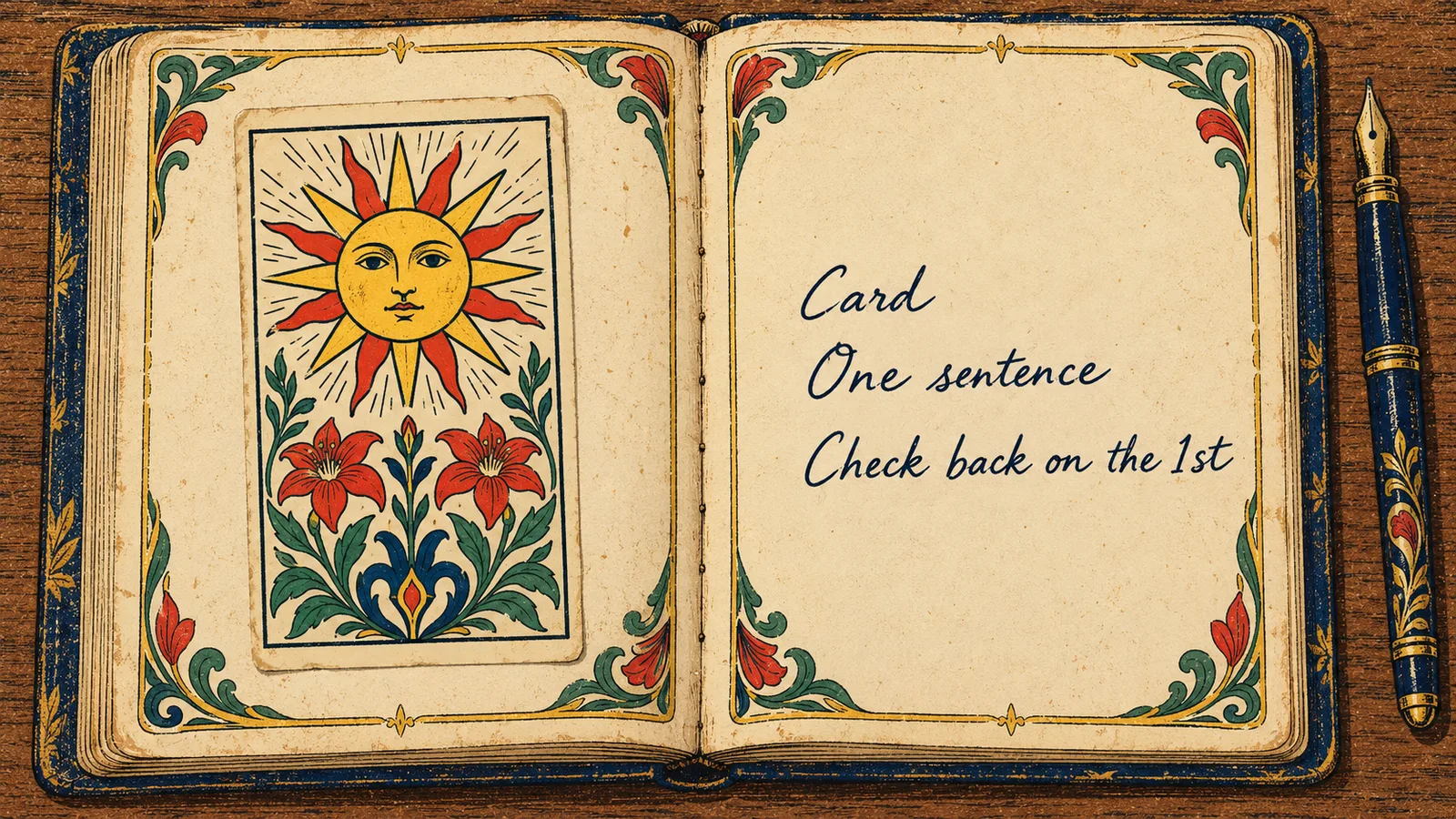
- Card: the name, the position and whether it was upright or reversed.
- One sentence: what the card suggests for that month, in your words.
- Check back on the 1st: on the first day of the month, read your sentence and add what actually happened.
After a few months you will see how the reading speaks to you: which cards pointed to something real and which were wishful. That is how you learn to read your own year.
Good to know
A tough card in a month is a heads-up to prepare, and a bright one is a window to use. Research has not shown that tarot predicts events, and traditions differ, so treat your year spread as guidance for your choices.
Frequently asked questions
How many cards are in a New Year tarot spread?
There is no standard number. Some spreads use twelve cards, others twelve plus a center card. This article uses 13: twelve months in a ring plus one center card for the year's theme.
When is the best time to do a year-ahead tarot reading?
Whenever you will have an hour of quiet. Common choices are December 31 or January 1, the New Moon on January 7, 2027 (20:24 UTC, January 8 in Beijing and Taipei), your birthday, or Lunar New Year on February 6, 2027.
What can a tarot spread tell me about 2027?
A year spread shows the theme of the year and the character of each month: where the pressure and the openings are likely to fall, and what each period asks of you. Readers use it to plan and to prepare, then check back each month. See does tarot work for how readers and research approach accuracy.
Can I draw the 13-card spread on GOOD TIMING?
The online tarot reading offers spreads of one to seven cards, so the full ring is for your own deck. You can still bring a single question about a month to the online reading.
What if a month's card looks negative?
Describe the picture, then ask what you could prepare or protect. A hard card is a heads-up to get ready. If it is unclear, draw one clarifier or use a follow-up question.
Should I read all 13 cards at once?
You do not have to. Read the Year Theme and the first three months, then return to the others quarterly or on the first day of each month.