Last night, the cards seemed to point toward reconciliation. This morning, another reading suggested distance and silence. Which one are you supposed to believe?
If you've drawn tarot cards several times about the same person and received different answers, you probably know the feeling. Did you fail to connect with the cards? Has the energy changed overnight? Or was one of the readings simply wrong?
Different answers do not necessarily mean that one reading has failed. Sometimes the question has changed; sometimes the timeframe is different. At other times, the relationship or situation itself has genuinely moved in a new direction. And if anxiety keeps drawing you back to the deck, increasingly confusing answers may be a sign that you need to stop drawing for a moment and look more closely at the cards you already have.
1. Why Is It Better Not to Keep Asking the Same Question?
One principle is especially helpful in tarot: for one clear, specific question, one thoughtful reading is usually enough.
Before shuffling, give yourself a moment to settle and concentrate on what you really want to know. Perhaps your question is: “My ex and I haven't spoken for two months. Is there a chance we'll reconnect within the next month?”
This question identifies the person, the situation, and the period you want to explore. You can bring that intention into the act of shuffling and drawing, keeping your attention on this relationship and where it might go.
In many tarot traditions, drawing cards is understood as a form of energetic connection. A clear intention and focused attention can help you engage more deeply with the messages and symbols in the spread.
Now imagine that the first reading isn't what you hoped to hear. You shuffle again a few minutes later, then a third and fourth time. At first, all you wanted to know was whether your ex might come back. By the second reading, you're worried about whether the first answer was accurate. By the third, you're afraid of drawing another difficult card—or secretly hoping to see a particular one.
Your original intention can gradually become tangled with anxiety, doubt, and the desire for a reassuring answer. From an energetic perspective, repeated readings may feel scattered; from a practical perspective, they can leave you with several spreads that are hard to interpret together.
This doesn't mean you may never return to a question. It means that if nothing has changed, and you're only drawing again because you dislike the first result, more cards may not bring more clarity.
2. One Reading Asks About Feelings; Another Asks About Action
Imagine you've been separated from your ex for a month. In your first reading, you ask: “Does he still have feelings for me?”
You draw Six of Cups (Upright), Two of Swords (Upright), and Judgement (Upright).
The Six of Cups speaks of shared memories, affection, and the continuing significance of the past. The Two of Swords suggests hesitation or an unresolved decision. Judgement may point to reconsidering the relationship, an important conversation, or the possibility of a second chance. Overall, there may still be an emotional bond, but something remains undecided.
A few days later, you ask: “Will he message me this week?”
This time you draw Four of Swords (Upright), The Hermit (Upright), and Eight of Wands (Reversed).
The Four of Swords evokes rest and withdrawal. The Hermit suggests solitude and reflection rather than outward action. Eight of Wands reversed can indicate delayed messages or slow progress. This spread leans toward silence or postponement in the immediate future.
At first these readings sound contradictory. But are they really answering the same question? The first explores lingering feelings and the potential for reconnection. The second concerns a particular action within a very short timeframe.
Someone can miss you and still not be ready to reach out. Feeling something and acting on it are two different things. Before comparing conclusions, compare the questions themselves.
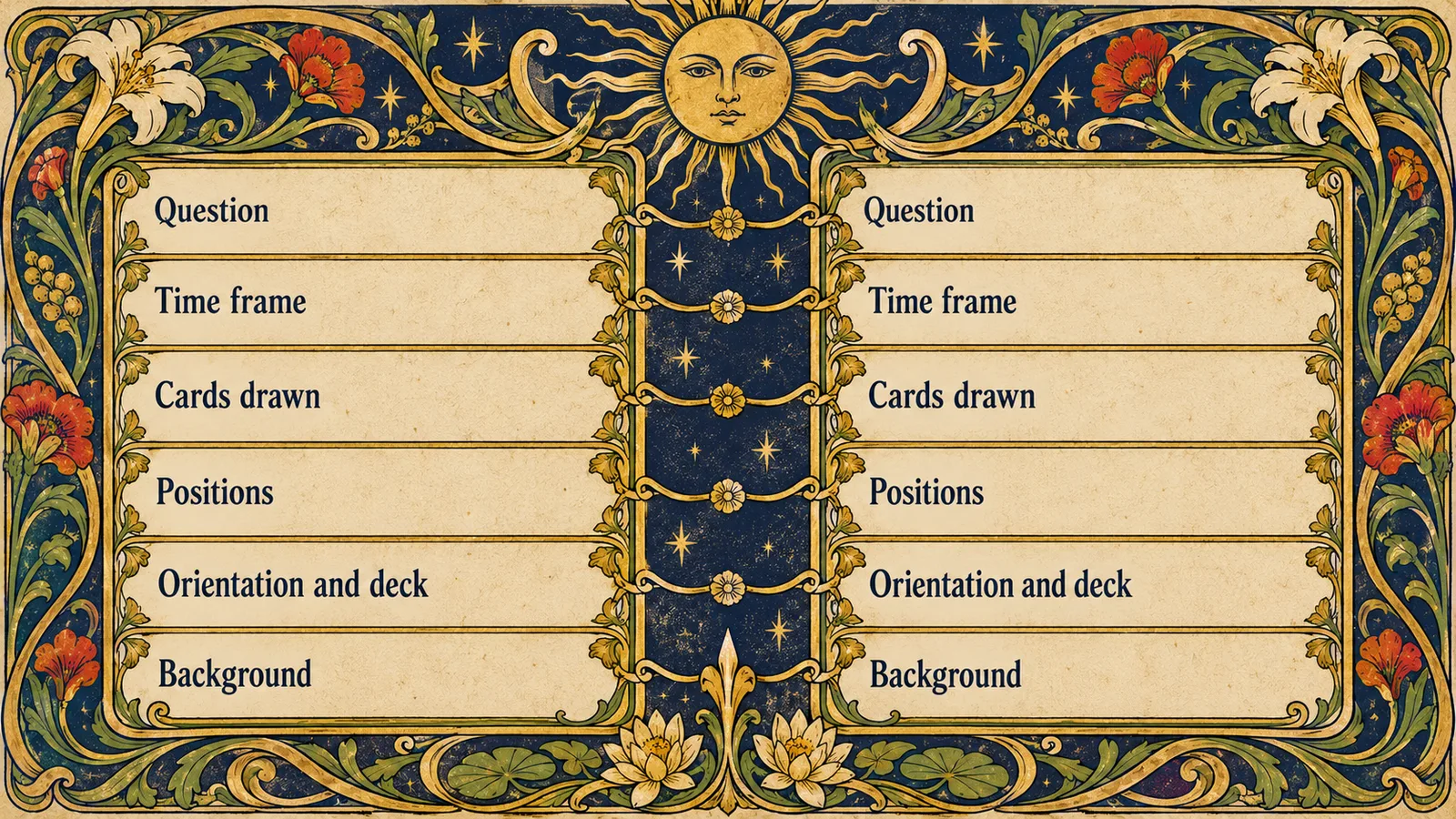
3. The Future Isn't Frozen: Why Last Month's Reading May Differ From This Month's
Consider a woman who comes for a reading at the end of September. Her relationship feels steady, and she asks how things might develop in October. Her cards are:
- The Lovers (Upright)
- Two of Cups (Upright)
- The Sun (Upright)
It's an encouraging combination. The Lovers suggests attraction, emotional connection, and mutual choice. The Two of Cups emphasizes affection, understanding, and reciprocity. The Sun brings joy, honesty, and openness. A reader might interpret this as a positive month with opportunities for the couple to grow closer.
But then October unfolds differently. An argument makes her question her boyfriend's feelings. Neither is willing to apologize first. A manageable disagreement grows, they begin speaking less often, and an important date gets cancelled.
In late October, she asks about the remaining days of the month. This time she draws:
- Five of Swords (Upright)
- Five of Cups (Upright)
- Temperance (Reversed)
The Five of Swords can represent conflict, defensiveness, or the urge to win an argument. The Five of Cups reflects disappointment and regret. Temperance reversed suggests that emotional balance and communication have become strained.
Does that mean September's reading was wrong? Not necessarily.
In traditional divination, a spread may reflect the energies and tendencies developing at the time of the question. A tendency is not an unchangeable railway track. In September, the couple may genuinely have been moving toward closeness. Their choices, misunderstandings, and actions in October could have altered that direction.
It's also important that the second reading asks about the remainder of October, not the whole month from the same starting point. The question and circumstances are no longer identical.
What we do, how we respond, and how we treat one another can change how a situation develops. When two readings are weeks apart, ask yourself what actually happened between them. Sometimes those events are the missing piece.
4. What If the Two Readings Really Are Opposites?
Suppose the question and timeframe are exactly the same, yet the spreads look completely different. You don't have to rush into a third reading.
Return to the first spread. Was a reversed card overlooked? Did you love the appearance of one positive card so much that you read the whole spread too optimistically? Could a difficult card have pointed to a temporary delay rather than a final failure?
Tarot isn't a matter of adding up keywords. Card positions, orientations, and the relationships among the cards all influence the reading.
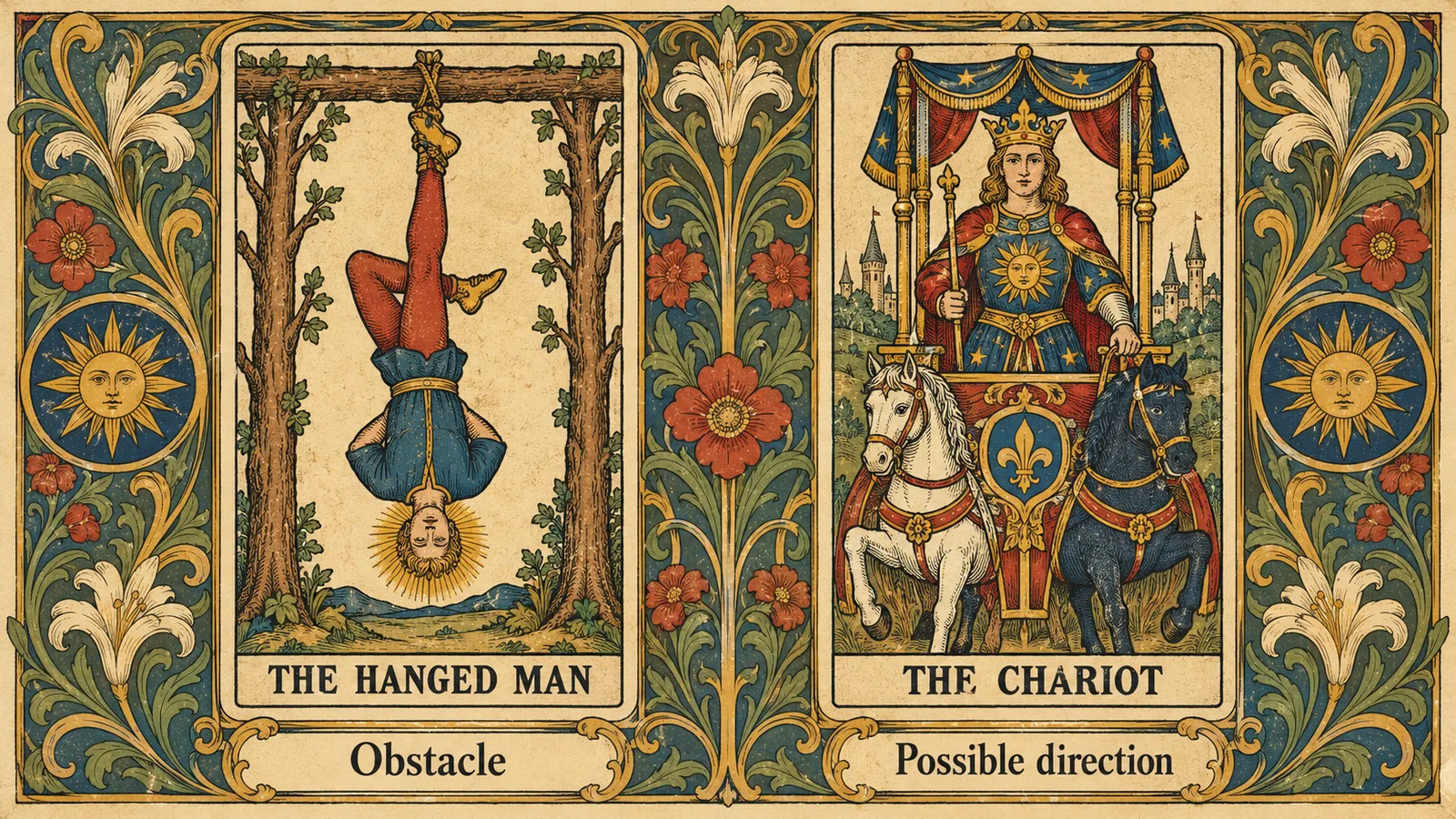
For instance, The Hanged Man (Upright) in a future position may indicate waiting, suspension, or the need for a fresh perspective. Beside The Star (Upright), it might suggest a slow period during which hope and healing gradually return. If you interpret the Hanged Man only as “it won't happen,” you may miss what the combination is telling you.
Take time with the original spread before drawing again. Sometimes the conflict lies in an interpretation that hasn't yet been fully explored.
5. The Hanged Man: Sometimes Pausing Is an Answer
If you've been reading repeatedly about someone you miss, The Hanged Man may resonate more deeply than you expect.
The Hanged Man (Upright) is not simply passive waiting. It can represent stepping away from action, loosening your grip on an outcome, and seeing a situation from an unfamiliar angle.
When you keep asking “Will he come back? When will he text? Why hasn't anything happened?” your attention can become fixed on a future event you cannot force. More cards won't necessarily make another person move sooner.
The pause suggested by the Hanged Man may be exactly what this moment calls for. You don't have to abandon your hopes or decide that the relationship has no future. Some situations need time, and some things only become clear after circumstances change.
Pausing is not failure, and it doesn't mean you've lost your connection to tarot. Sometimes letting go of the urge to ask again is what allows you to see differently.
If you still have questions about your previous reading, there's another way to explore them without drawing a new spread.
6. Want More Detail? Use Follow-up Instead of Drawing Again
Many people repeat a reading because the first interpretation doesn't feel specific enough—not because they truly want to start over.
Say The Moon (Upright) appears in your relationship spread. The interpretation mentions uncertainty, feelings that aren't fully understood, or something unspoken. Naturally, you want to know more:
“Is the uncertainty more likely to come from him or from me?”
“How does The Moon change the meaning of The Lovers beside it?”
“If there are still feelings, why does the future position suggest hesitation?”
These are excellent follow-up questions.
With GOOD TIMING Tarot, you can use Follow-up after your initial reading to continue exploring the spread you've already drawn. Follow-up does not draw new cards. It retains the original cards, whether they appeared upright or reversed, and their positions. You can add context, ask about a particular symbol, or explore how multiple cards support a conclusion.
Think of a conversation with a tarot reader. The reading is complete, but one card stays on your mind. You ask another question, and the reader returns to the same spread to explain it in greater depth—without shuffling again.
A focused follow-up can sometimes help more than three or four fresh spreads. Start a tarot reading on GOOD TIMING and continue the conversation after your cards are revealed.
7. When Does a New Reading Make Sense?
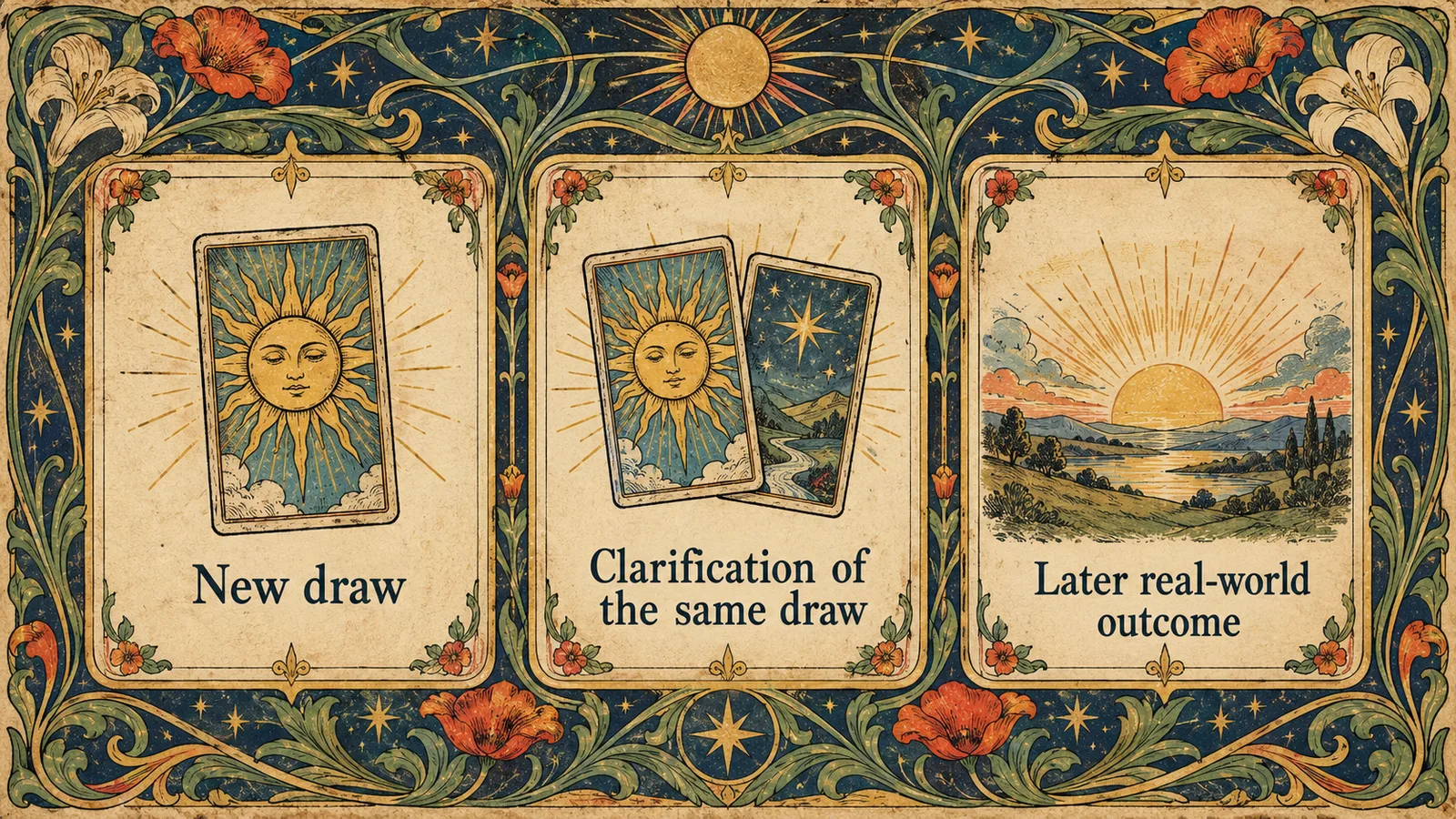
Not repeating a question impulsively doesn't mean you can never ask it again. A new reading can be meaningful when something important has changed.
Perhaps you asked about your relationship last month, and since then you've reconciled, had a serious disagreement, or made contact again. The situation is no longer what it was. Likewise, a job opportunity may look different once you receive an offer or learn new terms.
You may also have a genuinely different question. “Will he contact me first?” and “What might happen if I contact him?” explore two separate choices.
The goal isn't to impose a strict limit on the number of readings. It's to bring a clear intention to each one. If nothing has changed, consider returning to the original spread or asking a Follow-up. If new circumstances have emerged, a new reading may offer a fresh perspective on what is developing now.
8. So Which Reading Should You Believe?
You don't need to dismiss one reading immediately just because the conclusions differ. They may concern different questions, different periods, or a situation reshaped by actual decisions and events.
If you've been drawing repeatedly within a short time, notice whether anxiety has pulled your attention away from your original question. Tarot's value isn't only in delivering new answers. It can also lie in understanding the cards already on the table, and recognizing how a situation is changing.
When you have a specific question, give it your full attention and draw thoughtfully. If you're still uncertain, look again at the cards and consider another interpretation.
As the Hanged Man reminds us: sometimes clarity comes not from searching again, but from knowing when to pause.
Frequently Asked Questions
Why does tarot give different answers to the same question?
The wording, timeframe, circumstances, or interpretation may be different. When you draw repeatedly within a short period, anxiety and expectations can also make it harder to focus and reconcile several spreads.
Can I ask tarot the same question multiple times?
You can, but repeatedly asking when nothing has changed is usually not helpful. One focused reading followed by thoughtful interpretation is often more useful.
Can repeated readings affect an energetic connection?
In some tarot traditions, clear intention and focus are considered important to the connection. Repeatedly drawing in a state of anxiety may scatter your attention and make the original intention harder to maintain.
Why did last month's reading differ from this month's?
Circumstances, choices, and relationships change. An earlier spread may have reflected the tendencies present at that moment, while a later reading addresses a new situation. Different results alone don't prove that energy changed; consider the actual events too.
Does The Hanged Man upright mean it won't happen?
Not necessarily. It often points to a pause, waiting, a shift in perspective, or releasing control. In a future position it may suggest a delay rather than an absolute ending; context matters.
Does GOOD TIMING Follow-up draw new cards?
No. Follow-up keeps the original cards and their spread positions so you can ask more about the same reading, share context, or explore one card in greater detail.
When should I do another tarot reading?
When circumstances have materially changed, an earlier question has entered a new phase, or you have a genuinely different question to explore.
Continue exploring
- Start a Tarot Reading
- How to Ask Clearer Tarot Questions
- How to Ask Follow-up Questions After a Tarot Reading
- Three-Card Tarot Spread Guide
Clarity, at the Right Time. — GOOD TIMING