If tarot spreads had a flagship, it would be the Celtic Cross.
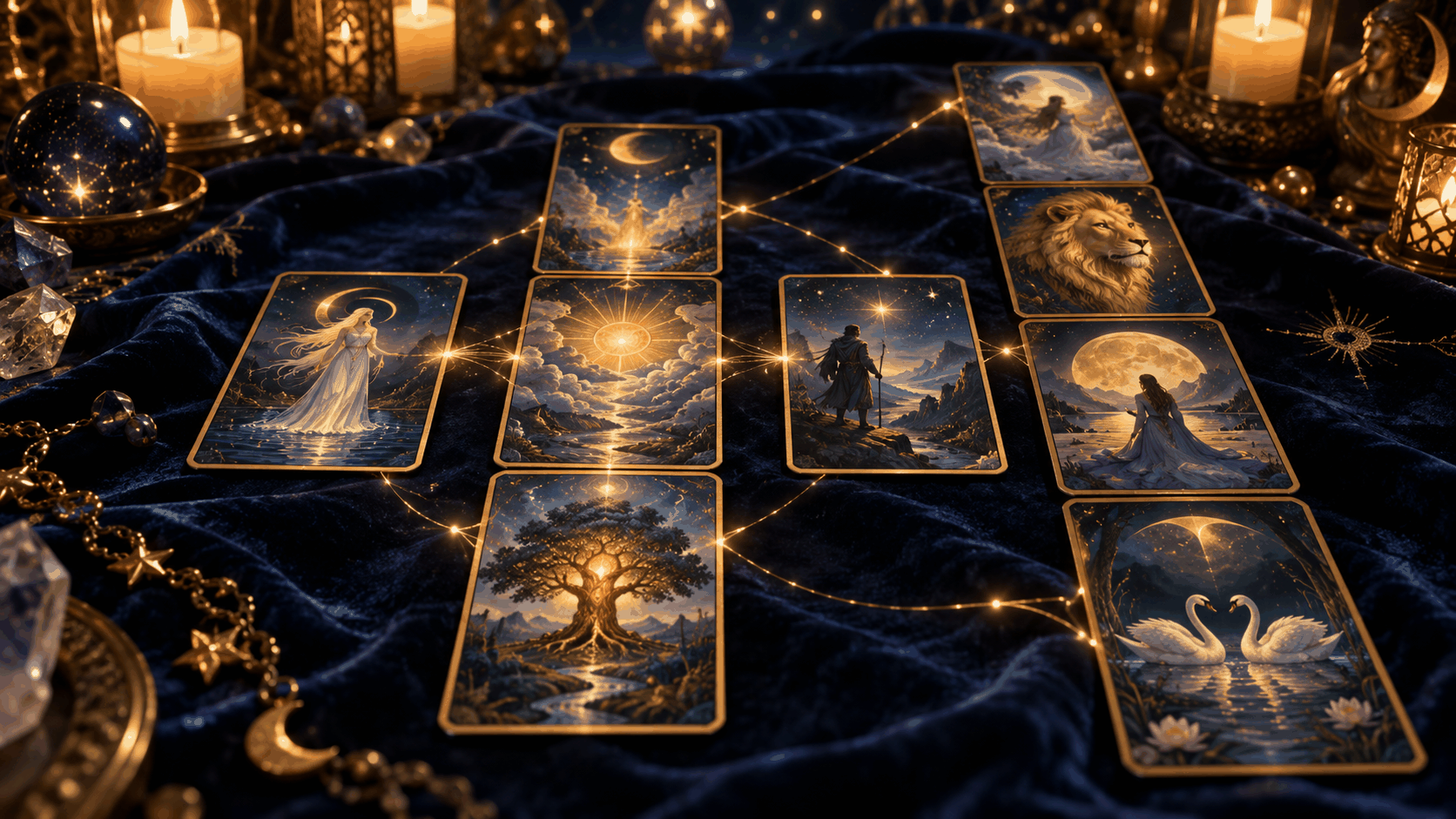
It is the layout printed in countless tarot guidebooks, the one many readers learn after their first three-card spreads, and the one people picture when they imagine a "full" tarot reading: a cross of six cards with a column of four standing beside it.
The Celtic Cross tarot spread has lasted for more than a century because it does something few spreads can. In ten cards, it looks at the heart of a situation, what is complicating it, its roots, its recent past and near future, your own attitude, the people around you, your hopes and fears, and where everything is heading.
This guide explains the Celtic Cross position by position, shows you how the cards relate to each other, walks through a complete worked example and shares tips to keep a ten-card reading clear rather than overwhelming.
What Is the Celtic Cross Tarot Spread?
The Celtic Cross is a ten-card tarot spread. It is made of two parts:
- The cross (cards 1–6): a central pair of cards (one laid across the other), surrounded by four cards above, below, to the left and to the right. This part describes the situation itself.
- The staff (cards 7–10): a vertical column of four cards to the right of the cross. This part describes you, your environment, your inner hopes and fears, and the likely outcome.
It is best suited to complex or important questions, where you want to understand the whole picture: a relationship at a turning point, a career decision, a period of change or a situation you feel stuck in. For quick daily guidance, a simpler layout like the 3 card tarot spread is usually a better fit.
A Brief History of the Celtic Cross
The Celtic Cross became famous through Arthur Edward Waite, the occultist who designed the Rider-Waite-Smith tarot with the artist Pamela Colman Smith. In The Pictorial Key to the Tarot (1910), Waite presented it as "an ancient Celtic method of divination."

Despite that description, there is no evidence that the ancient Celts used tarot or this spread. Tarot cards themselves appeared in fifteenth-century Italy as a card game, and their use for divination developed much later. The layout most likely took shape in esoteric circles in Britain in the late nineteenth century, and its name comes from its shape, which echoes the ringed stone crosses found across Ireland and Britain.
Since Waite, the spread has been adapted many times. Different books number the positions in slightly different orders and give them slightly different names. That is normal. What matters is that you choose one version, learn it well and stay consistent. The version below is one of the most widely used today.
How to Lay Out the Celtic Cross
Shuffle with your question in mind, then lay out the cards in this order:
- Place card 1 in the center.
- Lay card 2 horizontally across card 1.
- Place card 3 below the center.
- Place card 4 to the left of the center.
- Place card 5 above the center.
- Place card 6 to the right of the center.
- Then build the staff on the right, from bottom to top: cards 7, 8, 9 and 10.
A note on variations: In Waite's original, card 3 "crowns" the querent (above) and card 4 is "beneath." Many modern readers place the foundation below as card 3 and the past to the left as card 4, as here. Either works if you are consistent.
What about a significator? Traditionally, readers chose a card to represent the person asking (the significator) and placed it in the center before laying card 1 over it. Many modern readers skip this. If you use one, a court card or a card that feels like you is a common choice.
The 10 Positions of the Celtic Cross
1. The Present: the Heart of the Matter
What is happening now, at the center of the question. Read this card first and keep coming back to it; every other card relates to it.
Ask: What is really going on here?
2. The Challenge: What Crosses You
The obstacle, tension or complicating factor. Even a "positive" card here describes a challenge: the Sun crossing you might suggest overconfidence or a distraction from something important.
Ask: What is making this difficult?
3. The Foundation: the Root of the Situation
What lies beneath. The deeper cause, the history or the unconscious factor that the situation grows from. This card often explains why.
Ask: Where does this really come from?
4. The Recent Past
What is passing or has just happened. Its influence is fading but still felt.
Ask: What am I moving away from?
5. The Crown: Goal or Conscious Focus
What you are aiming for, consciously thinking about, or what is possible at best. Some readers call this "what is above you."
Ask: What am I reaching for?
6. The Near Future
What is coming next, in the coming weeks or so. Not the final outcome, but the next step on the path.
Ask: What is the next chapter?
7. Yourself: Your Attitude
How you are approaching the situation: your stance, mindset and the energy you are bringing.
Ask: How am I showing up in this?
8. External Influences
Other people, your environment, and circumstances outside your control. How others see you or the situation.
Ask: What is around me that I need to account for?
9. Hopes and Fears
What you hope for, what you fear, or often both at once. It is common for a single card here to describe a hope and a fear together.
Ask: What do I secretly want, and what am I afraid of?
10. The Outcome
Where things are likely to go if the current path continues. Read it as the destination of the current trajectory, not an unchangeable fate.
Ask: Where is this heading if nothing changes?
How the Positions Work Together
The Celtic Cross becomes much easier to read when you see it as a set of relationships rather than ten separate answers. Compare these pairs:
| Compare | What it shows |
|---|---|
| 1 and 2 (present and challenge) | The core tension of the reading |
| 3 and 5 (foundation and crown) | The gap between what is underneath and what you are reaching for |
| 4 and 6 (past and near future) | The direction of movement in time |
| 7 and 8 (self and environment) | How your inner stance matches the outer world |
| 9 and 10 (hopes/fears and outcome) | Whether hopes or fears are shaping the result |
| 1 and 10 (present and outcome) | The overall arc of the story |
Example: if card 3 (foundation) is the Five of Cups and card 5 (crown) is the Ten of Cups, the reading may be saying: you are reaching for emotional fulfilment, but an old grief is still sitting underneath it.
How to Read a Celtic Cross Step by Step
- Read the center first. Cards 1 and 2 together describe the core situation and its main tension. Summarize them in a sentence before moving on.
- Read the cross as a timeline and a depth map. Left to right (4, 1, 6) is past, present and near future. Bottom to top (3, 1, 5) is root, present and goal.
- Read the staff from bottom to top. Self, environment, hopes and fears, outcome.
- Compare the pairs from the table above.
- Look at the overall pattern. Count suits, Major Arcana and court cards. Many Major Arcana suggest a significant life chapter. Many court cards often point to other people's involvement.
- Summarize the whole reading in two or three sentences.
- Choose one action. What can you do with this insight?
If you are still learning card meanings, keep our tarot card meanings guide nearby. It is also fine to read the spread slowly over two sittings.
A Worked Example of the Celtic Cross
Imagine Nina, who asks: "What do I need to understand about whether to stay in my current job?" She lays out a Celtic Cross:
- Present: Four of Cups. Nina is bored and emotionally disengaged. She is not seeing the opportunities around her.
- Challenge: Eight of Pentacles. The challenge is her dedication. She is so focused on doing the work well that she has not stepped back to ask whether it is the work she wants.
- Foundation: Ten of Pentacles. Underneath is a strong value of security and family expectations about a stable career.
- Recent past: Six of Wands. She recently had a success or recognition, perhaps a promotion, that felt good but did not last.
- Crown: Page of Cups. What she is reaching for is creativity, curiosity and work that feels emotionally meaningful.
- Near future: Two of Wands. Planning and looking at options. A decision point is coming.
- Self: Queen of Pentacles. She approaches things practically and responsibly, and cares about stability.
- External influences: Three of Pentacles. Colleagues value her and collaboration is strong. Others see her as essential.
- Hopes and fears: Eight of Wands. She hopes for, and fears, rapid change.
- Outcome: Ace of Cups. An emotional new beginning: a renewed sense of meaning.
Reading the relationships:
- 1 and 2: Boredom crossed by dedication. Nina keeps working hard on something that no longer moves her.
- 3 and 5: Security underneath, creativity above. Part of her tension is between the stable career she was raised to value and the meaningful work she wants.
- 4 and 6: From a short-lived success to a planning phase. She is moving from "doing well" to "deciding what next."
- 7 and 8: Practical and valued. Leaving feels hard because she is good at the job and people rely on her.
- 9 and 10: She fears fast change, but the outcome is gentle and emotional, not dramatic.
Overall pattern: Four Pentacles, three Cups, three Wands, no Swords and no Major Arcana. This is an everyday life decision that is very much in her hands. The lack of Swords suggests the issue is less about conflict and more about values and feelings.
Summary: Nina is good at a job that no longer feeds her. Her need for security is real, but so is her longing for meaningful work. The coming weeks are a planning phase, and the path leads to renewed emotional fulfilment, possibly through a creative project or role change that does not require a dramatic leap.
One action: spend the next two weeks exploring one creative or meaningful option, such as a course, a conversation or a side project, before making any decision.
Notice the reading does not say "quit" or "stay." It clarifies what is really happening and points to a manageable next step.
Tips for Reading the Celtic Cross
- Ask a meaningful question. Ten cards deserve an important question. Our guide on how to ask tarot questions can help you phrase it well.
- Take notes. Write each card and position as you go. Patterns are easier to see on paper.
- Do not skip the challenge card. It is often the most useful card in the spread.
- Treat the outcome as a direction. If you do not like it, look at cards 7 and 9; your attitude and fears are often the easiest things to change.
- If a card confuses you, return to card 1. Ask how it relates to the heart of the matter.
- Court cards often mean people. In positions 7 and 8 especially, a king, queen, knight or page may describe you or someone around you. Ask, "Who in my life feels like this?"
- If you read reversals, treat a reversed card in the Celtic Cross as energy that is blocked, delayed or turned inward. A reversed card in position 2, for example, may describe a challenge that is fading or mostly internal.
- For love questions, the Celtic Cross works well, but dedicated love tarot spreads may give clearer positions for both people.
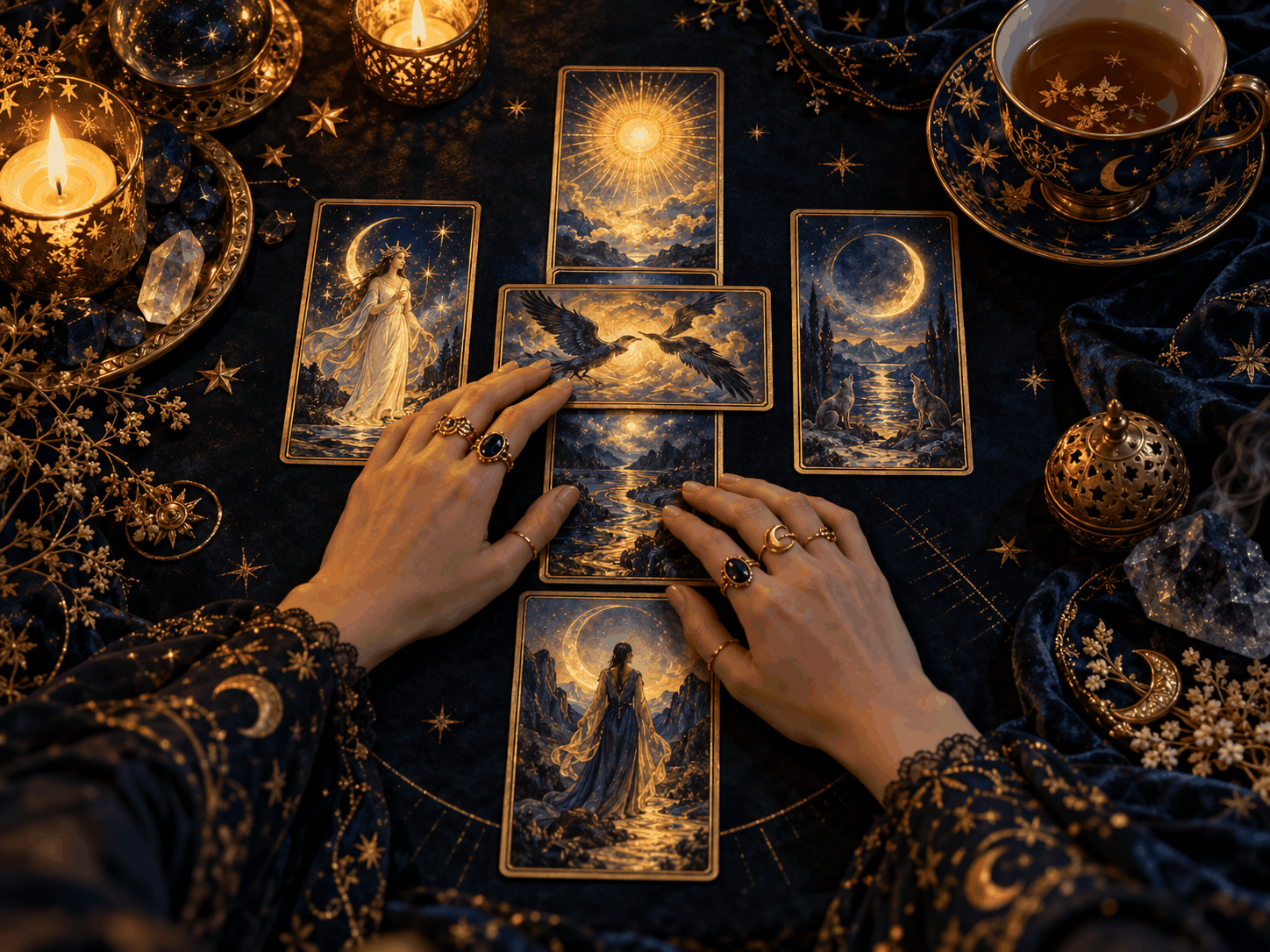
Short on time? You do not always need all ten cards. A "mini cross" of cards 1, 2, 3, 5 and 10 (present, challenge, foundation, goal and outcome) gives you much of the depth in half the time. You can also lay only the cross (cards 1–6) when you want to understand a situation without asking about the outcome. When you feel ready, return to the full spread, because the staff, especially cards 7 and 9, is where many of the most personal insights appear.
Common Celtic Cross Mistakes
- Reading ten separate answers. The power of the spread is in the relationships between cards.
- Using it for small questions. "What should I wear today?" does not need ten cards.
- Mixing versions of the layout. Choose one numbering and stick to it.
- Panicking about the outcome card. It reflects the current path, which you can change.
- Rushing. It is perfectly fine to sit with a Celtic Cross for twenty minutes, or come back to it the next day.
Try a Celtic Cross Reading With GOOD TIMING
If you would like to practice without a physical deck, you can draw cards online with GOOD TIMING's free tarot reading and work through your question step by step.
Frequently Asked Questions
What is the Celtic Cross tarot spread?
The Celtic Cross is a ten-card tarot spread made of a cross of six cards and a vertical staff of four. It looks at the present situation, the challenge, the foundation, the recent past, the goal, the near future, your attitude, external influences, hopes and fears, and the likely outcome.
What are the 10 positions of the Celtic Cross?
In a widely used version: 1 present, 2 challenge, 3 foundation, 4 recent past, 5 crown or goal, 6 near future, 7 self, 8 external influences, 9 hopes and fears, and 10 outcome. Some books order cards 3–6 differently, so choose one version and stay consistent.
Is the Celtic Cross really Celtic?
Not in origin. It was popularized by Arthur Edward Waite in 1910, who called it an ancient Celtic method, but there is no evidence the ancient Celts used tarot. The name comes from its shape, which resembles a Celtic cross.
Is the Celtic Cross good for beginners?
It can be, once you are comfortable with a few simpler spreads. Many beginners start with three-card spreads and move to the Celtic Cross when they want a deeper reading. Taking notes and comparing the position pairs makes it much easier.
What question should I ask with a Celtic Cross?
Use it for important, complex questions where you want the whole picture, such as a relationship at a turning point, a career decision or a situation that feels stuck. Open questions like "What do I need to understand about…?" work best.
How do I read the outcome card in a Celtic Cross?
Read card 10 as where things are likely to go if the current path continues. Compare it with card 1 to see the overall arc, and with cards 7 and 9 to see how your attitude and hopes or fears are shaping it.
How long does a Celtic Cross reading take?
A thoughtful Celtic Cross reading usually takes twenty to forty minutes. It is fine to take longer, to make notes, or to revisit the spread the next day.
Final Thoughts: Ten Cards, One Clear Picture
The Celtic Cross can look intimidating at first: ten cards, two parts, dozens of possible relationships. But at heart, it is simply a structured way of asking the most useful questions about a situation: what is happening, what is in the way, where did it come from, where is it going, and what role do I play?
Read the center first, compare the pairs, look at the pattern and finish with one practical step. With a little practice, the cross and the staff stop feeling like a puzzle and start feeling like a map.
Lay the cross, read the relationships, and let the whole picture guide your next step.