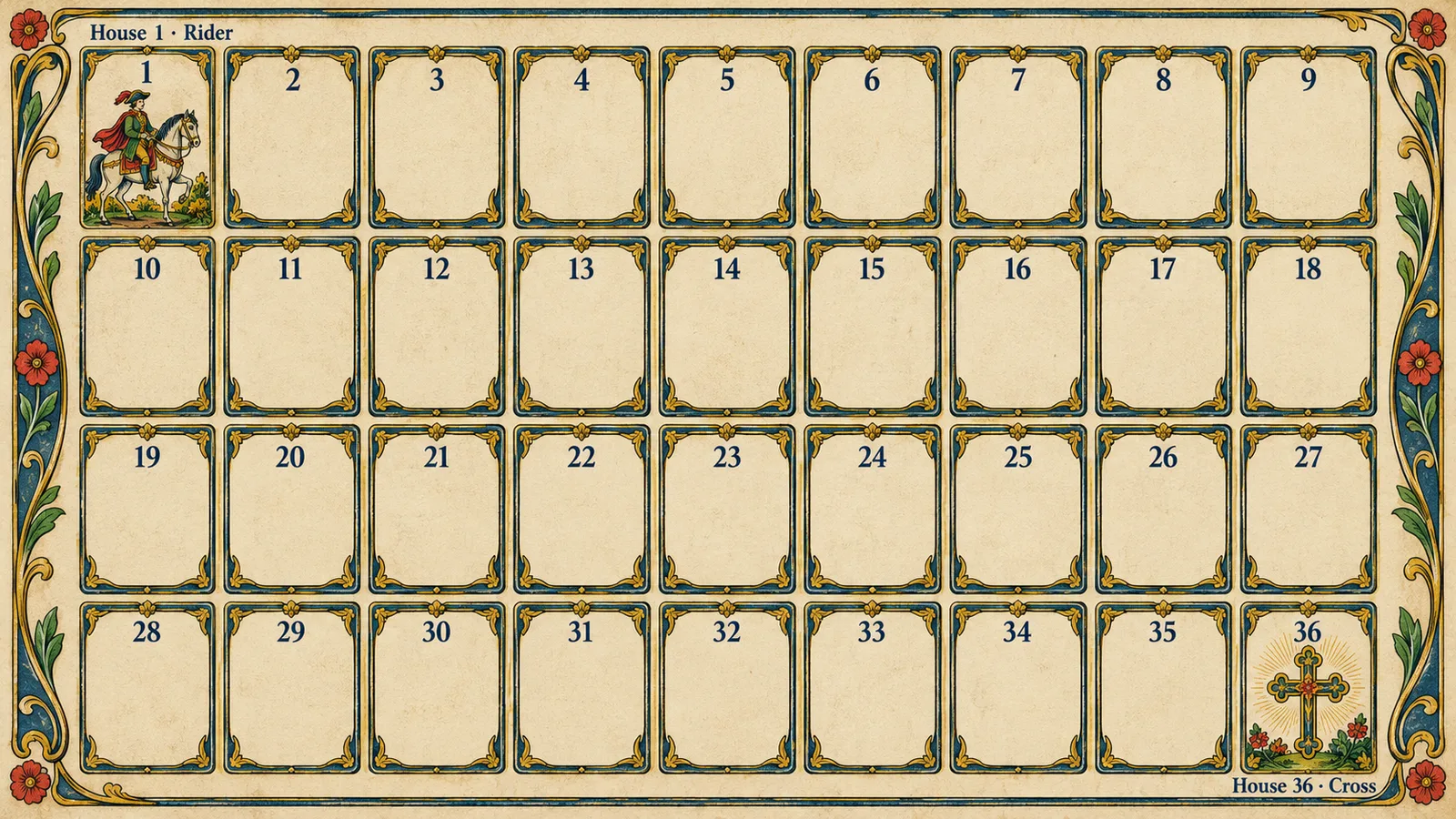
A Lenormand Grand Tableau lays out all 36 cards in a grid, usually 9 columns by 4 rows. Each position is a "house" tied to the card with the same number. Find the card for the person or question, then read its neighbors and the house it sits in.
What is a Lenormand Grand Tableau?
It is a spread that uses the whole 36-card Petit Lenormand deck at once, with every card visible at the same time. Instead of reading one short line, you read how the cards sit around the card that stands for the person asking, called the querent.
The Grand Tableau suits longer-term, general readings, covering the next month at the very least and usually more. It is not a quick yes-or-no spread. If you can already read a three-card line and a nine-card square, you have the building blocks.
GOOD TIMING's Lenormand reading offers Quick Look (1 card), Three-Card Line (3), Five-Card Line (5) and Nine-Card Portrait (9). It does not offer a 36-card tableau, so this guide is for learning the method with your own deck, and the Nine-Card Portrait is the closest thing you can cast with us.
How do you lay out the 36 cards?
Shuffle, then lay the cards left to right in rows of nine until you have four rows. Number the positions 1 to 36, row by row.
The table shows the layout by column. Each cell is a position number and the card whose house it is.
| Column | Row 1 | Row 2 | Row 3 | Row 4 |
|---|---|---|---|---|
| 1 | 1 Rider | 10 Scythe | 19 Tower | 28 Man |
| 2 | 2 Clover | 11 Whip | 20 Garden | 29 Woman |
| 3 | 3 Ship | 12 Birds | 21 Mountain | 30 Lily |
| 4 | 4 House | 13 Child | 22 Crossroads | 31 Sun |
| 5 | 5 Tree | 14 Fox | 23 Mice | 32 Moon |
| 6 | 6 Clouds | 15 Bear | 24 Heart | 33 Key |
| 7 | 7 Snake | 16 Stars | 25 Ring | 34 Fish |
| 8 | 8 Coffin | 17 Stork | 26 Book | 35 Anchor |
| 9 | 9 Bouquet | 18 Dog | 27 Letter | 36 Cross |
Is the layout 9×4 or 8×4 plus 4?
Both are in use. The other common version has four rows of eight, plus four cards centered in a last row. The two are almost identical, except that the final four cards act as an extra "finale" reading. Some readers call those last four the "cards of fate" and give them a range of about 8 to 12 weeks from the present. Numbering stays the same either way, but the neighbors change. Pick one layout before you shuffle and note it with your result.
What are houses in a Grand Tableau?
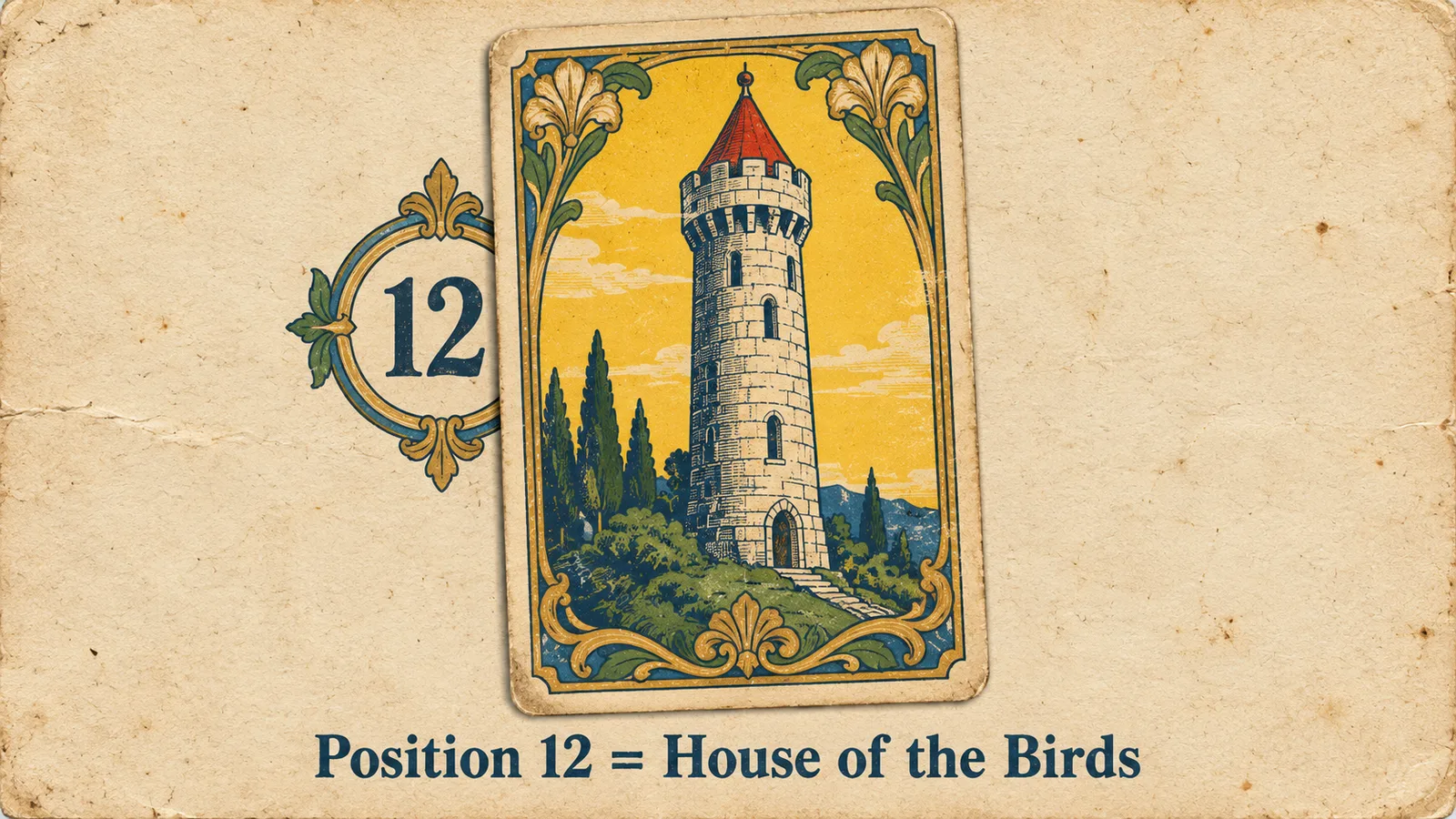
A house is the fixed theme of a position, taken from the card with the same number. Position 1 is always the House of the Rider, position 2 is the House of the Clover, and so on to position 36, the House of the Cross. The house never changes; the card that lands in it does.
Each house has a theme, such as news and visits for the Rider, communication and conversations for the Birds, work and survival for the Fox, love life for the Heart, and burdens and responsibilities for the Cross. Teachers phrase these a little differently, and some readers ignore houses altogether. Both ways work fine.
Keep two things separate: the card that was drawn and the house under it. For example, the Letter landing in house 25 is "Letter in the Ring house," read with the Letter's own neighbors. The house is not a second card to count. In practice, the house tends to lend its theme to the card in it rather than the other way around.
How do you find the significator?
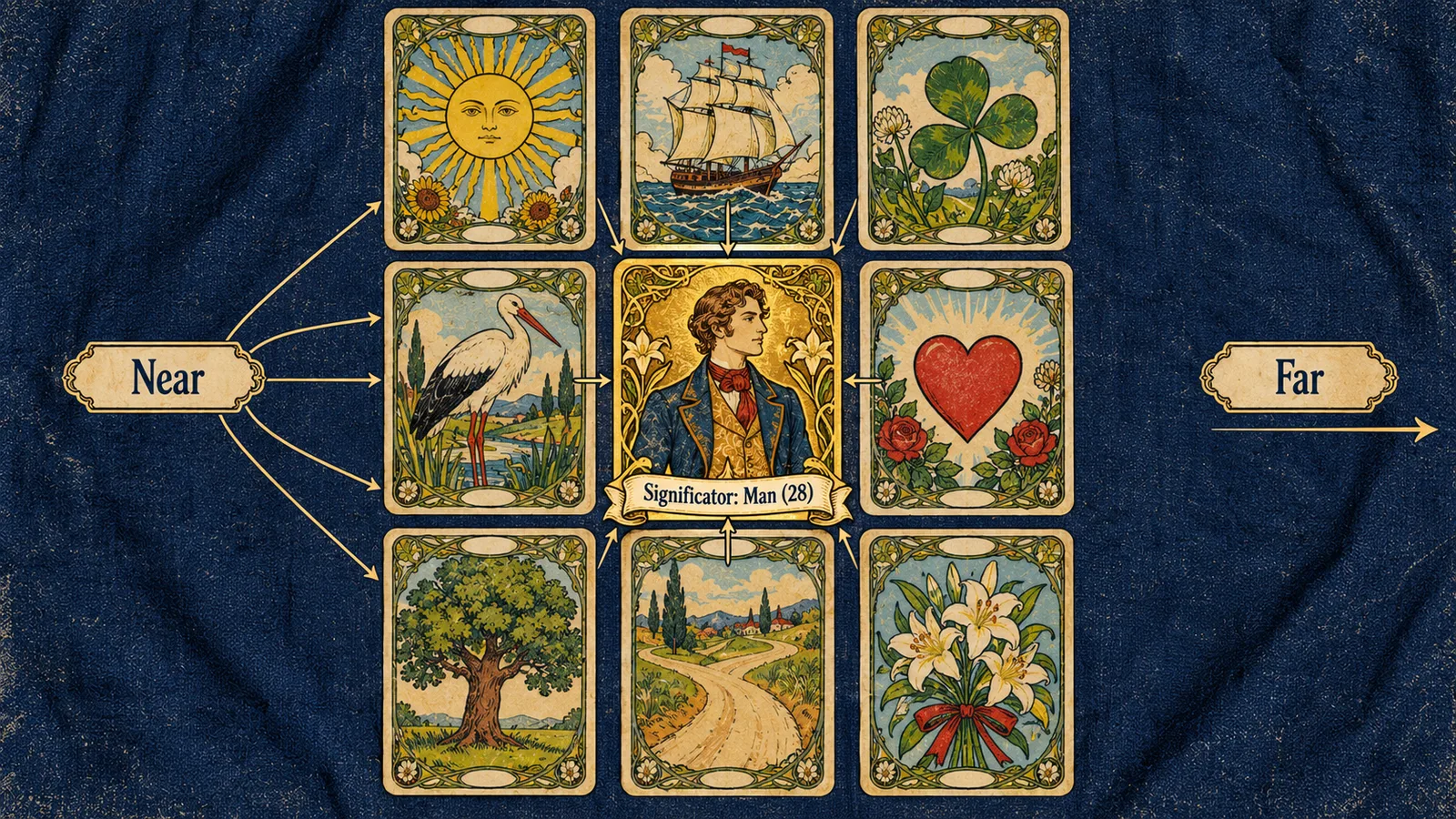
The significator is the card that stands for the querent. The usual rule is Man (28) for a male querent and Woman (29) for a female querent. Its position matters a great deal, because it affects the whole reading.
The classic rule assumes a male or female querent. If that doesn't fit, you can decide in advance which of the two cards, or which other card, will stand for the querent. That is a modern choice rather than a traditional rule, so settle it before you shuffle.
Once you find the card, read the main directions around it:
- Left of the card is the past, and right is the future.
- Above are conscious influences, and below are unconscious ones. The higher the card sits in the grid, the more control the querent is said to have.
- Closer cards have more influence now, and farther cards matter less or come later.
How do you read a Grand Tableau, step by step?
Readers differ, and you can go as deep as you like. This is a beginner's path for the 9×4 layout:
- Set the question and layout. Choose 9×4 or 8×4+4 and say what you are asking about.
- Get an overview. Look at the first four cards, then the four corners. In the 9×4 layout the corners are positions 1, 9, 28 and 36, read as the diagonal pairs 1 + 36 and 28 + 9.
- Find the querent card. Note its position, its house, and whether it sits more toward the past or the future.
- Read the nine-card square around it. Treat the querent as the center of a 3×3. Near an edge, you can only read part of it.
- Read its row and column in pairs. Move left to right along the row from past to future, and top to bottom along the column.
- Check the topic cards. If your question is about love, find the Heart and read the cards around it. Other topics have their own cards, such as Fish for money, House for home and family, and Ship for travel.
- Optionally, add houses. Read each card with the house it fell in.
Advanced readers add mirroring (the card directly opposite on an axis, so position 2 mirrors 29 vertically and 8 horizontally), reflection (the card in the point-opposite spot, so position 1 pairs with 36) and "knighting." You do not need them to start. For pairs and short chains, see how Lenormand combinations work, and for what each card means, see our Lenormand card meanings guide.
What does a complete worked example look like?
Here is a full 36-card layout to read along with. The reader asks, "What should I weigh as I plan the next few months?" and the querent is a woman, so the significator is the Woman. Each cell shows the position number first, then the card that landed there.
| Column | Row 1 | Row 2 | Row 3 | Row 4 |
|---|---|---|---|---|
| 1 | 1 Birds | 10 Snake | 19 Ship | 28 Mice |
| 2 | 2 Child | 11 Lily | 20 Stars | 29 Cross |
| 3 | 3 Moon | 12 Tower | 21 Garden | 30 Bouquet |
| 4 | 4 Sun | 13 Fish | 22 Woman | 31 Mountain |
| 5 | 5 Man | 14 Scythe | 23 Crossroads | 32 Key |
| 6 | 6 House | 15 Stork | 24 Bear | 33 Dog |
| 7 | 7 Letter | 16 Heart | 25 Tree | 34 Rider |
| 8 | 8 Fox | 17 Anchor | 26 Whip | 35 Coffin |
| 9 | 9 Ring | 18 Book | 27 Clouds | 36 Clover |
Read it with the steps above:
- Overview. The first four cards (positions 1 to 4) are Birds, Child, Moon and Sun: conversation, a small step, recognition and clarity. The corner pairs are Birds with Clover (positions 1 and 36) and Mice with Ring (28 and 9): talk and luck on one diagonal, worry and commitment on the other.
- Querent. The Woman sits in position 22, in row 3, column 4. That is the House of the Crossroads, which is a thematic clue that choices and options are in play. The Woman is in the middle of the grid, so a full 3×3 square fits around her.
- The square around her. Tower (12), Fish (13) and Scythe (14) are above; Garden (21) and Crossroads (23) are on either side; Bouquet (30), Mountain (31) and Key (32) are below. Garden beside the Woman suggests she is active in public or shared spaces. The Crossroads card on her right, the future side, points to a choice ahead, and because it is adjacent, it is near in time. Fish above puts money and resources in conscious view. Mountain below hints at a delay or obstacle under the surface, and the Key on the lower right suggests a possible opening.
- Her row and column. In row 3, the cards on the left, Ship, Stars and Garden, suggest earlier movement and aiming. On the right, Crossroads, Bear, Tree, Whip and Clouds suggest a choice, then resources or protection, then slow growth, with friction and uncertainty farther out. In column 4, the Sun at the top shows clarity in the background, and the Mountain at the bottom is the thing to plan around.
- A topic card. The question is about planning, so look at the Fish for money (position 13, right above her) and the Heart for what she wants (position 16, in the House of the Stars, so her wishes link to her goals).
- A house check. The Tower sits in position 12, the House of the Birds, so the Tower's formal structure may involve conversations or messages.
A fair summary: a choice is coming soon, money is in view, an obstacle may be hiding, and an opening is possible. The practical advice is to weigh the money and the hidden delay before the choice arrives, and to use the Key's opening once the choice is made. Note the date and your reading, and look back after a month.
Where does the Grand Tableau come from?
The deck behind it is older than the name suggests. The 36 cards trace back to Das Spiel der Hoffnung (The Game of Hope), published in Nuremberg by Johann Kaspar Hechtel around 1799. The game was meant for a 6×6 grid, with the Rider at the start and the Anchor, called Hope, at the end.
The divination deck, the Petit Lenormand, appeared in Germany in 1846. That was three years after the death of Marie-Anne Lenormand (1772–1843), a famous Paris fortune-teller whose name was borrowed for marketing; she never used it. Nobody knows exactly who first laid the deck out as a Grand Tableau, so it is hard to put a date on it. If you want the comparison with tarot, see tarot vs Lenormand, and for a topic-specific example, see Lenormand for career questions.
Good to know
Teachers read the Grand Tableau in different ways, with or without houses and in 9×4 or 8×4+4 layouts. Choose one method, write it down with your result, and treat a card in a tricky house such as Snake or Mountain as a cue to look closer.
Frequently asked questions
What is a Grand Tableau?
It is a Lenormand spread that lays out all 36 cards, usually in four rows of nine. You read the cards around the querent's card, the lines it sits in, and the house of each position, for a broad view of a longer period.
What are houses in a Grand Tableau?
Each of the 36 positions is a "house" taken from the card with the same number: position 1 is the Rider's house and position 36 is the Cross's house. The house stays fixed. It adds a theme to whichever card lands there.
How do I find the significator?
Look for Man (28) if the querent is male and Woman (29) if female. Its position shows how past, future, conscious and unconscious influences sit around the person. If neither fits, choose a card before shuffling and write it down.
Is the layout 9×4 or 8×4+4?
Both are in common use. 9×4 is four rows of nine. 8×4+4 is four rows of eight plus four centered cards. House numbers stay the same, but the neighbors and corner cards change, so choose one before you shuffle.
How long does a Grand Tableau reading take?
There is no standard length. It is not a quick reading, and the time depends on how many steps you use. A pass through the querent, the nine-card square and the corners is much shorter than reading every row, column and house.
Can I do a Grand Tableau on GOOD TIMING?
The online Lenormand reading offers Quick Look (1 card), Three-Card Line (3), Five-Card Line (5) and Nine-Card Portrait (9). The 36-card tableau is for your own deck.