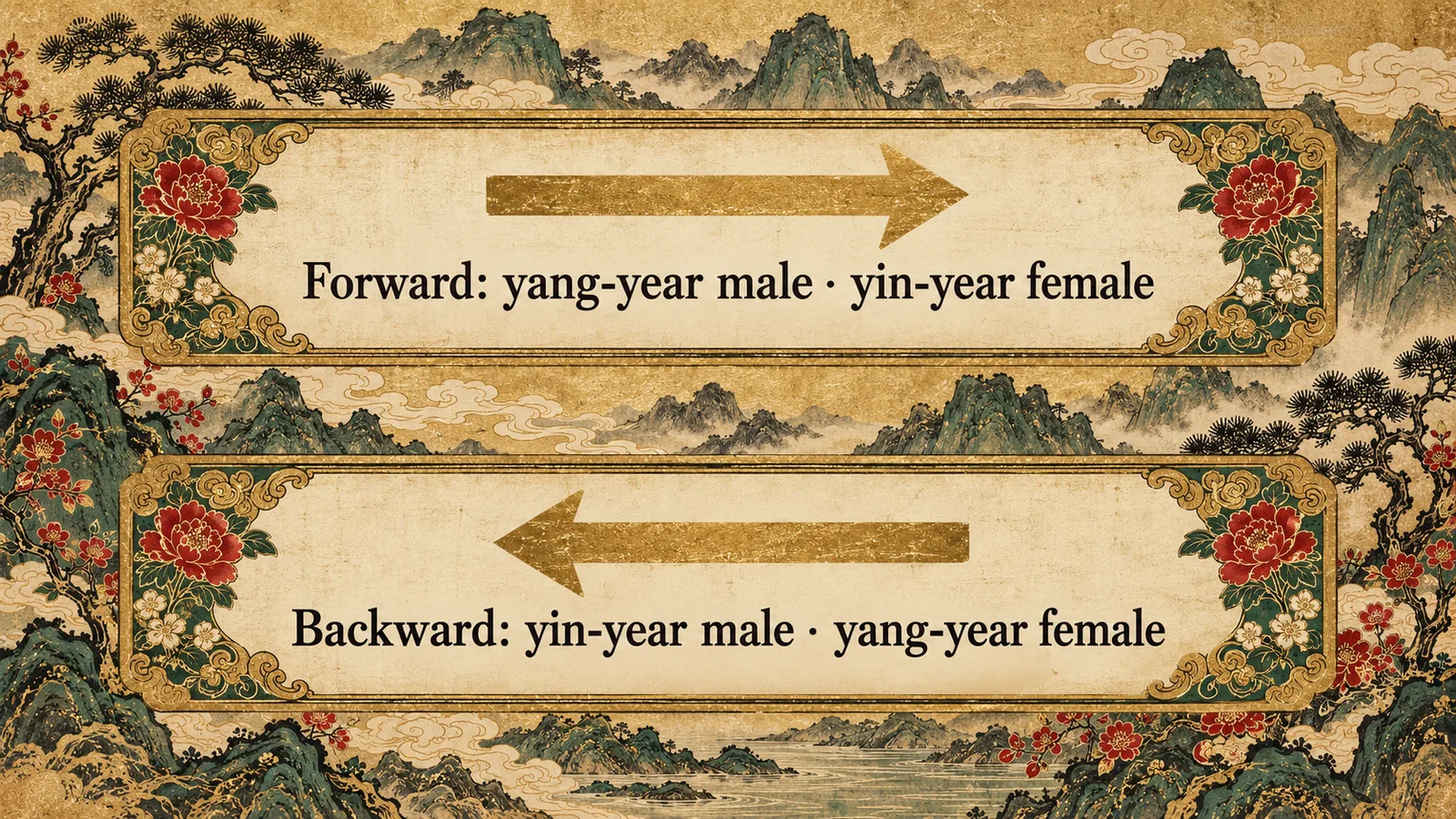
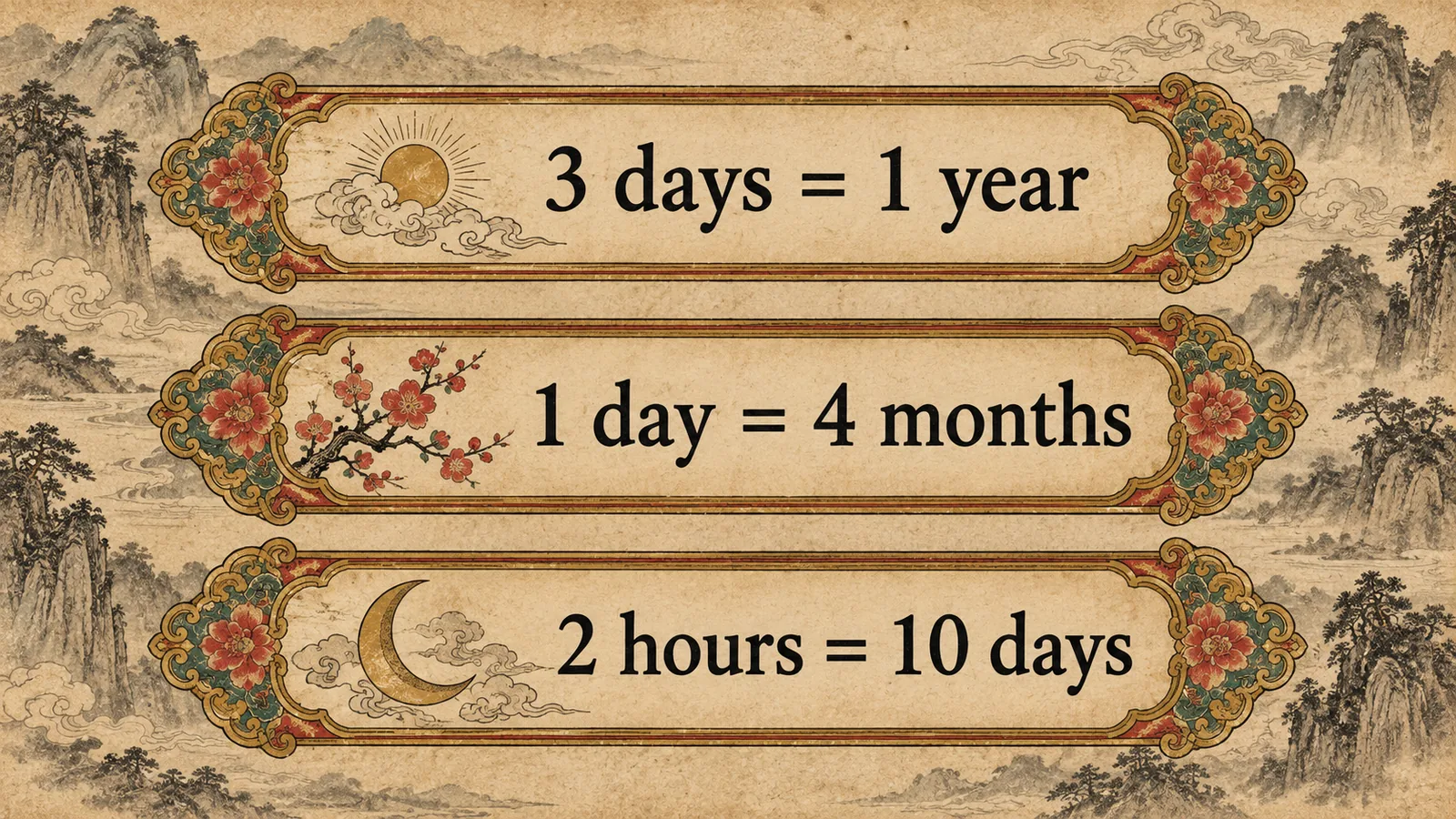
A BaZi luck pillar (Da Yun) is a 10-year chapter of life, written as a stem-branch pair and counted outward from your month pillar. Yang-year men and yin-year women count forward; the others count backward. Your start age comes from the days between your birth and a solar term: 3 days equal 1 year.
Want your own pillars without the arithmetic? The BaZi reading works out your Luck Cycles, with direction and start age done for you. The rest of this guide shows how the numbers work, so you can check any chart you see.
What is a luck pillar (Da Yun)?
A luck pillar is a ten-year stretch with its own flavor, and it is the main tool BaZi uses to judge which decades help you and which ask more of you. Your four pillars are the chart you are born with, and luck pillars are the weather that moves across it. Each one is a pair of characters, a Heavenly Stem and an Earthly Branch, like 庚午 (Geng-Wu), and it is read against your Day Master (the stem of your day pillar, the heart of your chart).
Think of it in layers. The natal chart is your climate, a luck pillar is the season you are in, and the annual pillar is this year's weather. Traditional readers use that stack to say which stretches tend to be supportive, which tend to be demanding, and when in a decade the turning points sit.
If you are new to BaZi, what is BaZi is a good place to start, and the Day Master guide explains the stem every pillar is compared with.
How are BaZi luck pillars calculated?
There are three steps: start from your month pillar, decide the direction, and work out the start age. After that, the pillars follow the 60-pair stem-branch cycle, ten years each.
Step 1: Start from your month pillar
The first luck pillar is the one right after (or right before) your month pillar. BaZi months follow the solar calendar, not the lunar one, and each month begins at a "jie" solar term, such as Lichun in early February. Any BaZi chart shows your month pillar.
Step 2: Decide the direction
Look at the stem of your year pillar, which turns over at Lichun and not on January 1 or Lunar New Year, and at the traditional male or female setting.
| Year stem | Male | Female |
|---|---|---|
| Yang (甲 丙 戊 庚 壬) | Forward | Backward |
| Yin (乙 丁 己 辛 癸) | Backward | Forward |
Forward means moving to the next pair in the 60-pair cycle: 己巳 becomes 庚午, then 辛未. Backward means the previous one: 己巳 becomes 戊辰, then 丁卯.
The traditional rule only has two settings, male and female. GOOD TIMING's BaZi reading asks for your gender (female, male or other), and if you choose "other" it asks which of the two traditional settings to use for the luck-pillar direction. Choose the one you want the calculation to follow, and the rest works the same.
Step 3: Work out the start age
Count the time from birth to the next jie (for a forward chart) or back to the previous jie (for a backward chart). The twelve jie are Lichun, Jingzhe, Qingming, Lixia, Mangzhong, Xiaoshu, Liqiu, Bailu, Hanlu, Lidong, Daxue and Xiaohan. Then use this rule:
- 3 days = 1 year
- 1 day = 4 months
- 2 hours = 10 days
The in-between solar terms, such as Yushui or Guyu, do not count here. Only the twelve jie do.
A worked example you can follow
Take a fictional man born on June 1, 1994 at 14:30 in Shanghai. His four pillars are 甲戌 (year), 己巳 (month), 戊午 (day) and 己未 (hour). His Day Master is 戊 (yang Earth).
- Direction. The year stem 甲 is yang and he is male, so the pillars go forward.
- Next jie. Mangzhong arrives on June 6, 1994 at 06:05 (China standard time).
- Counting. From June 1 at 14:30 to June 6 at 06:05 is 4 days, 15 hours and 35 minutes. Four days is 1 year and 4 months. Fifteen hours and 35 minutes is about 78 days at 1 hour = 5 days, or 2 months and 18 days. Total: 1 year, 6 months and 18 days, so his first pillar begins around December 19, 1995.
- Pillars. From the month pillar 己巳, going forward: 庚午, 辛未, 壬申, 癸酉, 甲戌.
| Luck pillar | Age label | Starts (about) |
|---|---|---|
| 庚午 | 2 to 11 | December 19, 1995 |
| 辛未 | 12 to 21 | December 19, 2005 |
| 壬申 | 22 to 31 | December 19, 2015 |
| 癸酉 | 32 to 41 | December 19, 2025 |
| 甲戌 | 42 to 51 | December 19, 2035 |
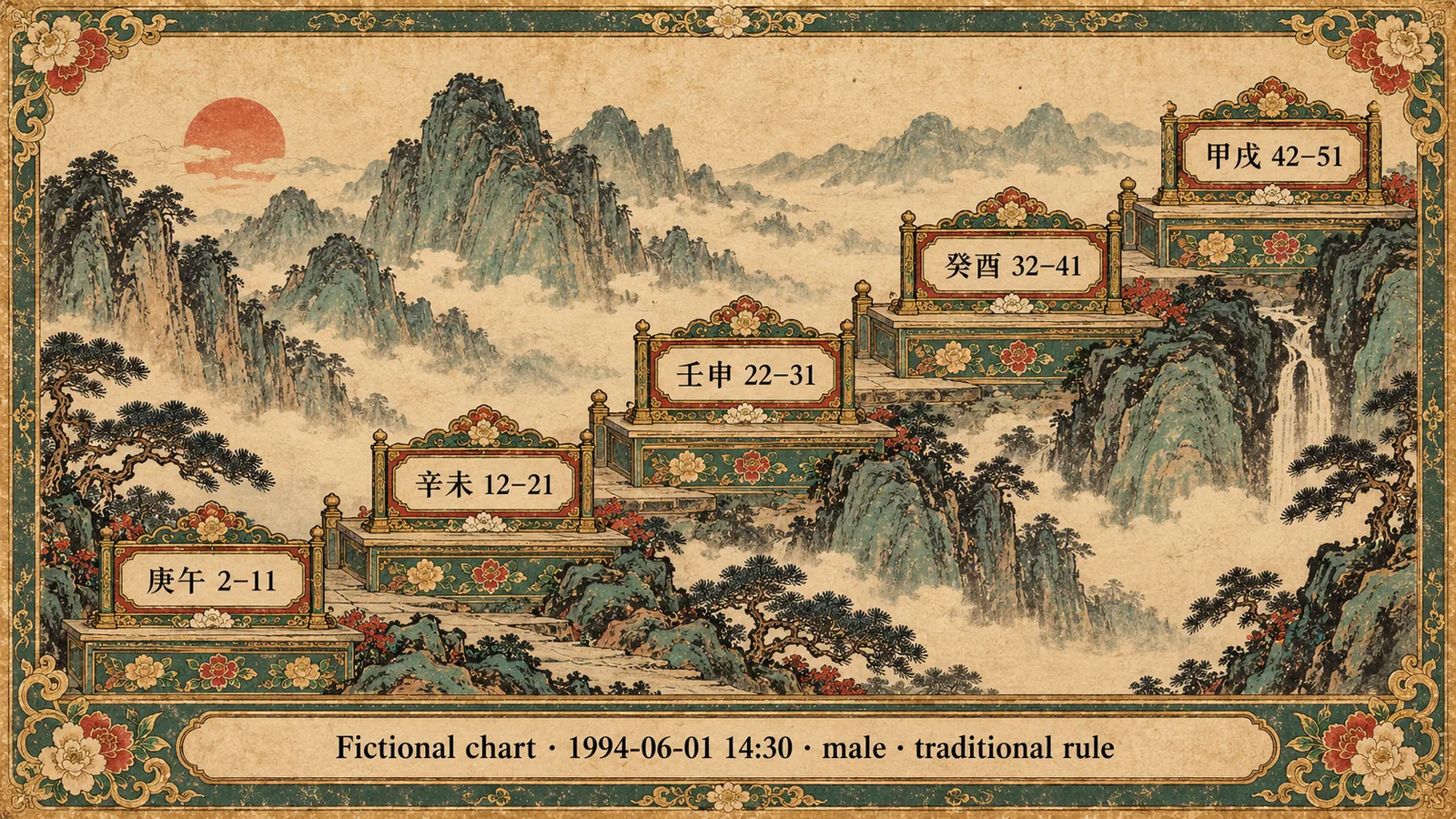
Which ages are these? The labels are traditional ages, where you count as 1 at birth and add a year with each new calendar year, so they run about a year ahead of the age you have completed. This man's first pillar really begins when he is 1½ years old (the "2" label), and his second when he is 11½ (the "12" label). Every chart in this guide uses the same labels, and the start dates show the exact timing.
Same birth, opposite direction
Now run the same birth as female. The year stem 甲 is yang and she is female, so the pillars go backward, and she counts back to the previous jie, Lixia on May 6, 1994 at 01:54. From there to June 1 at 14:30 is 26 days, 12 hours and 36 minutes: 26 days is 8 years and 8 months, and 12 hours 36 minutes is 63 days, or 2 months and 3 days. Total: 8 years, 10 months and 3 days, so her first pillar begins in early April 2003. Going backward from 己巳: 戊辰 (age label 10 to 19), 丁卯 (20 to 29), 丙寅 (30 to 39), 乙丑 (40 to 49), 甲子 (50 to 59).
Same four pillars, very different timeline. That is why direction matters so much.
Why do different calculators give slightly different start ages?
A day or two of difference between tools is almost always rounding. This guide counts to the minute from standard clock time, takes a month as 30 days and rounds to the day. Other tools may count in two-hour blocks, round to the month or use a different jie time, so the start date can shift by a few days, and the year or age label can shift if they count age differently. The pillars themselves should match. If the pillar sequence or the direction is different, check the year pillar (did the tool split the year at Lichun?) and the male or female setting.
How do you read a luck pillar?
Read a pillar against your whole natal chart, not by its name alone. The same stem-branch pair can lift one chart and weigh on another. Traditional readers check three things first: whether the Day Master is strong or weak and what the chart has too much or too little of, which hidden stems the pillar's branch brings in, and which combinations or clashes the new pillar forms with the branches already in your chart.
Our example shows why. The chart 甲戌 己巳 戊午 己未 is born in the fire month of 巳, and 巳, 午 and 未 together form the "south" fire combination, with 午 and 未 also pairing up. Earth is everywhere, fire keeps feeding it, and there is no water at all, so the Day Master 戊 is very strong and the chart runs hot and dry. A reader would look for what cools and drains it: water and metal.
That makes the pillars read very differently from how their ten-god labels alone suggest:
- 庚午 (2–11) and 辛未 (12–21): 庚 and 辛 are metal, which drains Earth (Eating God and Hurting Officer), but the branches 午 and 未 pour more fire and earth into a chart that already has plenty. Mixed: expressive and capable, but with a lot of heat.
- 壬申 (22–31) and 癸酉 (32–41): water on top of metal, bringing the cooling and draining the chart wants (Indirect and Direct Wealth). These are the supportive decades for this chart, and the second one is where he is now.
- 甲戌 (42–51): 甲 (Seven Killings) sits on 戌, an earth-and-fire storehouse. It adds weight and dryness again, so this decade is read as demanding, and the 甲己 combination with the month stem is part of that picture.
Some teachers read the stem as the first five years of a pillar and the branch as the last five. Others read the pair as one unit. Try the one-unit view first, then refine.
Checking your own pillars: four quick tips
- Born in January or early February? Check your year pillar. The year changes at Lichun, so you may belong to the previous year's stem, and that can flip your direction.
- Born close to a jie? If your birthday is within a day or two of a solar term (about the 4th to 8th of most months), the exact birth time and time zone matter, since they can change your month pillar.
- Know your current pillar. Write down its stem-branch, when it started and when it ends, so you can see which decade you are in.
- Ask a simple question. Does this pillar feed, drain or challenge my Day Master? That is where most readings begin.
To see all of this on your own chart, enter your birth details in the BaZi reading.
Luck pillars and annual pillars
The luck pillar is the decade backdrop, and the annual pillar (Liu Nian) is the layer of the year. 2027 is a 丁未 year. For our example man, in his 癸酉 decade, 丁未 adds fire and earth, which his chart already has plenty of, while the decade supplies the water and metal that balance it, so the decade softens the year. The year pillar changes at Lichun, so Lichun 2027 is the moment the 丁未 year begins, and the Year of the Goat 2027 explains that year.
Can I find my luck pillars without a birth time?
Mostly, yes. The direction and the sequence of pillars depend on your birth date, not the hour, unless you were born right around a jie. The hour only moves the start age, by up to about four months across a whole day, since one day equals four months. Our guide to BaZi without a birth time shows what you can still read.
Frequently asked questions
What is a luck pillar in BaZi?
A luck pillar (Da Yun) is a 10-year phase written as a stem-branch pair, like 庚午. It sits on top of your natal chart and sets the tone of that decade.
How do you calculate Da Yun?
Find the direction from your year stem and the traditional male or female setting (yang-year male and yin-year female go forward, the others go backward), count days to the next or previous jie with 3 days equal to 1 year to get the start age, and then step through the 60-pair cycle, 10 years each.
What is the difference between a luck pillar and an annual pillar?
A luck pillar lasts ten years and sets the decade's background. An annual pillar lasts one year, changes at Lichun and adds a yearly layer on top.
Why does my luck pillar start at age 2 or 8 rather than 0?
The start age depends on how far your birth is from the nearest jie, so it is different for everyone. The age labels also count you as 1 at birth, which pushes them up by one.
Can luck pillars predict my future?
Traditionally, that is what they are for: they show which decades tend to support you and which ask more, and the annual pillars place the timing inside each decade. Read the result as a tendency shaped by your whole chart, since the same pillar lands differently in different charts.
The BaZi reading shows your Luck Cycles and current pillar so you can try this on your own chart.