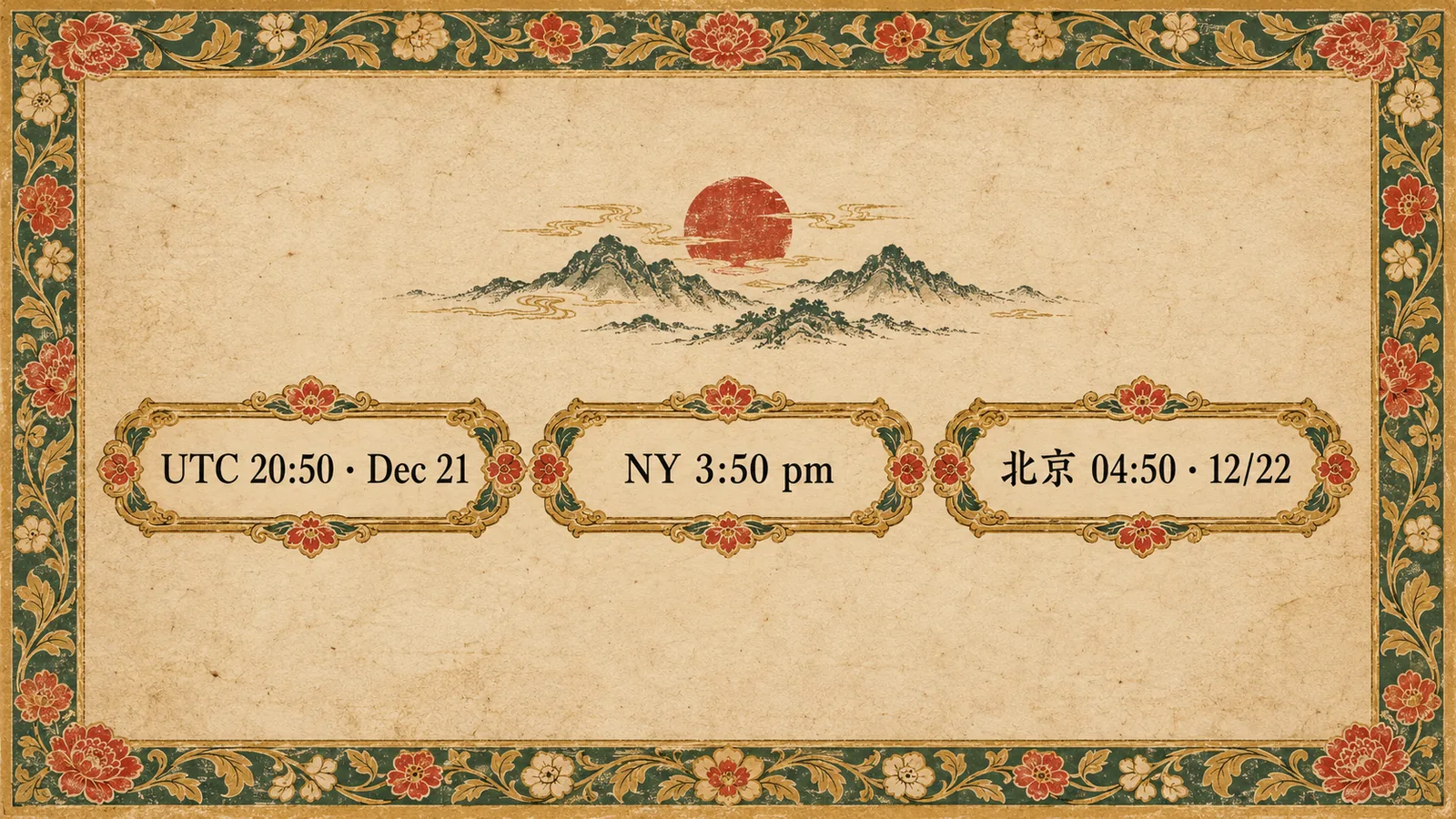
The winter solstice falls on December 21, 2026, at 20:50 UTC: 3:50 pm in New York, and 04:50 on Tuesday, December 22 in Beijing, Hong Kong and Taipei. That is why Chinese calendars mark Dongzhi (冬至) on December 22. It is the longest night of the year in the Northern Hemisphere, the moment the Sun enters Capricorn, and in Chinese tradition the turning point when yang energy is born again.
When is the winter solstice in 2026?
The solstice is a single moment: December 21, 2026 at 20:50 UTC. Because East Asia is already past midnight, the date there is December 22. Chinese, Taiwanese and Hong Kong calendars all list Dongzhi on December 22, which in the lunar calendar is the 14th day of the 11th month (冬月十四).
| Where | Date and time | What it marks |
|---|---|---|
| UTC | Mon, Dec 21, 20:50 | Sun reaches 0° Capricorn (tropical zodiac) |
| New York (EST, UTC−5) | Mon, Dec 21, 3:50 pm | First day of astronomical winter |
| Beijing / Hong Kong / Taipei (UTC+8) | Tue, Dec 22, 04:50 | Dongzhi, the 22nd of the 24 solar terms |
If you celebrate Dongzhi with family abroad, the Chinese calendar date is December 22, and many families cook the solstice meal that day or on the evening before. In the Southern Hemisphere, the same moment is the summer solstice and the longest day.
What does the winter solstice mean in Chinese tradition?
Dongzhi means "winter's extreme," and it is read as the darkest point that turns toward light. The old saying is 冬至一阳生, "at the winter solstice, one yang is born." Yin has reached its fullest, and from tonight the days begin to lengthen. That is why the solstice is a night for family, gratitude and setting your intentions for the bright half of the year.
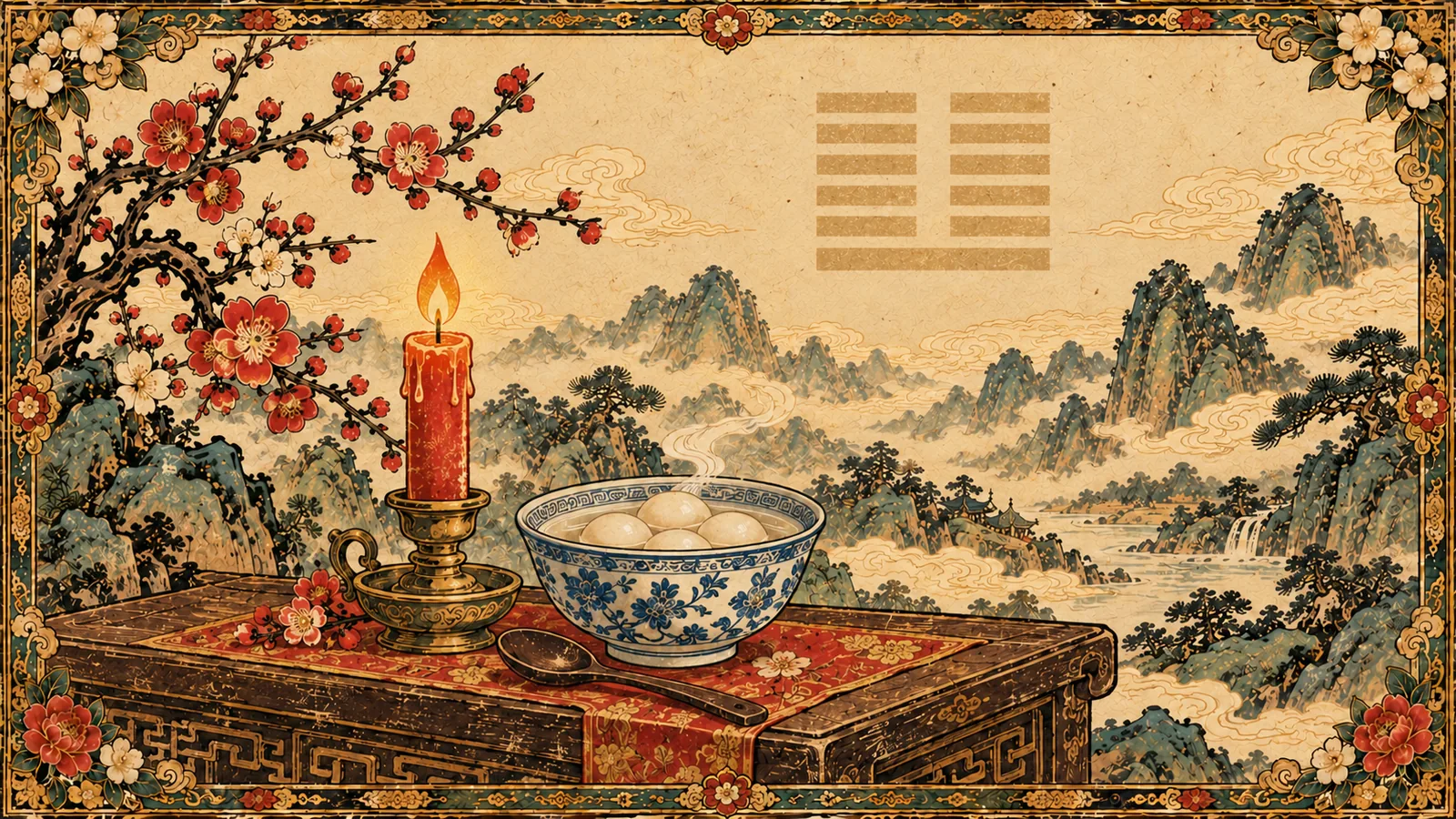
In the I Ching, the eleventh lunar month belongs to hexagram 24, Fu (复, Return): five broken yin lines with a single solid yang line at the bottom. It pictures thunder stirring deep inside the earth, a small new beginning under everything that still looks frozen. Its judgment speaks of the return coming "on the seventh day" and of going out and coming in without harm. The traditional advice for the solstice follows from that image: rest, protect the new spark, and do not force it to grow yet.
Dongzhi has been honored for well over two thousand years. In the Zhou dynasty the year was counted from the month of the solstice, and the saying 冬至大如年, "Dongzhi is as big as New Year," still holds in many families, especially in southern China, Hong Kong and among Cantonese and Hokkien communities, where it is called "doing winter" (做冬).
What do people eat and do on Dongzhi?
The solstice is a food holiday first. What lands on the table depends on where your family is from:
- Dumplings (饺子) in northern China. The saying goes that if you skip dumplings on Dongzhi, your ears will freeze off.
- Tangyuan (汤圆) in the south and in Taiwan, sweet glutinous rice balls whose roundness stands for reunion. Many families say you grow a year older once you have eaten them.
- Wonton, lamb soup or mutton hotpot in other regions, to warm the body for the cold months.
- Ancestor offerings at home or at the family shrine, a quiet thank-you at the turn of the year.
- Winter wine (冬酿酒) in Suzhou, sipped on the night before the solstice.
A practical example. If you live far from family, you can still keep the heart of it in an evening. Make a small bowl of tangyuan or a batch of frozen dumplings, set out one extra cup of tea for the people you are missing, and before you eat, say three things from 2026 you are grateful for and one thing you hope will "return" in 2027. That is a complete Dongzhi: warmth, reunion and a spark of yang.
What is "counting the nines" (数九)?
Counting the nines is the folk calendar of winter: 81 days, in nine blocks of nine, starting on Dongzhi. Each block has its own saying about how cold it gets, and the third and fourth nines are the coldest. For the 2026–2027 winter, counting from December 22:
| Nine | Dates | The old saying |
|---|---|---|
| 1st and 2nd nines | Dec 22, 2026 – Jan 8, 2027 | Hands stay in your sleeves (一九二九不出手) |
| 3rd and 4th nines | Jan 9 – Jan 26 | Walk on the ice (三九四九冰上走) |
| 5th and 6th nines | Jan 27 – Feb 13 | Watch the willows by the river (五九六九沿河看柳) |
| 7th nine | Feb 14 – Feb 22 | The river ice opens (七九河开) |
| 8th nine | Feb 23 – Mar 3 | The wild geese return (八九雁来) |
| 9th nine | Mar 4 – Mar 12 | Oxen are back in the fields (九九加一九,耕牛遍地走) |
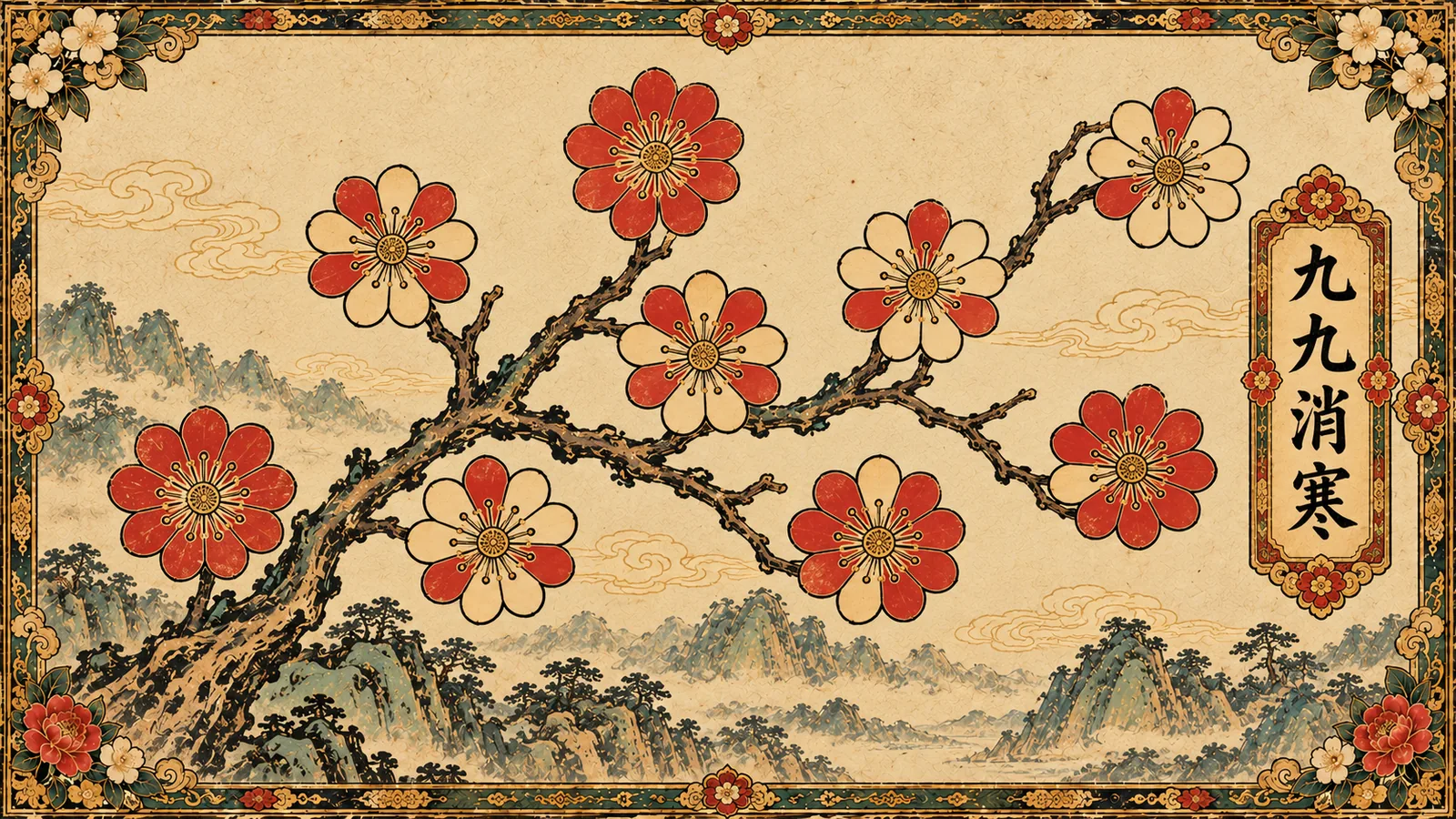
Lichun, the start of spring in the Chinese solar calendar, arrives on February 4, 2027, right at the end of the fifth nine, and Chinese New Year follows on February 6. If you like a slow ritual, try a "dispelling the cold" chart (九九消寒图): draw a plum branch with 81 petals and color in one petal a day. By the time the branch is full of color, spring has arrived.
What does the winter solstice mean in astrology?
In Western astrology, the solstice is the moment the Sun enters 0° Capricorn, so Capricorn season runs from December 21, 2026 to January 20, 2027 (the Sun enters Aquarius at 07:30 UTC that day). Capricorn is the sign of long-term goals, structure and patient climbing, which is why the solstice is a classic time to set intentions you plan to keep all year.
The 2026 solstice has two neighbors that make it feel especially charged. Jupiter turned retrograde in Leo on December 13, which favors reviewing and deepening your plans over starting from scratch. And the year's closest full moon peaks in Cancer on December 24, two days later, opposite the solstice Sun. So the week from December 21 to 24 brings the full Capricorn–Cancer axis into focus: work and home, ambition and care, what you build and who you build it for.
A Dongzhi ritual for the longest night
You need a candle, a bowl of something warm and twenty quiet minutes. In East Asia, do it on the evening of December 21 or 22; in the Americas and Europe, the evening of December 21 is the solstice night itself.
- Turn off all the lights for a minute and sit in the dark. This is yin at its fullest, so let it be restful rather than gloomy.
- Light one candle. That single flame is the one yang line of hexagram Return.
- Name what this year took and what it gave. Say each out loud or write them down.
- Name one thing you want to bring back into your life in 2027, a habit, a friendship, a creative practice, your health.
- Eat something round and warm, tangyuan, dumplings or soup, and keep the candle burning while you eat.
For more on the I Ching itself, see what is the I Ching, and for casting your own hexagram, the three-coin method walks you through it. The next big date on the Chinese calendar is Chinese New Year 2027 and Lichun, and the sky in the rest of the month is in our December 2026 astrology calendar.
Frequently asked questions
What date is the winter solstice in 2026?
December 21, 2026, at 20:50 UTC (3:50 pm EST). In Beijing, Hong Kong and Taipei it is December 22 at 04:50, so Dongzhi is on December 22 in Chinese calendars.
Is Dongzhi on December 21 or 22 in 2026?
December 22. The solstice happens at 04:50 on December 22, China and Taiwan time. In the Americas the astronomical solstice is December 21, but the Chinese calendar date stays December 22.
What do you eat on the winter solstice?
Dumplings in northern China, tangyuan in southern China and Taiwan, and warming soups or hotpot in many regions. In Suzhou people drink a sweet winter wine on the night before.
What does 冬至一阳生 mean?
"At the winter solstice, one yang is born." Yin is at its peak, and light starts returning from this point. In the I Ching it matches hexagram 24, Return, with one yang line under five yin lines.
When do the nines end in 2027?
The 81 days of counting the nines run from December 22, 2026 to March 12, 2027. The coldest stretch, the third and fourth nines, is January 9 to 26, 2027.
Is the solstice the start of the new year in BaZi?
No. In BaZi, months start at the "jie" solar terms, so the Rat month (子月) began at Daxue on December 7, and the new year pillar begins at Lichun on February 4, 2027. Dongzhi sits in the middle of the Rat month as the turning point of yin and yang.