Long before plastic pumpkins and costume aisles, the end of October meant something quieter in Ireland and Scotland.
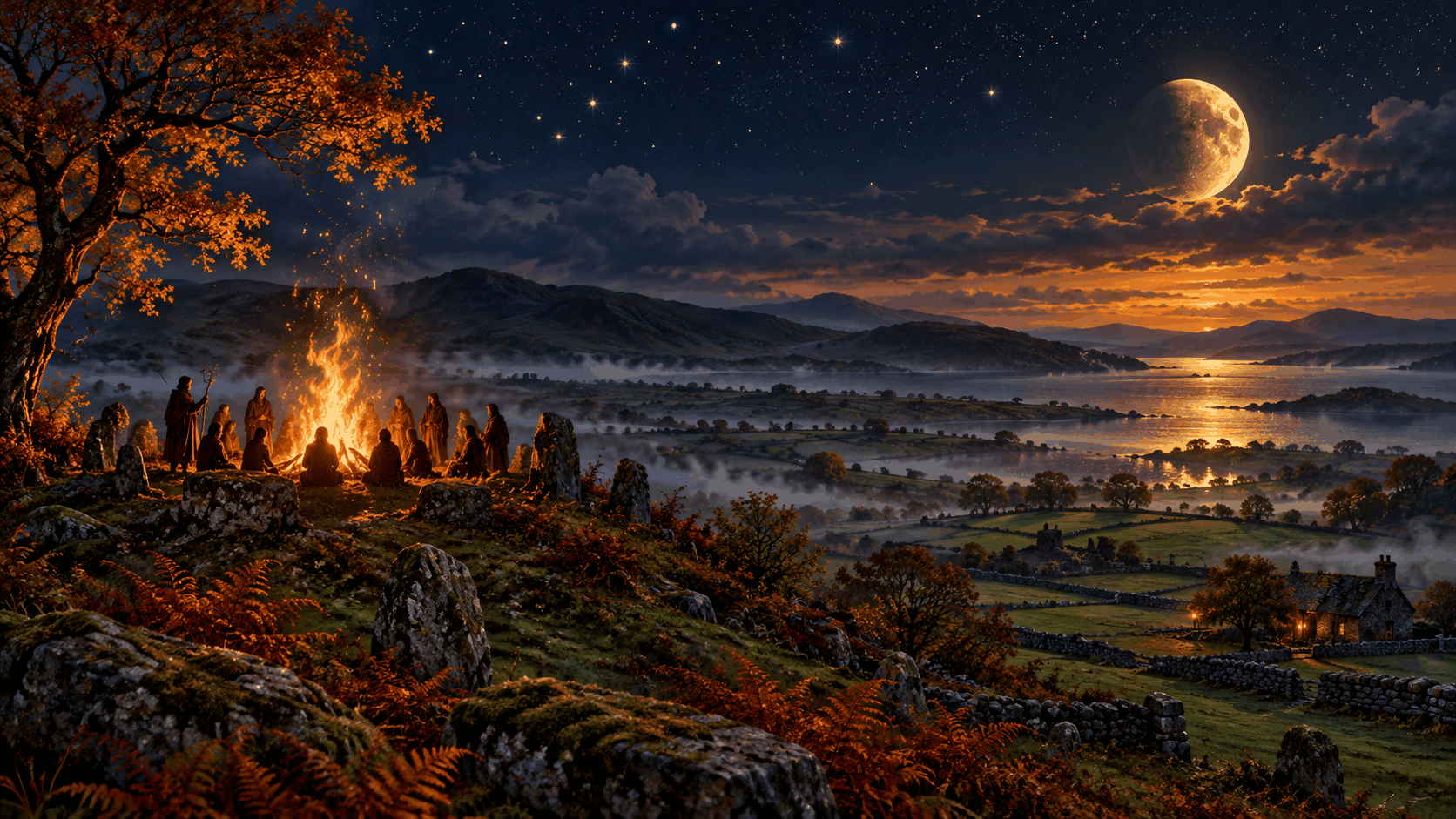
The harvest was in. The cattle were brought down from the summer pastures. The nights were getting long and cold, and the year was turning toward its dark half. People gathered around the fire, told stories, set out food, and, on one particular night, tried to catch a glimpse of what the coming year might hold.
That night was Samhain. And many of the games played around those fires were forms of divination, especially love divination.
This guide is a gentle introduction to Samhain Halloween divination. We will look at what Samhain actually is, where the idea of the "thin veil" comes from, and the traditional Irish and Scottish Halloween fortune-telling customs (apple peels, nuts in the fire, the candlelit mirror, a ring hidden in the colcannon), described honestly as the folklore they are. Then we will bring it into the present with a seven-card Samhain tarot spread, a worked example, and a simple, gentle way to remember the people you have loved and lost.
What Is Samhain?
Samhain (usually pronounced SOW-in or SAH-win) is the Gaelic festival that marks the end of the harvest and the beginning of winter. It is traditionally celebrated from sunset on October 31 to November 1, because in the old Gaelic way of reckoning, a day began at nightfall.
It was one of four great seasonal festivals in the Gaelic year:
| Festival | Approximate date | What it marked |
|---|---|---|
| Imbolc | February 1 | The first stirrings of spring |
| Bealtaine (Beltane) | May 1 | The start of summer |
| Lughnasadh | August 1 | The beginning of the harvest |
| Samhain | October 31–November 1 | The end of harvest and the start of winter |
Samhain appears in some of the earliest Irish literature, where it is a time of great gatherings, feasting, and events that cross between this world and the Otherworld. In later centuries it lived on in folk customs: bonfires on hilltops, guising (going door to door in disguise), carved turnip lanterns, special foods, and the divination games we will look at below.
Today, Samhain is also observed by many modern pagans and witches as a festival of endings, ancestors and reflection, often described as a kind of spiritual new year. In the Southern Hemisphere, where the seasons are reversed, many people who follow the wheel of the year celebrate Samhain around April 30–May 1 instead.
Where the "Thin Veil" Idea Comes From
You will often hear that at Samhain "the veil between the worlds is thin." The phrase is modern, but the idea is old. In Irish and Scottish folklore, Samhain was a liminal night: a doorway between the bright half of the year and the dark half. On that threshold, people believed the boundary between the human world and the Otherworld became easier to cross. The fairy folk, the aos sí, were said to be abroad. Spirits of the dead might return to their old homes, and families sometimes set a place or left food out for them.
With the ordinary rules loosened, it felt like a natural night to ask about the future: who you would marry, and what the coming year would bring.
You do not have to believe in a literal veil to find meaning in this. Many people today understand the "thin veil" more symbolically:
- a season when memory feels closer, and we think more about the people we have lost;
- a time when the darkening year makes us naturally more reflective;
- a threshold where it feels right to let go of the old year and set intentions for the next.
That symbolic reading is the spirit of everything in this guide. Folklore is a beautiful language for reflection, not a set of rules you have to obey.
From Samhain to Halloween
How did Samhain become Halloween?
In the early medieval period, the church established All Saints' Day on November 1, followed by All Souls' Day on November 2, a day for praying for the dead. The evening before All Saints' was All Hallows' Eve, which in time became Hallowe'en.
In Ireland and Scotland, the older Samhain customs and the newer Christian feast days blended together. The night of October 31 kept its bonfires, its disguises, its games and its sense of being a little uncanny. When large numbers of Irish and Scottish people emigrated to North America in the 1800s, they brought these traditions with them. There, the carved turnip lantern became the carved pumpkin, and Halloween slowly grew into the holiday many people know today.
Traditional Irish and Scottish Halloween Love Divinations
Halloween was once one of the great nights for fortune-telling games, especially among young people wondering about love and marriage. Many of these customs are recorded in folklore collections and in Robert Burns's 1785 poem Halloween, which describes a whole evening of them in rural Scotland.
Here are some of the best known. They are shared here as folklore and fun, not as reliable predictions, and with a few safety notes where they matter.
The Apple Peel
Apples are everywhere in Halloween folklore, and this is one of the simplest customs.
How it was done: Peel an apple in one long, unbroken strip. Then throw the peel over your left shoulder. When it lands, look at its shape: it was said to form the first letter of your future sweetheart's name.
Today: This is a lovely, harmless game for a Halloween gathering. Use a peeler rather than a sharp knife if children are joining in, and treat the "letter" as a fun prompt, not a verdict.
Nuts in the Fire
In parts of Scotland and northern England, Halloween was sometimes called Nutcrack Night.
How it was done: Two nuts, often hazelnuts, were named for a couple, perhaps yourself and someone you liked, and placed side by side near the hot embers of the fire. People then watched what happened. If the nuts burned quietly together, the couple would be happy. If one cracked loudly or jumped away from the other, the match would be stormy or would not last. Burns describes this game in Halloween, with nuts that flare up or fly off as signs of a doomed match.
Today: Be careful here. Nuts placed in a fire can pop and throw hot pieces. If you want to recreate the custom, do it only at a proper, guarded fireplace with an adult watching, keep faces and hands well back, and never improvise with an indoor candle. Many people simply tell the story and enjoy it as folklore.
The Candlelit Mirror
How it was done: On Halloween night, a young woman would sit alone before a mirror by candlelight, eating an apple or combing her hair. If she was lucky, the face of her future husband was supposed to appear over her shoulder in the glass. Burns includes a version of this too.
Today: If you try a reflective version of this, sit comfortably at a table, keep the candle in a stable holder, well away from your hair, sleeves and anything that can burn, and never leave it unattended. Treat it as a quiet moment of self-reflection rather than an attempt to summon anything. (Some old versions involve walking backwards down stairs while holding a candle and a mirror. Please skip that one entirely.)
Colcannon and the Hidden Charms
In Ireland, colcannon (mashed potatoes mixed with kale or cabbage, butter and scallions) was a traditional Halloween dish. Small charms were sometimes hidden in it, and whatever turned up on your spoon told your fortune for the year:
- a ring: you would marry soon;
- a coin: wealth or good fortune;
- a thimble: you would stay single;
- a button: a bachelor's life.
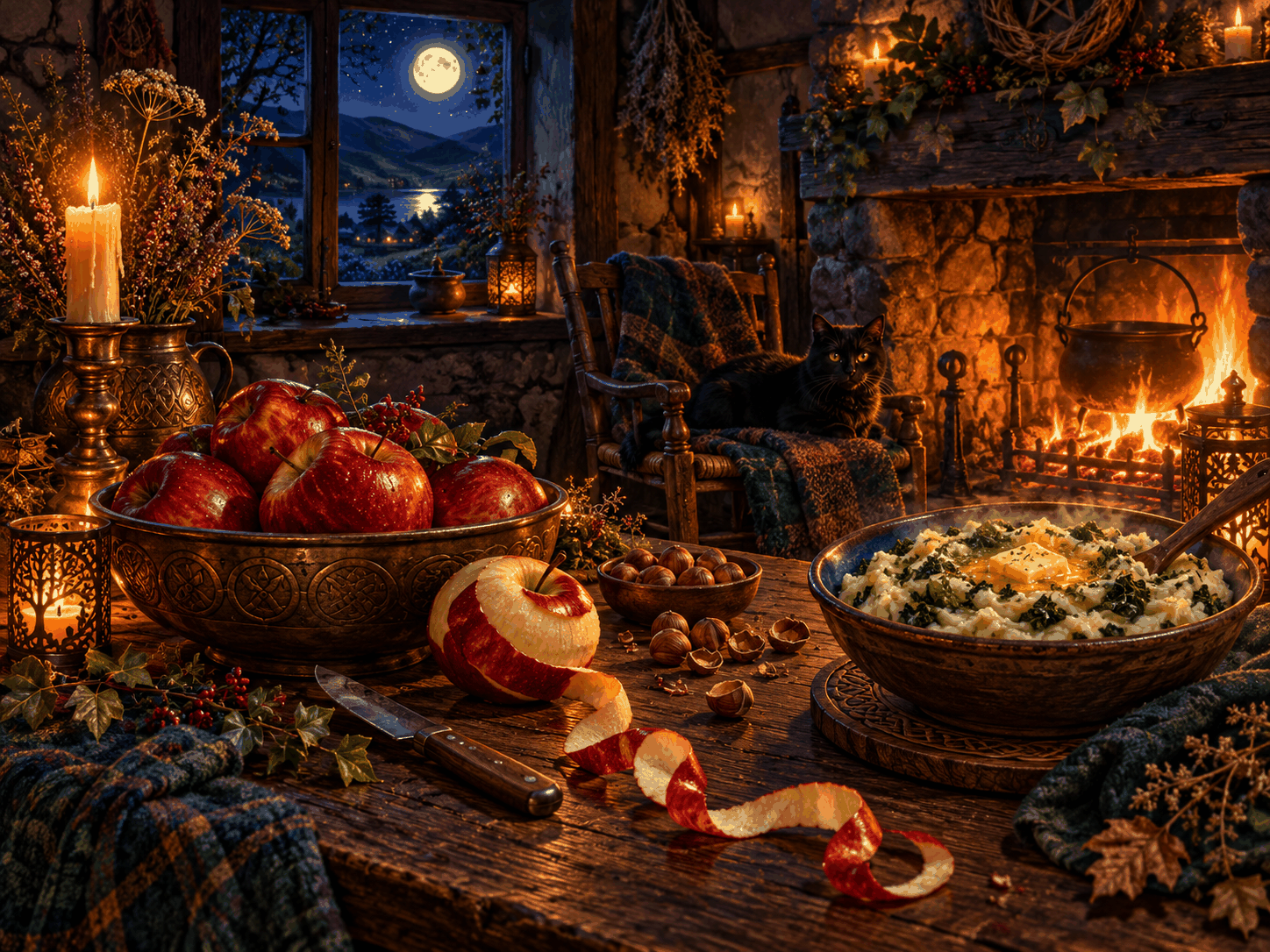
The same idea lives on in barmbrack, a sweet fruit bread still sold in Ireland around Halloween, which traditionally has a ring baked inside.
Today: Hidden objects in food are a real choking and tooth hazard. If you want to keep the custom, tell everyone at the table before they eat, use large, clean, wrapped charms, and do not do it with young children. Or place the charms beside each plate, or under it, instead of inside the food.
Other Old Customs
Folklore records many more Halloween games: pulling kale stalks blindfolded and reading the future spouse's height and character from the shape of the stalk and how much earth clung to it; ducking for apples in a tub of water; snap-apple, where an apple hangs from a string and players try to bite it with their hands behind their backs.
What they share is playfulness: most were group games full of laughter, and nobody took a crooked kale stalk as a life sentence.
A Samhain Tarot Spread
If you would like a more reflective practice, this seven-card Samhain tarot spread follows the themes of the season: endings, ancestors, the dark half of the year, and the seeds of what comes next.
Shuffle slowly and take a few breaths before you begin.
Lay the cards out like this: three cards in a row for the old year, one card above the middle for ancestral wisdom, and three cards in a row below for the year ahead.
- What the past year has harvested for me. What I have grown, learned or gathered.
- What is ready to be released. What belongs to the old year and can be let go.
- What I am grieving or missing. What deserves tenderness before I move on.
- A message of ancestral wisdom. What my roots, my family line or my own past self would want me to know. (This is the card above the middle.)
- What the dark season asks of me. Rest, reflection, or inner work for the winter months.
- The seed I am planting for the new year. An intention to carry forward.
- How to honor the threshold. A small action that marks this turning point.
How to read it: Read the first three cards as one story about the year that is ending, then let card 4 sit over everything as a kind of blessing or advice. Cards 5–7 describe the path into winter and beyond. If card 2 is a heavy card, such as the Tower, Death or the Ten of Swords, that is very fitting for Samhain: it is naming what is ending so you can release it with intention.
If you want help phrasing questions for a spread like this, how to ask tarot questions has many examples.
A Worked Example of the Samhain Spread
Here is how this spread might read for someone at the end of a demanding year. Imagine Ana, who changed jobs, moved city and lost her grandmother in the same twelve months.
- 1. Harvest: Eight of Pentacles. Ana has built real skill this year. The new job was hard, and she rose to it.
- 2. Ready to release: Five of Wands. The constant competition and proving herself at work. The struggle phase is over.
- 3. Grieving: Six of Cups. Childhood, home, the warmth of her grandmother's kitchen. This card asks for tenderness, not hurry.
- 4. Ancestral wisdom: The Empress. Nurturing, abundance, care. It reads almost like her grandmother speaking: feed yourself, rest, let things grow in their own time.
- 5. What the dark season asks: Four of Swords. Real rest. A winter of fewer commitments.
- 6. The seed: Ace of Cups. Opening her heart again, to friendship, creativity and perhaps love.
- 7. How to honor the threshold: Three of Cups. Gather with people who matter. Share a meal, raise a glass, tell stories.
One-sentence summary: I have grown a lot and fought hard this year; now I can stop proving myself, grieve gently, rest through the winter, and let my heart open again, starting with a warm gathering.
The spread does not predict events. It helps Ana understand the year she has lived and how to walk into the next one, which is exactly what Samhain is for.
A Gentle Ancestor Remembrance Practice
For many people, the most meaningful part of Samhain is not fortune-telling at all. It is remembrance.
You do not need any special belief or tradition to do this. Here is a simple, gentle practice:
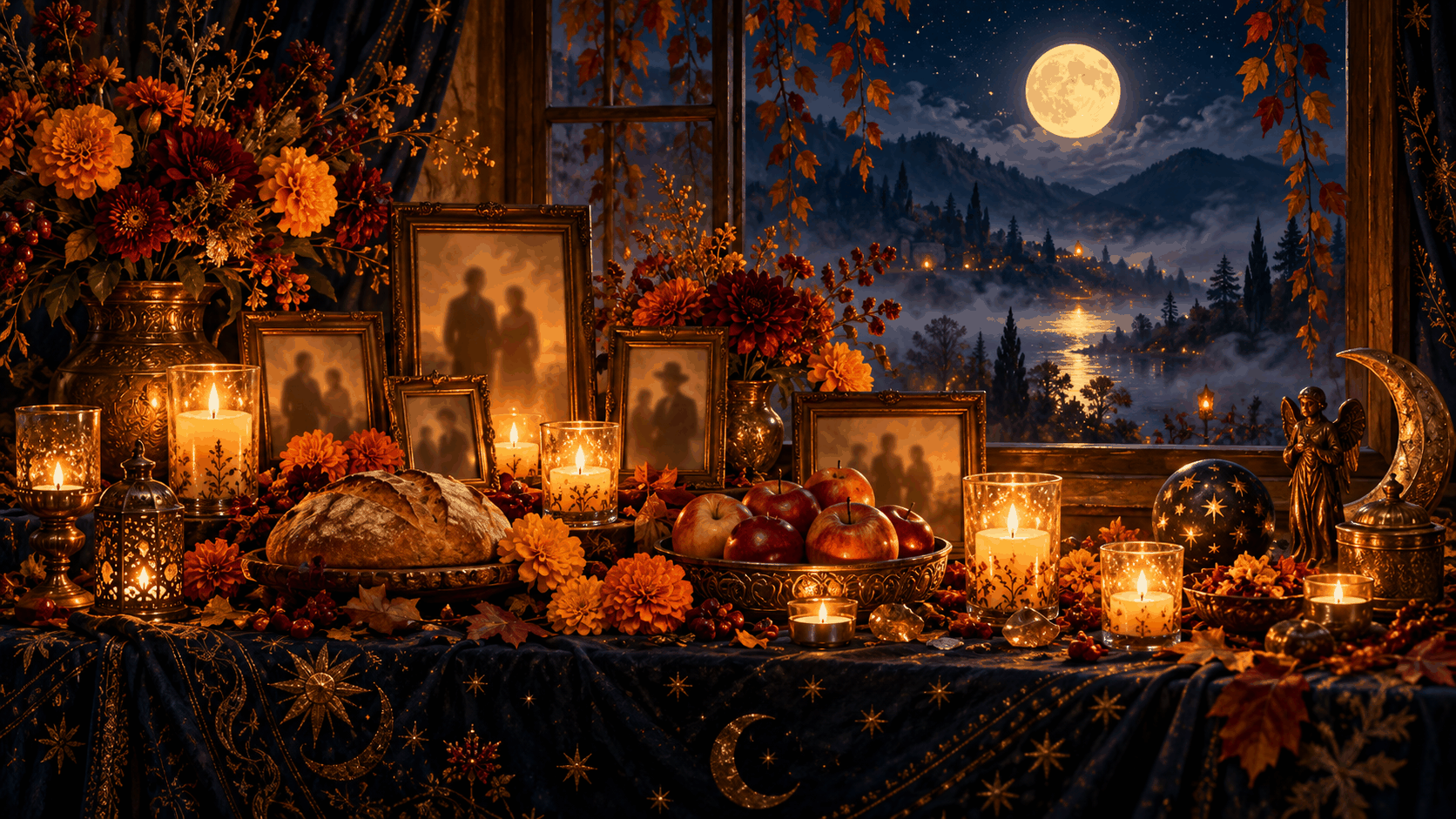
- Choose a small space. A shelf, a windowsill or a corner of the table is enough.
- Add a few meaningful things. Photographs, a letter, a piece of jewelry, a favorite flower, or something that reminds you of the person. Seasonal food such as apples, bread or a small cup of tea is a traditional touch.
- Light a candle, safely. Use a stable holder on a heat-safe surface, well away from curtains, papers and dried leaves, and blow it out before you leave the room. An LED candle works perfectly well.
- Say their names. Out loud or silently. Many traditions hold that a person is remembered for as long as their name is spoken.
- Share a memory. Tell a story about them, write it in a journal, or cook something they loved.
- Close gently. Thank them, blow out the candle, and take a moment before returning to your evening.
If your family history is complicated or painful, remembrance can look different. You can honor chosen family, mentors, friends, beloved animals, or simply "those who came before me" without naming anyone in particular. You can also remember the earlier versions of yourself and what they carried for you. If you are drawn to that idea, our guide to past life gifts explores the strengths people feel they carry from somewhere further back.
Grief does not follow a calendar, and Samhain may bring up more than you expect. Go slowly, and lean on the people around you if it gets heavy.
Simple Ways to Mark Samhain at Home
No elaborate ritual is needed. A few ideas:
- Cook a seasonal meal. Colcannon, apple cake, soup or fresh bread. Share it with people you love.
- Take an evening walk and notice the season turning: early darkness, falling leaves, the smell of the cold.
- Clear something out. Samhain is a natural time to finish, clear and release. Tidy one drawer, send one long-delayed message, or close one open loop.
- Write two lists: what you are leaving in the old year, and what you want to grow in the new one.
- Carve a lantern. A pumpkin today, or try an old-fashioned turnip if you want a real challenge.
- Follow the moon. In 2026 the full moon in Taurus on October 26 falls just before Samhain, a lovely time for gratitude and release; see our guide to full moon rituals. The next new moon, in Scorpio on November 9, is a fitting moment to plant the seed from card 6 of your spread; see our new moon ritual guide.
A note on safety and respect: keep every candle and lantern in a stable holder, away from anything that can burn, and never leave a flame unattended. Avoid any custom that involves eating unknown plants, wandering alone in the dark, or frightening yourself or others. And remember that Samhain is a living tradition for many Irish and Scottish people and modern pagans, so approach it with curiosity and respect.
Try a Samhain Tarot Reading With GOOD TIMING
If you would like to try the Samhain spread or simply ask a question as the year turns, you can draw cards online with GOOD TIMING's free tarot reading. It is a calm space to reflect on what is ending and what you want to carry forward.
Frequently Asked Questions
When is Samhain?
Samhain is traditionally celebrated from sunset on October 31 to November 1 in the Northern Hemisphere. Many people in the Southern Hemisphere who follow the wheel of the year celebrate it around April 30–May 1 instead.
Is Samhain the same as Halloween?
Not exactly. Samhain is the older Gaelic festival marking the end of harvest and the start of winter. Halloween comes from All Hallows' Eve, the night before the Christian All Saints' Day, but in Ireland and Scotland many Samhain customs blended into Halloween, and those traditions later spread to North America.
What does "the veil is thin" mean at Samhain?
It is a modern phrase for an old folk belief that at Samhain the boundary between the human world and the Otherworld was easier to cross, so spirits and fairy folk were thought to be close. Many people today understand it symbolically, as a season when memory, reflection and intuition feel especially strong.
What were traditional Halloween love divinations?
In Ireland and Scotland, common customs included throwing an apple peel over your shoulder to see the initial of your future love, placing two named nuts by the fire to see whether they burned together or jumped apart, gazing into a mirror by candlelight, and finding a ring hidden in colcannon or barmbrack.
What is a good tarot spread for Samhain?
A Samhain spread usually focuses on endings, ancestors and new beginnings. The seven-card spread in this guide covers what the past year harvested, what to release, what you are grieving, ancestral wisdom, what the winter asks of you, the seed for the new year, and how to honor the threshold.
How can I honor my ancestors at Samhain?
A simple way is to set up a small remembrance space with photographs or keepsakes, light a candle safely, say their names, share a memory, and perhaps cook a dish they loved. You can also honor chosen family, friends or "those who came before" if family history is difficult.
Is Samhain divination safe for beginners?
Yes, as long as you treat it as reflection rather than fear, and keep it practically safe. Keep candles in stable holders away from anything that can burn, take care around open fires, warn people about any charms hidden in food, and skip customs that involve stairs, darkness or anything risky.
Final Thoughts: Standing at the Threshold
Samhain has never really been about frightening yourself. At its heart, it is a pause at the turning of the year: a night to gather, to remember, to laugh at an apple peel on the floor, and to ask what the dark months might bring.
Whether you play the old Halloween games, lay out a tarot spread, or simply light a candle beside a photograph, you are joining a very old human habit of standing at a threshold and looking both ways.
Honor what has ended, remember who you have loved, and carry one good seed into the dark half of the year.