A reversed tarot card is one that lands upside down in your spread. Many readers read it as the upright meaning blocked, delayed, turned inward or in shadow, and not as "bad." Reading reversals is optional, but decide before you draw and keep that rule for the whole reading: upright only, or reversals with one chosen lens.
Do you have to read reversed tarot cards?
No. Reading every card upright is a complete, respectable way to read tarot, and it is the best place to start. You get 78 cards to learn instead of 156 meanings, and your readings stay clear while you build confidence.
Add reversals when you want a little more nuance, not because someone told you that you must. If you would like to see how they read in a real spread, a tarot reading here draws both upright and reversed cards and explains each one in its position. Here is a quick way to decide whether to add them yourself.
| You might skip reversals if | You might add reversals if |
|---|---|
| You are still learning the 78 cards | You can read most cards without a cheat sheet |
| You like clear, direct answers | You like shades of "yes, but" |
| You read for lots of people quickly | You read slowly, for yourself or a friend |
| Your deck or tradition does not use them | You enjoy a bit of extra story in each spread |
A good rule of thumb: get comfortable with about 20 cards upright first, then try reversals for a while and see how they feel. Our 2027 New Year spread is a lovely place to practice either way.
Where do reversed cards come from?
It is an old habit, but not an ancient one. The French card reader Etteilla published meanings for upright and reversed cards back in the late 1700s, and A. E. Waite's classic early-1900s guide to the Rider-Waite-Smith deck gives a reversed meaning for every card. Some traditions never took it up: the Golden Dawn and Crowley's Thoth deck read the cards upright and add nuance through other systems instead. So when you read a spread without reversals, you are in good company.
Decide before you draw, then keep it for the whole reading
Make the choice before the first shuffle: are reversals in or out, and if they are in, which lens will you read them through? Then keep that rule until the reading is finished. Do not switch after you see the cards.
Here is why it matters. A rule you can change once you see an unwelcome card stops being a rule, and the reading slides into a search for the answer you were hoping for. If you decide first, the cards get to say what they say, including the inconvenient parts. In practice:
- Say it out loud or write it down. One line is enough: "Reversals on. Lens: blocked or delayed."
- Read each card as it landed. If a card is one you did not want, that is exactly the information you asked for, so read it as it fell.
- Try a different approach next time. If you are curious about another lens or about reading upright only, use it in your next reading with a fresh question.
How do cards end up reversed?
Your shuffle decides how many reversals you see, so choose your method to match the rule you just made:
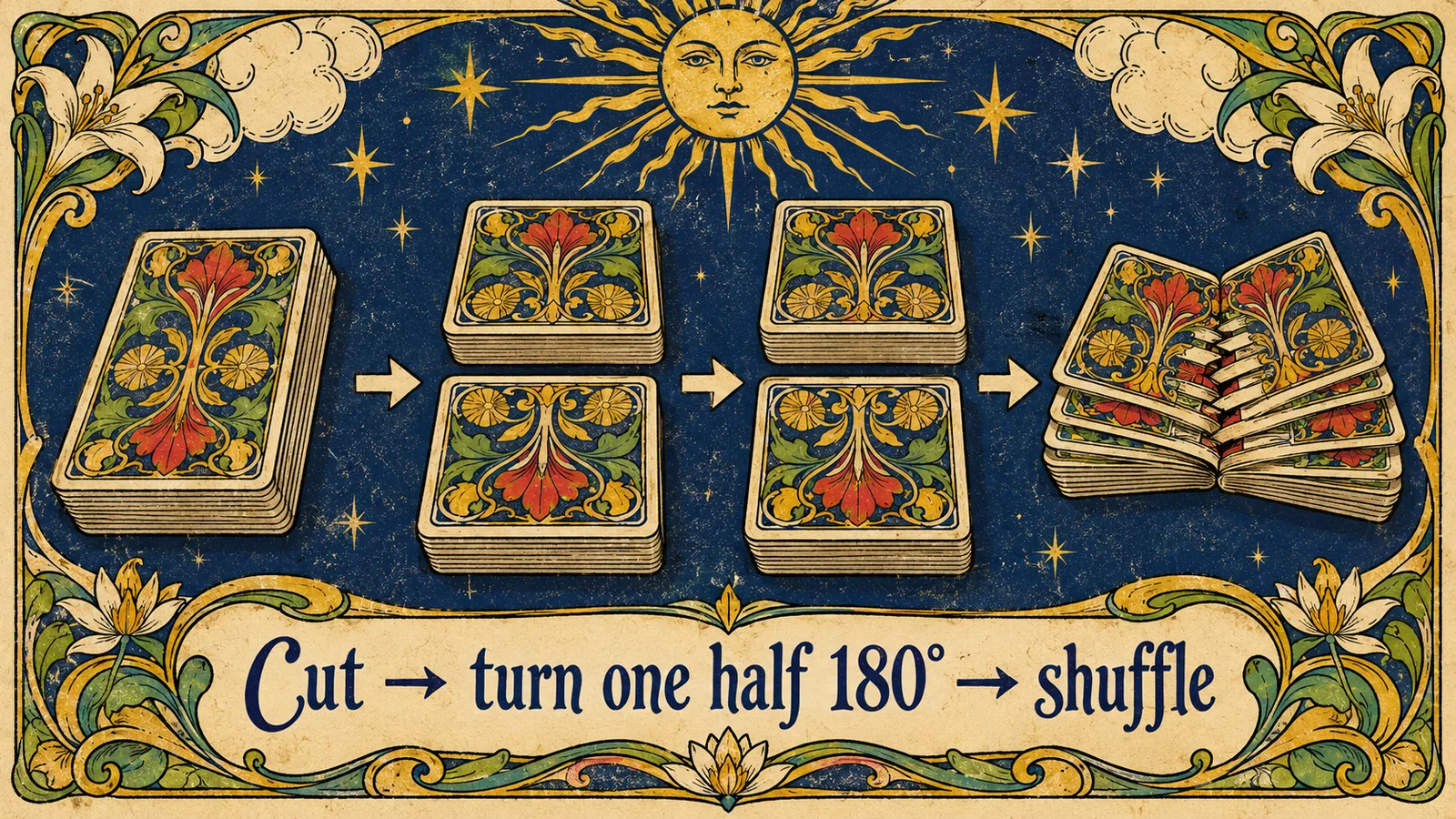
- Cut-and-turn (the easy way). Cut the deck into two piles, turn one pile around 180 degrees, then shuffle both together. About half your cards end up reversed, in a natural mix.
- Wash or swirl. Spread the cards face down on a table, mix them with your hands, and gather them back up. Good for a random mix.
- Ordinary shuffling. An overhand shuffle usually keeps your cards the way they started, so you see few or no reversals. That is perfect if you read upright only.
Practical tip: when you turn a card over, flip it from the side, like turning the page of a book. If you flip it top to bottom, you will accidentally reverse it.
Do reversed tarot cards mean something bad?
Not at all. Plenty of reversals are good news, and some are better than the upright card. Here are a few:
- The Devil reversed often means you are loosening a grip or seeing a habit clearly.
- Three of Swords reversed points to healing beginning after heartache.
- Eight of Swords reversed is getting out of the box, with a new perspective.
- Ten of Wands reversed can mean putting a heavy load down.
The right question for a reversal is "what is different about the energy?" and not "what went wrong?"
Four ways to read a reversed card
There is no single official method, so most readers pick one of four approaches. Pick one before you draw, and your readings will feel more consistent.
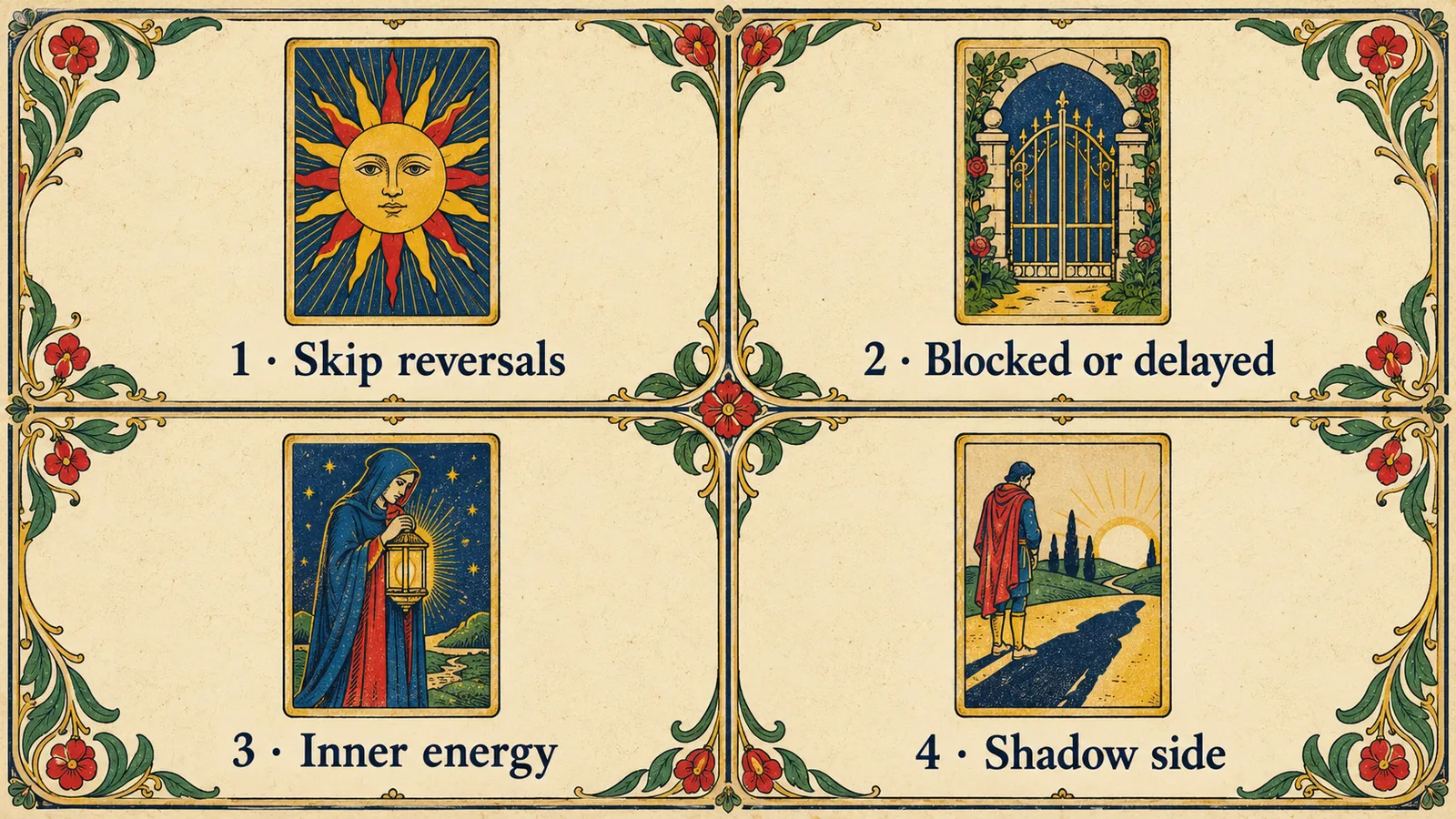
1. Skip reversals
Read every card upright, even if it shows up the other way, or never reverse cards in the first place. This is the simplest method, and it is a complete one.
2. Blocked or delayed
The upright energy is there, but something is slowing it down. The Ace of Cups upright is an open heart and new feelings; reversed, the feelings are there but they cannot flow yet. This is often the easiest approach for beginners, because you can start with the upright meaning and add "but not yet."
3. Inner energy
The upright theme is happening inside you rather than out in the world. The Tower upright is a sudden, visible change; reversed, you may be feeling the shake-up inwardly while the outside still looks calm, or you might be avoiding a change you already sense.
4. Shadow side
The reversed card shows the upside-down version of a strength: too much, too little, or used the wrong way. The Queen of Swords is clear-headed and honest upright; reversed she can be cold, over-critical or hiding behind logic.
A fifth method, flipping to the exact opposite, works for a few cards but not most. Death reversed is not "life," and the Sun reversed is not "darkness." For beginners, I would leave it out. If you are not sure which lens to choose, start with "blocked or delayed." It keeps the upright meaning in front of you, and it is the easiest to explain to a friend.
A simple three-step method for beginners
Use this with any of the lenses above:
- Say the upright meaning first, in one short phrase.
- Ask "what is different?" Use your chosen lens: is it blocked, inside, or in shadow?
- Look at the position. A reversed card in "advice" suggests an action, while one in "obstacle" is often exactly what you expected.
Quick example: Ten of Wands reversed
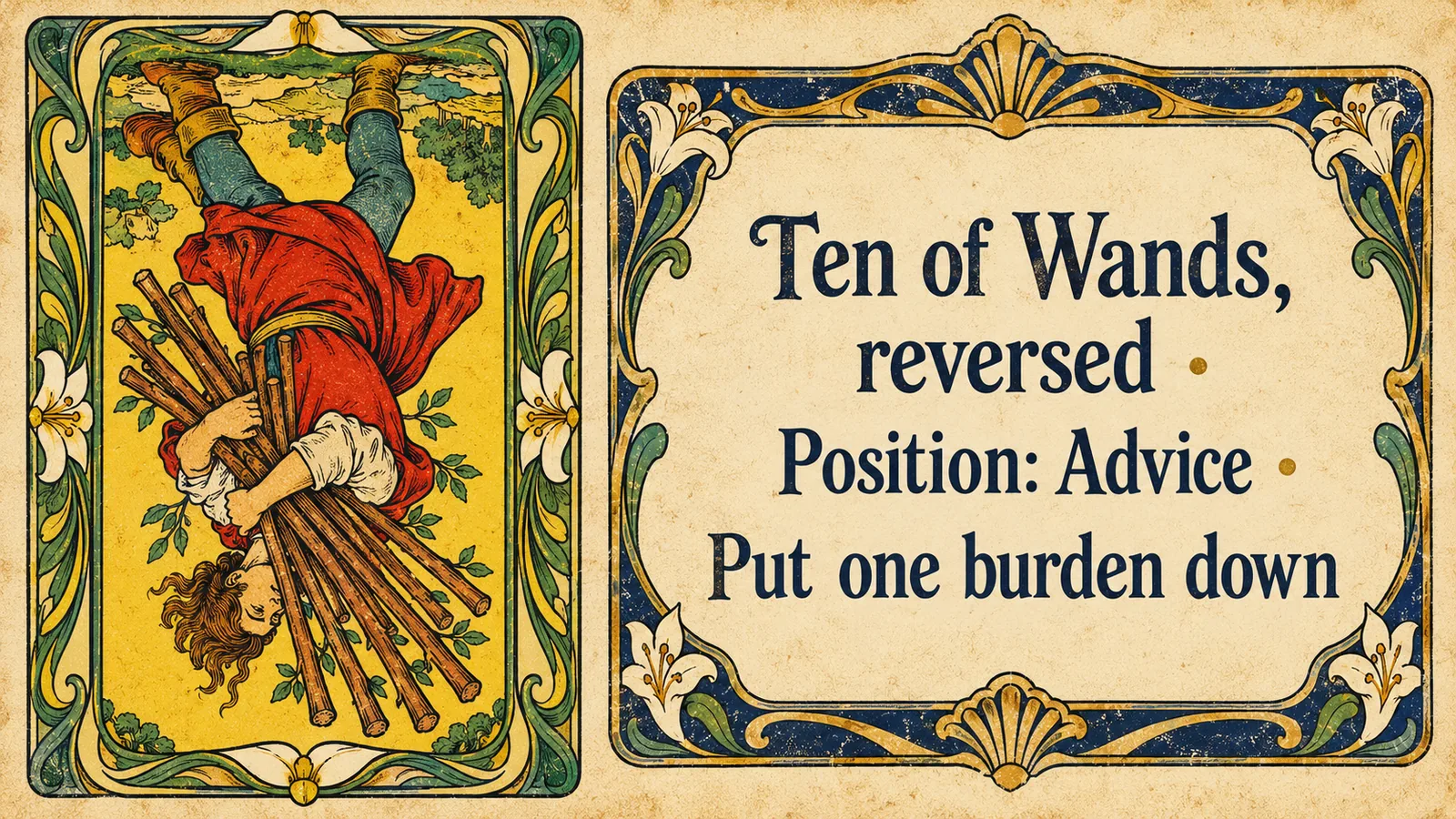
Imagine the Ten of Wands reversed in the "advice" position.
- Upright: you are carrying too much.
- Blocked: you want to put it down, but something is stopping you, like guilt or a deadline.
- Inner: the load is mostly in your head, the worry about it is heavier than the work.
- Shadow: you are playing the martyr and not asking for help.
Notice how all four readings arrive at the same practical advice: put one burden down. Delegate it, say no to it, or stop carrying something that is not yours.
A full five-card reading with upright and reversed cards
In a real spread, upright and reversed cards shape each other, and the way to read them is to take the whole picture before the details. Here is one from start to finish.
The setup. The question is: "Will things with the person I have been dating for six months become serious?" Before drawing, I decided reversals are on, read through the "blocked or delayed" lens, for the whole reading. Five positions: You, Them, Connection, Challenge and Potential.
| Position | Card | Orientation |
|---|---|---|
| You | Two of Cups | Upright |
| Them | Knight of Cups | Reversed |
| Connection | The Lovers | Upright |
| Challenge | Four of Wands | Reversed |
| Potential | Temperance | Upright |
The answer first. Yes, this can become serious, but on a slower timetable than you would like. The warmth is real. What is missing is a clear, steady signal from them and a shared foundation, so the way forward is a steady pace and honest questions, not chasing.
How the cards get there:
- You: Two of Cups, upright. You are open and ready for a two-way connection.
- Them: Knight of Cups, reversed. Romance with mixed signals: the interest is there, but the follow-through is not yet. Set next to your upright Two of Cups, the contrast is clear: you are ready to meet in the middle while they are still circling.
- Connection: The Lovers, upright. The bond itself is meaningful and asks for real alignment. This card changes how the Knight reads. With a strong upright bond in the middle, the mixed signals look like "not ready yet" and not "not interested." If The Lovers had landed reversed (disharmony, mismatched values), the same Knight would read as drifting apart, and the answer would turn into "slow down, you may want different things."
- Challenge: Four of Wands, reversed. The celebration is delayed because the foundation is not steady: nothing is official yet, perhaps no label and no shared plans. It echoes the Knight, since both say "not landed yet," which makes it a pattern and not a one-off.
- Potential: Temperance, upright. Balance, patience and a steady pace. It is the remedy for both reversed cards, calming the Knight's hot-and-cold swings and slowly building the foundation the Four of Wands is missing.
The advice. If I were reading this for a friend, I would say: ask a kind, direct question about where things are heading, make one small shared plan, and watch whether the follow-through is consistent over the next few weeks. Notice what the reversals added. With all five cards upright, the reading would say "go for it." The reversals supply the "when" and "how."
Practice tip: for a month, write down every reversed card you draw, the lens you used, and what actually happened. You will quickly see which lens fits you best, and it is a lovely way to learn your own deck.
Reversed cards in yes or no readings
A reversed card does not automatically mean "no," and an upright card does not automatically mean "yes." The Tower upright is a big shake-up, and the Devil reversed can be a very hopeful sign. Read the card first, then the question. Our guide to yes or no tarot shows how.
Frequently asked questions
What do reversed tarot cards mean?
Most readers see a reversed card as its upright meaning with a twist: blocked, delayed, turned inward, overdone or in shadow. Sometimes it signals release or recovery. It does not mean bad news.
Do I have to read reversed cards?
No. You can read every card upright, and many experienced readers do. Beginners often start there, then add reversals once they know the cards well.
Can I change my mind about reversals after I draw?
It is best not to. Decide before the first shuffle whether reversals are in and which lens you will use, then keep it for the whole reading. Try something different in your next reading.
How do reversed cards happen?
Only if you make them happen. Cut the deck and turn one half around before you shuffle, or wash the cards face down on a table. A plain overhand shuffle usually leaves few or no reversals.
Is a reversed card a no?
Not by itself. Some reversed cards are positive, like the Devil reversed (loosening a grip) or the Three of Swords reversed (healing). Read the card's meaning first, then fit it to the question.
Do all tarot systems use reversals?
No. Etteilla and Waite gave reversed meanings, but the Golden Dawn and Crowley's Thoth tradition read cards upright. Both ways are accepted, so choose the one that helps you read clearly.
To practice with a real spread, our three-card tarot spread guide is a gentle place to start, does tarot work? explains why readings can feel so on point, and a tarot reading here includes both upright and reversed cards.