Will they reply? Will the interview lead to an offer? Is your plan likely to move forward? These questions seem to invite a simple yes or no. Lenormand is especially compelling here because its 36 images are rooted in everyday life: the Rider brings news, the Letter points to written communication, and the Mountain stands in the way.
Lenormand can be used for yes-or-no readings. But a good reading also reveals why an answer leans one way, what is delaying it, and which part of the situation remains unresolved. Rather than counting “good” and “bad” cards, read the cards as a sentence about your actual question.
You can try your own spread with GOOD TIMING's Lenormand reading.
Ask One Specific Question First
“Will my love life improve?” could refer to a new relationship, an ex, or your feelings about someone you have not met. Even a positive spread might be difficult to interpret.
Compare that with: “We haven't spoken in three weeks. Will they send me a message within the next 14 days?” Now you have a person, an action, and a time frame. Cards involving communication, distance and obstacles acquire more precise relevance.
Decide on the time frame before you draw. No message this week is not the same as no contact in three months. Do not change the question after seeing the cards simply to make the outcome fit.
Which Cards Tend Toward Yes, No or Delay?
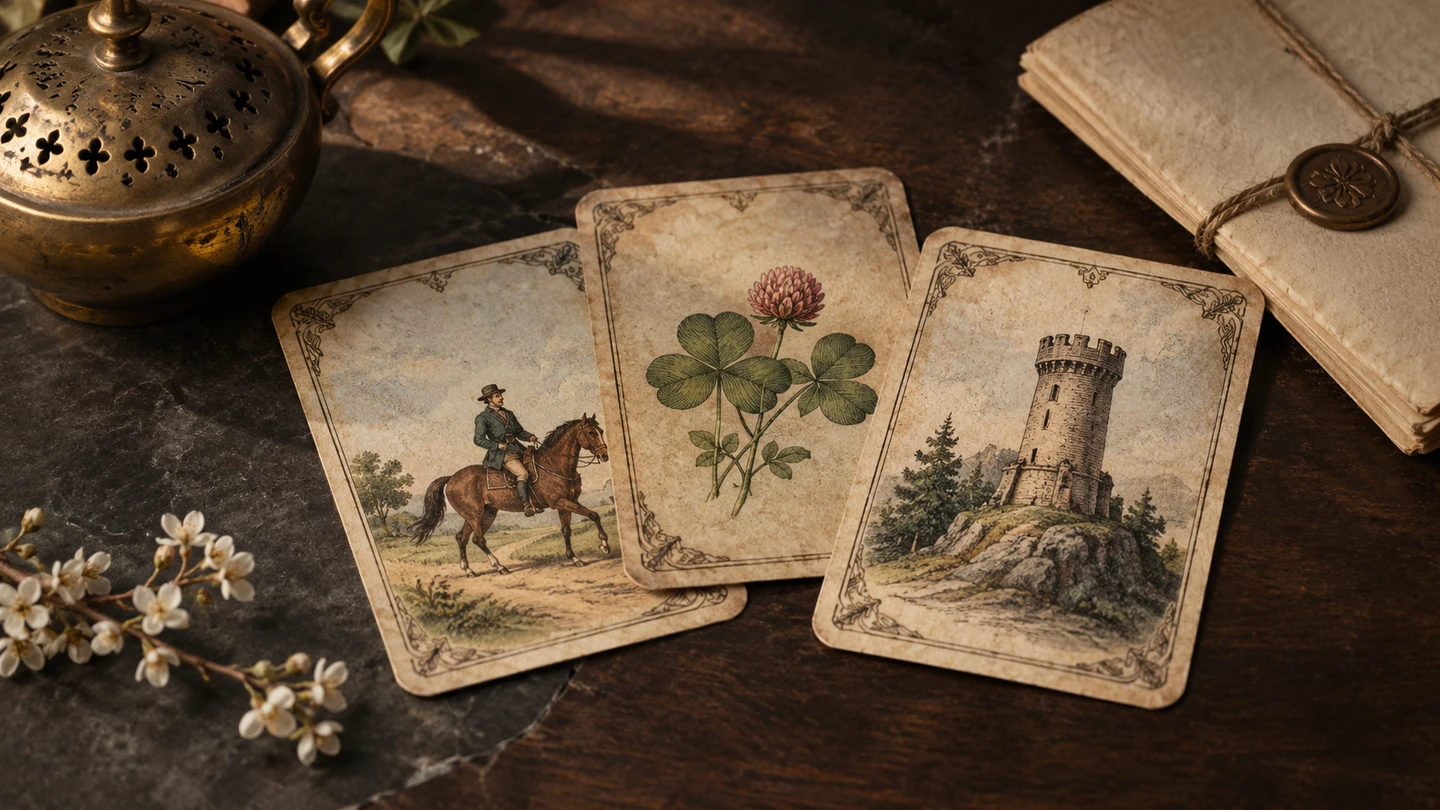
The Sun often favors success, clarity and a favorable outcome. The Key can indicate an answer, an opening or an important solution. Clover suggests a brief opportunity or stroke of luck. The Rider and Letter are especially relevant when you are waiting for a message.
The Mountain often indicates an obstacle or delay; the Coffin can suggest an ending; the Scythe may describe a sudden cut or decision; the Clouds show uncertainty or a lack of clarity.
Yet these are not fixed votes. A Rider does not promise that the news will be welcome. A Coffin may describe the end of an old phase rather than the failure of everything that comes afterward. The neighboring cards and the question determine what the symbols mean together.
Three-Card Example: Will They Text Within Two Weeks?
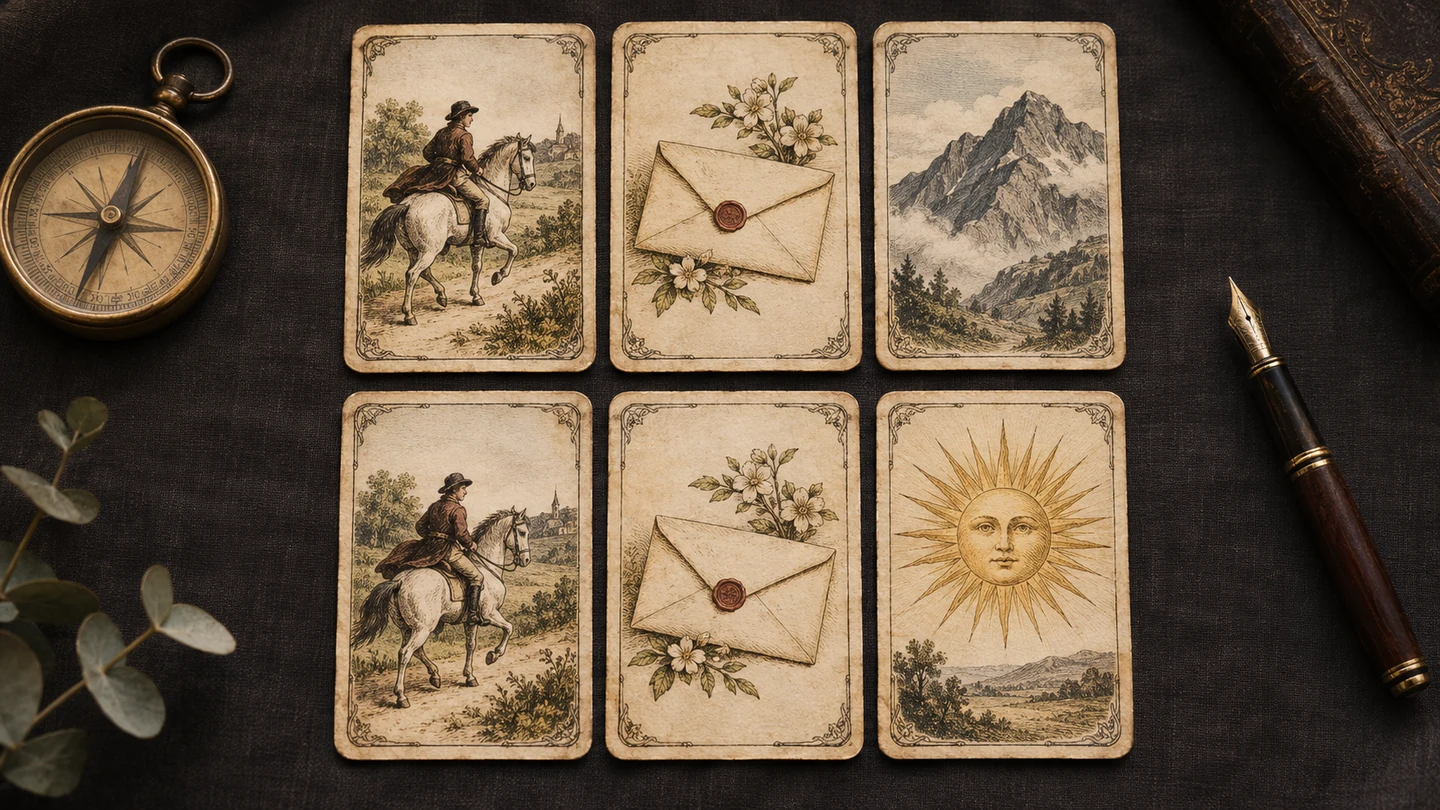
Imagine someone asks: “We've been apart for a month. Will my ex message me within two weeks?” The cards are:
Rider — Letter — Mountain
Rider and Letter form a strong communication pair. The subject of news or a written message is clearly present. But Mountain changes the pace: there is an obstruction, distance or difficulty that interrupts the expected flow.
Overall reading: Contact is a meaningful theme, but receiving a clear message within the specified two weeks looks difficult. This is not an absolute “never.” It is a qualified “not yet” or a negative answer for the short window.
Now replace the final card:
Rider — Letter — Sun
A message followed by the Sun is considerably brighter. Communication seems more likely to arrive clearly and to produce a positive result. For this question, the spread leans yes.
Now try:
Rider — Letter — Clouds
Communication appears again, but the outcome may be ambiguous: mixed signals, an unclear message, or plans that have not settled. The most faithful answer may be “there are signs of contact, but the result remains uncertain.” Forcing yes or no would flatten the reading.
These combinations illustrate traditional Lenormand meanings; they are not predictions about a real person.
When Does the Answer Mean “Not Yet”?
Many people mistake a delay for a permanent refusal. But Mountain, Tree and Anchor may describe slowness, stability, or a situation that needs time, depending on their positions and companions. They do not mean the same thing as a definitive ending.
Suppose you ask: “Can I change jobs this month?” and draw Anchor — Mountain — Key. Anchor speaks to employment or a stable situation, Mountain blocks the path, and Key signals a possible solution. That does not guarantee an offer before the month ends; neither does it necessarily rule out a later breakthrough. The reading points you toward the obstacle and the way through it.
Our Lenormand combinations guide explains how to build meaning across a pair or line of cards rather than collecting disconnected keywords.
Should You Keep Drawing Until You Get a Yes?
For one well-defined question, one focused draw is often more useful than asking it again every few minutes. If the situation changes, new information arrives, or you genuinely have a different question, a new reading makes more sense. Otherwise, return to the cards already on the table.
Lenormand's strength is its concreteness: it can reveal the message, the obstacle, and the sequence in which things may unfold—not merely a vote. For a closer look at individual symbols, see the 36 Lenormand card meanings.
FAQ
Can I draw just one Lenormand card for yes or no?
Yes, but a single card leaves less context. Three cards are often more informative about the situation and its conditions.
Is Mountain always a no?
No. It frequently indicates an obstacle or delay. The time frame and neighboring cards help show whether the matter is blocked for now or unlikely to move forward.
Do Lenormand cards use reversals?
Most Petit Lenormand traditions do not center upright and reversed meanings the way tarot does. Combinations and positions matter more.
Can I keep drawing until the Sun appears?
It is better not to. Repeated draws can obscure the original question. Read the first spread carefully, and return later if reality has changed.
The illustrations are artistic interpretations, not exact reproductions of a particular deck.