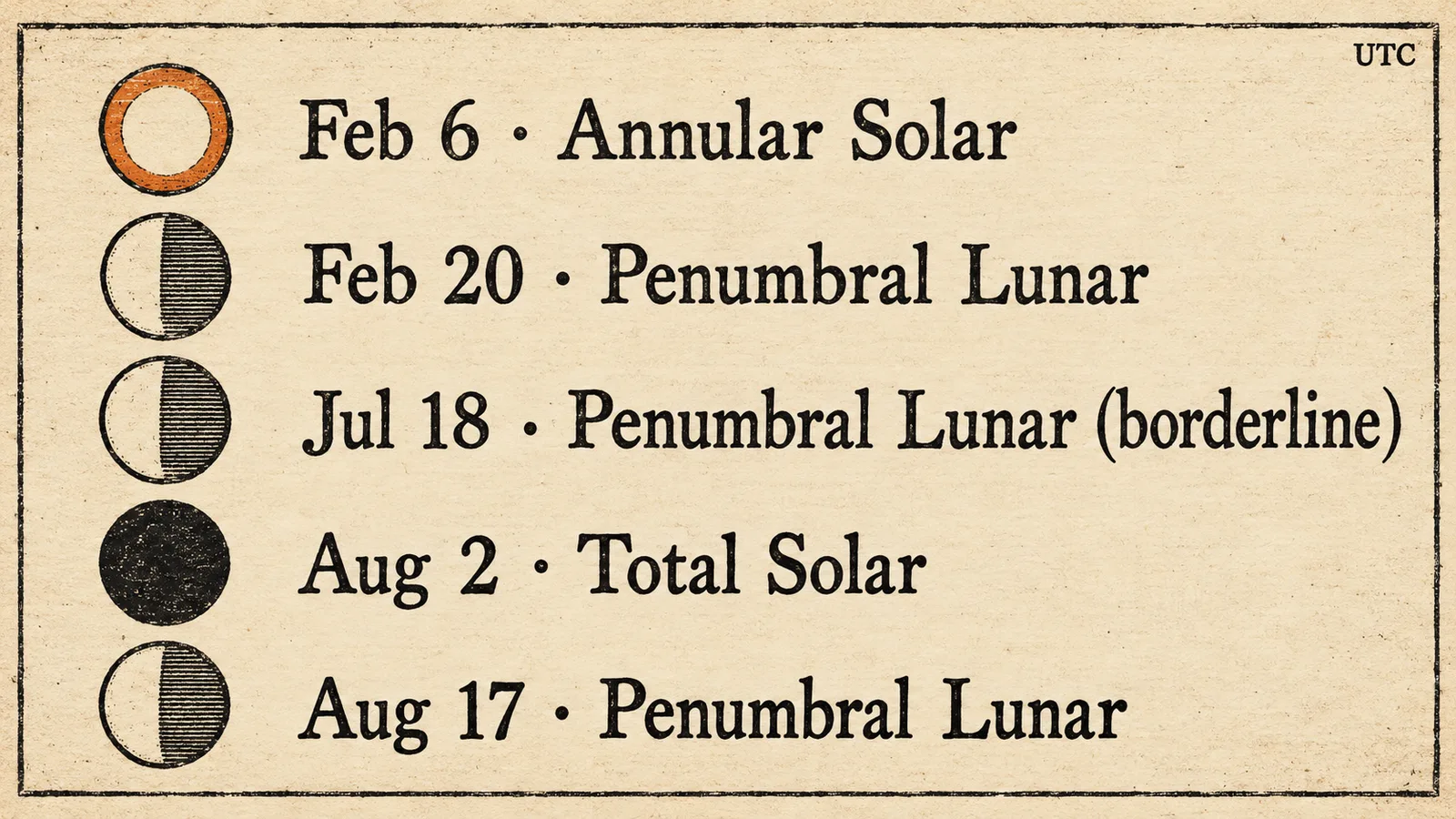
2027 has five eclipses: an annular solar eclipse on February 6, a total solar eclipse on August 2, and penumbral lunar eclipses on February 20, July 18 and August 17 (UTC). Totality on August 2 lasts up to 6 minutes 23 seconds along a path from Spain to Somalia, with a partial eclipse across a much wider region. The July 18 lunar eclipse is a borderline graze that is barely noticeable.
When are the eclipses in 2027?
There are two solar eclipses and three lunar eclipses. The table gives the moment of greatest eclipse in UTC, the same moment in Beijing and Taipei time (UTC+8), and the zodiac position of the New or Full Moon, which is the degree astrologers use.
| Date (UTC) | Eclipse | Greatest eclipse (UTC) | Beijing / Taipei (UTC+8) | Zodiac position at the New or Full Moon |
|---|---|---|---|---|
| Feb 6 | Annular Solar | 15:59:39 | Feb 6, 23:59 | 17°38′ Aquarius |
| Feb 20 | Penumbral Lunar | 23:12:55 | Feb 21, 07:12 | 2°06′ Virgo |
| Jul 18 | Penumbral Lunar (borderline) | 16:03:00 | Jul 19, 00:03 | 25°49′ Capricorn |
| Aug 2 | Total Solar | 10:06:41 | Aug 2, 18:06 | 9°55′ Leo |
| Aug 17 | Penumbral Lunar | 07:13:47 | Aug 17, 15:13 | 24°12′ Aquarius |
Two small notes. Many sites round to the nearest minute, so you may see times that differ from the table by a minute or so. And on February 6 the greatest eclipse falls at 15:59 UTC, just 21 seconds before midnight in Beijing and Taipei, so it is still February 6 there.
Why are there only five eclipses in 2027, and why do they come in clusters?
The Moon's orbit is tilted about 5 degrees to Earth's orbit around the Sun. Because of that tilt, the Moon usually passes above or below the Sun at New Moon, and above or below Earth's shadow at Full Moon. An eclipse only happens when a New Moon or Full Moon falls close to one of the two points where the orbits cross, called the lunar nodes.
The Sun passes a node about every six months, and each pass opens an eclipse season. In 2027 the first season holds two eclipses, February 6 and February 20, two weeks apart. The second holds three, July 18, August 2 and August 17, again about two weeks apart. A year can have anywhere from four to seven eclipses, so five is perfectly ordinary.
What is the difference between an annular and a total solar eclipse?
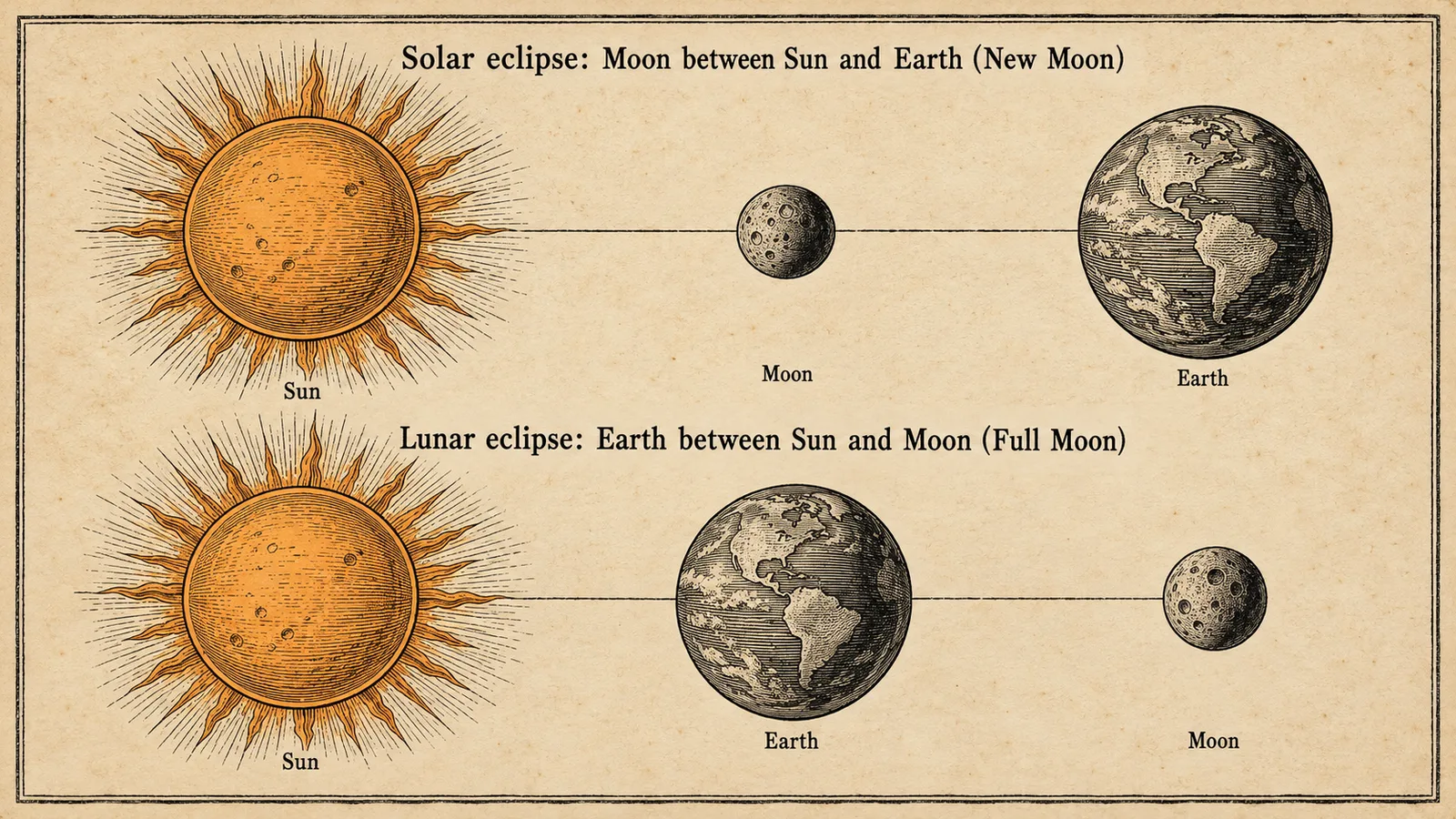
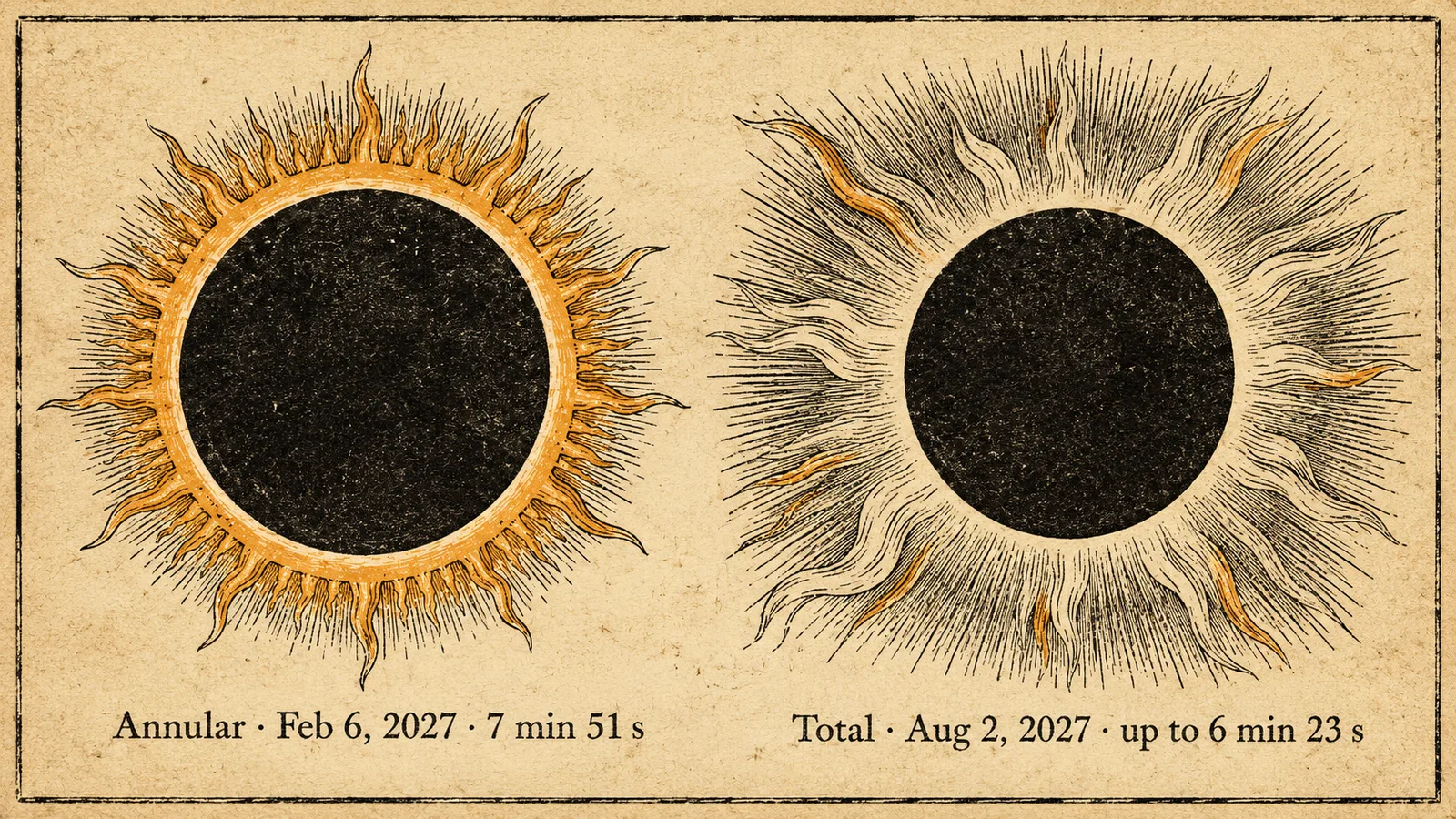
In both, the Moon passes in front of the Sun. In a total eclipse the Moon looks slightly larger than the Sun, so it hides the bright disk completely for a short time. In an annular eclipse the Moon looks slightly smaller, so a bright ring of Sun, the "ring of fire", stays visible around it. In 2027 the February 6 eclipse is annular (the Moon covers about 93% of the Sun's width, and about 86% of its area) and the August 2 eclipse is total (the Moon looks about 8% wider than the Sun).
Where you stand matters. The ring or the totality is visible only inside a narrow path, while a partial eclipse, where the Moon takes a bite out of the Sun, is visible across a much wider region around it.
| Solar eclipse | Narrow path (ring or totality) | Wider region with a partial eclipse | Beijing / Taipei |
|---|---|---|---|
| Feb 6, annular | Chile, Argentina, Uruguay and Brazil, then Ivory Coast, Ghana, Togo, Benin and Nigeria | Large areas of South America, Africa and Antarctica, plus the South Pacific and South Atlantic | Not visible |
| Aug 2, total | Morocco, Spain, Algeria, Libya, Egypt, Saudi Arabia, Yemen and Somalia (most maps also include Tunisia and Gibraltar) | Most of Europe, much of Africa, the Middle East, South and Southeast Asia, eastern Canada and northern Maine, plus the Atlantic and Indian oceans | Not visible; far western and southern China see at most a sliver |
What is the February 6, 2027 annular solar eclipse?
The ring is visible along a narrow band about 282 km wide. At the point of greatest eclipse, over the South Atlantic, the Sun is 73° high and the ring lasts 7 minutes 51 seconds. The path crosses Chile and Argentina, brushes the coasts of Uruguay and Brazil, crosses the Atlantic and ends at sunset on the West African coast, from Ivory Coast to Nigeria. Outside the path, a partial eclipse is visible across large areas of South America, Africa and Antarctica. East Asia is outside the visibility region, so Beijing and Taipei do not see it.
The New Moon is at 15:56 UTC, which is 23:56 in Beijing, three minutes before midnight. That is why the lunar new year begins on February 6 in China, and our Chinese New Year 2027 guide explains the date. Mercury turns retrograde three days later, on February 9, covered in our Mercury retrograde 2027 dates.
What is the August 2, 2027 total solar eclipse, and where can you see it?
This is the big one of 2027. Totality (the path where the Sun is fully covered) crosses Morocco, Spain, Algeria, Libya, Egypt, Saudi Arabia, Yemen and Somalia, and most maps also include Tunisia and Gibraltar. The path is about 258 km wide. At the point of greatest eclipse, in southern Egypt close to Luxor, the Sun is 82° high, almost overhead, and totality lasts up to 6 minutes 23 seconds.
Totality that long is rare. The previous total eclipse over six minutes was on July 22, 2009 (6 min 39 s), and the next one over six minutes is not until June 3, 2114 (6 min 32 s).
A partial eclipse is visible over a far wider area: most of Europe, much of Africa, the Middle East, South and Southeast Asia, eastern Canada and northern Maine, and across the Atlantic and Indian oceans. In the partial zone the Sun is only partly covered and it does not go dark. Beijing and Taipei are outside that region (far western and southern China see at most a sliver), so if you are travelling, check a local eclipse map for your exact spot.
Eye safety: it is not safe to look directly at the Sun without proper eye protection, except during the brief total phase of a total eclipse. During a partial or annular eclipse it is never safe, and you need solar viewers that meet the ISO 12312-2 standard, not sunglasses. If you travel to see totality, put the glasses back on as soon as a bit of bright Sun reappears.
What are the three lunar eclipses in 2027, and can you see them?
All three are penumbral: the Moon passes only through the faint outer part of Earth's shadow and never enters the dark inner shadow (the umbra). The umbral magnitudes are −0.057 (February 20), −1.068 (July 18) and −0.525 (August 17); a negative value means the Moon misses the umbra. The penumbral magnitudes are 0.927, 0.001 and 0.546.
In practice, a penumbral magnitude of about 0.6 or more is needed before a skilled observer can see faint shading across the Moon. By that yardstick:
- February 20 (greatest eclipse 23:12 UTC) is the most noticeable of the three, visible from the Americas, Europe, Africa and Asia. A penumbral eclipse becomes easy to see only when it comes within about 0.05 of a partial one, and this one falls 0.057 short, so you may spot a faint darkening on one edge of the Moon near the maximum.
- July 18 (about 16:03 UTC) is barely noticeable. The penumbral magnitude is only 0.001 and the whole penumbral phase lasts about 12 minutes, from 15:57 to 16:09. Most listings count it, but a few treat it as a near miss because Earth's shadow only just reaches the Moon, which is why you will sometimes see "four eclipses in 2027". Nothing visible is expected.
- August 17 (07:13 UTC) is visible from the Pacific and the Americas. Its penumbral magnitude of 0.546 is below the 0.6 mark, so you are unlikely to notice anything.
The next lunar eclipses are a small partial eclipse on January 12, 2028 (umbral magnitude 0.066) and a total lunar eclipse on December 31, 2028. The next solar eclipses are an annular one on January 26, 2028, and a total one on July 22, 2028 over Australia and New Zealand.
What does an eclipse mean in astrology?
In astrology, an eclipse is a New Moon or Full Moon that happens near the lunar nodes. A solar eclipse is read as a more potent lunation, a turning point whose themes unfold over about six months and are felt most by people with personal planets near the eclipse degree. Astrologers differ on how much weight penumbral lunar eclipses carry.
Astrologers quote the degree at the exact New Moon or Full Moon, which differs a little from the moment of greatest eclipse. For lunar eclipses the gap is up to about 9 arcminutes, so the table above uses the lunation degree. The five lunations, with the time in Beijing and Taipei in brackets, are:
- Feb 6, New Moon, 15:56 UTC (Feb 6, 23:56): 17°38′ Aquarius, about 3° from the North Node (the node sits near 20°32′ Aquarius at that time).
- Feb 20, Full Moon, 23:23 UTC (Feb 21, 07:23): 2°06′ Virgo, Sun in Pisces.
- Jul 18, Full Moon, 15:45 UTC (Jul 18, 23:45): 25°49′ Capricorn, Sun in Cancer.
- Aug 2, New Moon, 10:05 UTC (Aug 2, 18:05): 9°55′ Leo, about 1.5° from the South Node. Many astrologers say eclipses near the South Node feel more challenging than those near the North Node, which is a traditional astrological idea.
- Aug 17, Full Moon, 07:28 UTC (Aug 17, 15:28): 24°12′ Aquarius, Sun in Leo.
The July 18 Full Moon is at 23:45 in Beijing, but the greatest eclipse is at 00:03 on July 19, so the date depends on which moment you use. Through 2027 the Moon's North Node is in Aquarius and the South Node in Leo (about 20°32′ Aquarius on February 6 and 11°29′ Leo on August 2), so the year's eclipses cluster around the Leo–Aquarius axis, part of a Leo–Aquarius series running from February 2026 to January 2028.
In the symbolic tradition, Leo themes are creativity, self-expression, romance and play, and Aquarius themes are community, friendship, ideals and independence.
How do you find which part of your life an eclipse touches?
The practical astrological use is to see which house of your birth chart each degree falls in, and whether a planet or point of yours sits within a few degrees of it. A planet within about 3° of the eclipse degree is the classic sign that the eclipse speaks to you.
Here is an example. Someone born with the Sun at 10° Leo has it within a degree of the August 2 eclipse at 9°55′ Leo. Astrologers would expect the themes of that eclipse, visibility, self-expression and what you want to be known for, to come to the foreground over the following six months. Someone with the Moon at 18° Aquarius would look at the February 6 eclipse, at 17°38′ Aquarius, and ask what they are ready to put down in their circle of friends and community.
To place the degrees in your own chart, start with our astrology for beginners guide. For simple ways to mark a New Moon or Full Moon, see the New Moon ritual and Full Moon rituals, and for the lunations leading up to this year, our December 2026 astrology calendar.
Good to know
The dates and visibility come from astronomy, and the meanings come from astrological tradition. Astrologers differ on how much weight to give penumbral eclipses, so lean on the solar ones and on the degrees that touch your chart.
Frequently asked questions
How many eclipses are there in 2027? Five: two solar and three lunar. A few listings count only four, because the July 18 lunar eclipse is such a faint graze.
Is there a total solar eclipse in 2027? Yes, on August 2, with totality up to 6 minutes 23 seconds in the path across Spain, North Africa and the Middle East. The February 6 eclipse is annular, not total.
Can I see the 2027 eclipses from the US or China? The August 2 eclipse is visible as a partial eclipse in eastern Canada and northern Maine, in the far northeast of the US. From the rest of the US and from China there is no solar eclipse to see. Neither Beijing nor Taipei sees either solar eclipse, and far western and southern China see at most a sliver of the August 2 partial. The February 20 lunar eclipse is visible from the Americas, Europe, Africa and Asia, and the August 17 one from the Pacific and the Americas, though only the February 20 one is likely to show any shading.
Why does an astrology site show a different time from an eclipse calendar? Eclipse calendars give the moment of greatest eclipse in Universal Time, rounded to the minute. Astrology sites usually give the exact New or Full Moon in a local time zone, which can be a few minutes earlier or later and sometimes on a different calendar date.
When is the next total solar eclipse after August 2, 2027? July 22, 2028, over Australia and New Zealand, with a maximum of about 5 minutes 10 seconds.