You may have opened that chat window more times than you care to admit.
You type “How have you been?” and delete it because it feels too deliberate. You think about sending a funny photo, then wonder how it might be taken. In the end, you send nothing. Instead, you scroll through an old conversation one more time.
After a breakup, the hardest question is not always “Do I still love them?” Sometimes it is this: If I reach out, what happens between us next?
Perhaps you have been out of contact for months, or perhaps it has only been two weeks. You do not know whether feelings remain, whether silence means the relationship is over, or whether both of you are waiting for something to change. You may even be prepared for no reply—and still wonder whether sending that message is worth it.
“Should I text my ex?” is a common question in love readings. In Tarot and Lenormand, though, it can be explored through several more precise questions: Is there movement toward communication? What is blocking contact? What might happen if you reach out now? And if the connection begins again, could the problems that ended it return?
This guide uses specific Tarot spreads and Lenormand combinations to show how to read those questions, rather than reducing them to a single yes or no.
Will My Ex Reply? Start With Lenormand to Explore Communication
If what matters most to you right now is not a complicated psychological portrait but a direct question—is there still an opening for us to talk again?—Lenormand can be a useful place to begin.
Try a GOOD TIMING Love Lenormand reading. You can ask about no contact, communication, the direction of a relationship, or reconciliation, and explore the pattern formed by the cards.
Why begin here?
Tarot and Lenormand can both be used for love questions, but they speak in different symbolic languages. Tarot often unfolds the emotions, motives, and inner conflicts of a relationship. Lenormand uses more concrete symbols to describe messages, distance, action, obstacles, and change.
Those symbols are particularly helpful in a no-contact reading.
The Letter points to written messages and communication. The Rider suggests news, movement, or an approach. The Birds can signify conversation and repeated exchanges, but also nervousness around communication.
That does not mean pulling the Letter proves your ex will text.
What matters in Lenormand is how one card changes the next, and how the combination answers the question you actually asked.
Two Three-Card Lenormand Lines, Two Very Different Outcomes
Imagine asking:
“Is there an opportunity for meaningful communication between me and my ex in the next two weeks?”
Consider these two hypothetical teaching examples. They are not readings for a real person.
Example One: Rider + Letter + Heart
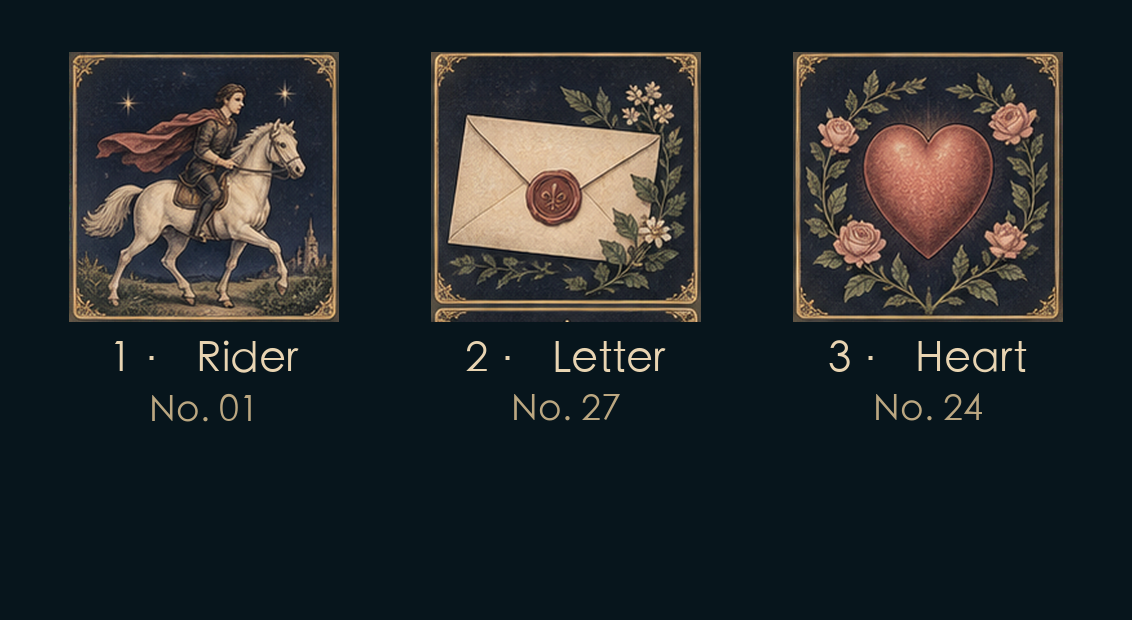
The Rider brings news, an approach, or a situation beginning to move. The Letter gives that movement a more specific form: written communication. The Heart introduces affection, care, or romantic feeling.
Using a common left-to-right method, Rider + Letter can suggest news arriving in writing, while Letter + Heart can suggest a message with emotional significance.
In a question about contact after a breakup, this is a comparatively encouraging sign of movement toward communication. A conversation may reopen, and it may touch on a bond that once mattered to both people.
But notice the distinction: the cards do not, by themselves, identify who will initiate the contact. Nor do they promise that a warm message leads to a renewed relationship. To explore the initiator, you would need a question and a spread designed for that purpose, with appropriate person cards or positions.
Example Two: Letter + Mountain + Tower
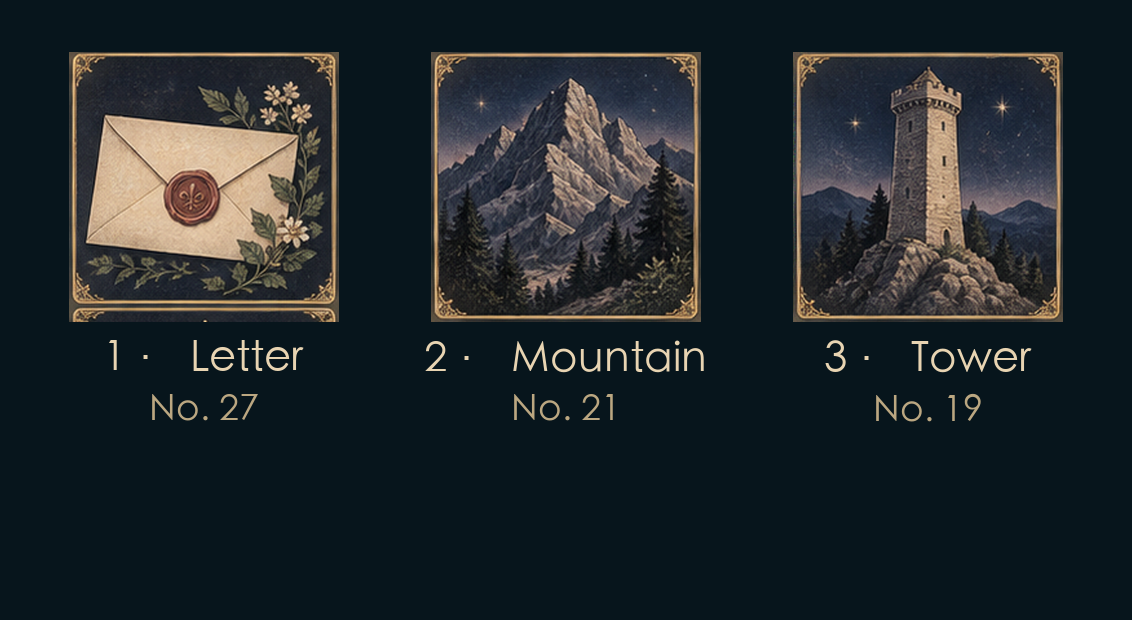
The Letter appears again, but the surrounding cards change the line considerably.
The Letter indicates communication; the Mountain introduces obstacles, delay, or something difficult to move past; and the Tower can speak of distance, independence, separation, or boundaries.
Read as neighboring pairs, Letter + Mountain can describe a blocked or delayed message, while Mountain + Tower emphasizes an ongoing separation or difficulty getting close.
This line may suggest communication that does not move forward easily—or contact that resumes while both people remain quite distant.
The practical point is not that wanting to reconnect is wrong. It is that the desire to communicate and the conditions for an open conversation are not always the same thing.
How to Read a Three-Card Lenormand Line
One common beginner mistake is to treat the cards as three separate verdicts: positive, negative, neutral—and then average them into a vague answer.
It is more useful to choose a consistent reading method. In a three-card line, for example, read the neighboring pairs 1 + 2 and 2 + 3, then put the whole sequence together. The middle card often deserves particular attention because it connects both sides.
Different Lenormand traditions handle direction, the center card, and significators differently. Decide which approach you are using before interpreting the outcome rather than changing the rules afterward to make a result fit.
Set a clear time frame, too. “Will they ever come back?” might refer to months or years. “Will there be one meaningful exchange within the next two weeks?” describes a more specific event.
For more examples of how individual symbols form a sentence together, see our Lenormand combinations guide.
If I Text First, What Can Tarot Tell Me?
Lenormand can help you examine the likelihood and character of contact. But whether renewed contact is good for the relationship is a different, often deeper question.
Perhaps the relationship ended because communication repeatedly broke down. Even if your ex replies now, that underlying pattern may not have changed.
Or perhaps the breakup had less to do with affection than with distance, family, different plans, or other practical circumstances.
Tarot lets you explore more than the possibility of one message. It can illuminate the feelings behind the wish to reconnect, the obstacles still present, and the different directions the relationship could take.
You can bring your own question to a GOOD TIMING Tarot reading. With a decision such as “Reach out now or keep waiting?”, define whether you are examining a short-term conversation or the longer-term possibility of reconciliation. Mixing those time frames can make the interpretation less clear.
A Four-Card Tarot Spread for No Contact
This four-card spread is designed to examine the decision to make contact, not to guarantee an ultimate reconciliation outcome.
| Position | Question | What to Examine |
|---|---|---|
| Card 1 | Why do I want to reach out now? | Motivation, nostalgia, expectations |
| Card 2 | What is preventing us from communicating? | Unresolved issues, practical barriers |
| Card 3 | What might develop if I reach out now? | Response, tone of contact, short-term direction |
| Card 4 | What should I keep in mind? | Timing, attitude, boundaries, longer-term conditions |
An important rule of careful interpretation: do not turn every card position into a claim about your ex's private feelings.
If the Six of Cups appears in position one, it may describe your longing for the past. It does not automatically mean your ex is thinking about you.
And even if position three looks favorable, you still need to read it alongside the obstacles in position two.
Each position gives a card a specific job. Respecting those jobs is what allows the spread to tell a coherent story.
Worked Tarot Example: Should I Reach Out Two Months After a Breakup?
Consider a couple who dated for more than a year. The breakup was not explosive, but their expectations about the future were different. One person wanted a more settled relationship; the other was not ready to commit. They have not spoken for two months.
Now one person misses the other and is considering a message.
The question is:
“If I reach out to my ex within the next two weeks, how might communication develop, and what do I need to keep in mind?”
For this hypothetical teaching reading, imagine drawing these four cards in order:
Six of Cups · Two of Swords · Page of Cups · Justice
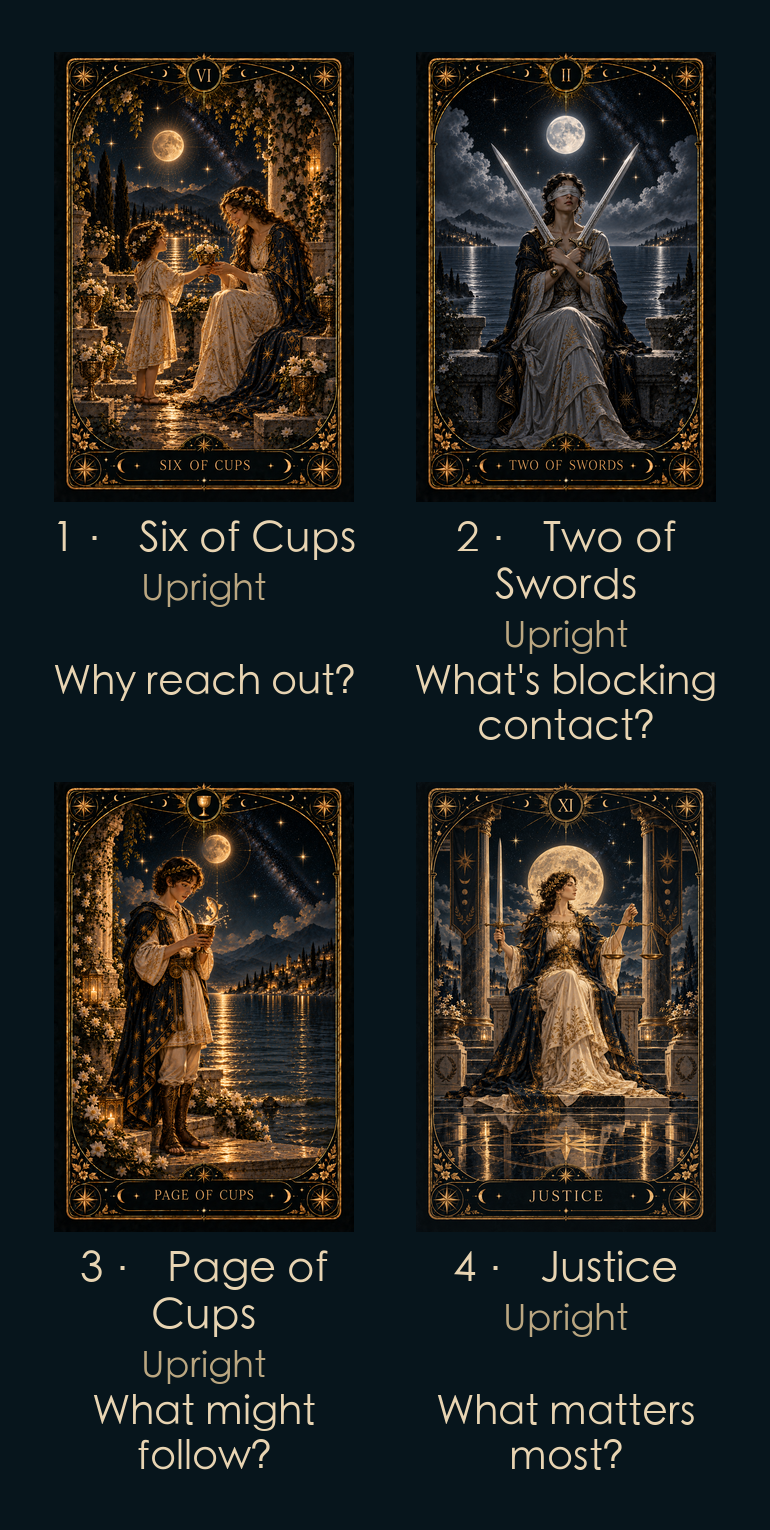
Card One: Six of Cups — The Pull of the Past
The Six of Cups is often associated with memories, familiar connections, past relationships, and a sense of nostalgia.
In the position “Why do I want to reach out?”, it suggests that the wish to make contact may be rooted in what the relationship once meant.
But nostalgia is not the same as reconciliation.
The card may describe remembered closeness, the comfort of being understood, or a longing for the best period of a relationship.
That raises a useful question: Do you want to get to know this person as they are now, or return to how the relationship used to feel?
Those desires may look similar, but they will shape very different expectations after you send a message.
Card Two: Two of Swords — A Choice Still Unmade
The Two of Swords commonly speaks to hesitation, stalemate, avoidance, or difficulty making a decision.
Given the scenario—two people who wanted different futures—it may point to a disagreement that never really reached a resolution.
Two months of silence may have stopped the argument without solving what brought the relationship to an end.
If contact resumes but the two people still cannot agree on where the relationship is going, they may find themselves in a familiar impasse.
The Two of Swords also reminds us that a lack of action is not identical to a lack of feeling. What it shows more clearly is that a decision has not been made. Without additional positions, it is not sound to declare which person is hesitating.
Card Three: Page of Cups — A Gentle Opening
The Page of Cups is associated with early expressions of feeling, apologies, tentative gestures, and softer forms of communication.
In the position describing what may develop after contact, it can indicate a relatively gentle start: a reply, an exchange that does not demand too much at once, or an opening to talk about what happened.
Why not simply read this as “You will get back together”?
Because a Page often emphasizes the beginning of emotional expression, not a mature, stable commitment already in place.
Here it is more supportive of reopening a conversation than of confirming a lasting reunion. What follows would depend on how the two people engage and whether they can face the problems that remain.
Card Four: Justice — Responsibility Before Reunion
Justice is one of the most important cards in this example.
Its themes include fairness, accountability, consequences, and clear-eyed judgment.
In the advice position, Justice asks more than “Are there still feelings?” It invites you to examine whether either person's understanding of the past has actually changed.
Who could not make the commitment the relationship required? Does the original reason for the breakup still exist? If both people want another chance, what would be different this time?
Justice is not a command to set feelings aside. It is a reminder that a sustainable relationship requires honest agreement and responsibility on both sides.
Putting the Four Cards Together
These four cards are not all pointing in one simple direction—and that is precisely what makes the reading useful.
The Six of Cups and Page of Cups both speak to emotional connection and may feel encouraging. The Two of Swords introduces indecision; Justice insists on examining the practical and ethical conditions of reconnecting.
If we select only the comforting cards, we could leap to “They still love me, so we'll definitely get back together.” That would ignore half the spread.
A more complete interpretation is this: The past still has emotional weight, and a gentle reopening of communication is possible. Yet the disagreement that contributed to the breakup may remain unresolved. Even if the message is answered, both people would still need to show that something can meaningfully change.
Taken together, the cards lean toward a careful attempt at conversation, but they do not establish a certain reconciliation.
This is a central Tarot skill: encouraging cards and difficult cards do not always cancel each other out. They may describe different stages or conditions within the same story.
For other ways to read a developing connection, explore our guide to nine Tarot spreads for love, covering new attraction, relationships, breakups, and reconciliation.
When Does Reaching Out Make Sense—and When Should You Wait?
Divination can help you consider a relationship's direction, but your decision should also reflect the other person's actual words and behavior.
Imagine two people both draw the Page of Cups.
In the first case, the breakup was respectful, some ordinary communication remains possible, and neither person has asked the other to stop contacting them.
In the second, the ex has clearly said they do not want contact, and has reinforced that boundary by blocking messages.
The same card should not lead to the same advice in these situations.
In the first, the Page of Cups might fit a gentle approach. In the second, even a card about emotional expression is not permission to ignore a boundary.
This is why the background of the question matters to a responsible reading.
Situations Where You Might Consider Reaching Out
It may be reasonable to consider contacting an ex when the breakup was relatively peaceful, neither person has expressly closed the door to communication, and you know what you are hoping to say or learn.
This can be especially relevant when the original obstacle was a misunderstanding, poor timing, or a practical condition that has genuinely changed. One conversation may help both people discover where things stand now.
But “reasonable to consider” does not mean “guaranteed to receive a reply.”
Situations Where Reaching Out May Not Be Appropriate
If the other person has clearly asked you not to contact them, or the relationship involved threats, coercion, violence, or other safety concerns, do not use a reading as a reason to cross that boundary.
There is another situation that may not involve safety but can still be painful: you have already sent multiple messages without receiving a reply, yet keep hoping the next one will change everything.
Sending more may not add any new information.
One unanswered message cannot explain every feeling someone has. Persistent non-response, though, is meaningful evidence about the current state of communication, and it deserves to be taken seriously.
If You Do Decide to Text, What Should You Say?
“Hey.”
“How have you been?”
“I miss you.”
The right opening depends on how the relationship ended and what you genuinely want from making contact.
If you hope to reopen a low-pressure conversation, a shared memory might work:
“I heard that song we used to listen to today and thought of you. Hope you've been doing well.”
This does not demand an immediate answer to a complicated question or turn a small message into a proposal to reconcile.
If you want to discuss what went wrong, you can be more direct:
“I've been thinking about some things we never really talked through. If you'd be open to it, I'd like to find a time to talk.”
And if what you want is a fuller ending rather than a renewed relationship, you do not have to disguise that as casual small talk:
“There's something about our past I'd like to understand more clearly. If you're willing, I'd appreciate a calm conversation.”
All of these examples assume the other person has not explicitly declined contact.
There is no message formula that guarantees a reply. A useful first message is simply clear, respectful, and aligned with your real intentions.
They Replied. Does That Mean They Want to Get Back Together?
This is one of the most common mistakes in readings about no contact.
Reestablishing contact, rebuilding closeness, and making a new commitment are different stages.
An ex might reply out of politeness, curiosity, nostalgia, or a genuine wish to know how you have been. A reply by itself is not proof that they are ready to resume a relationship.
Tarot can help us distinguish these themes symbolically.
The Page of Cups, for example, may indicate an initial emotional gesture. The Two of Cups speaks more directly to mutual exchange and connection. In an appropriate relationship position, the Knight of Pentacles might describe steady effort, consistency, and the patient rebuilding of trust.
These are not mandatory stages of reconciliation, nor do the cards carry one fixed meaning independent of context. They illustrate an important distinction: having feelings, being willing to talk, and building something sustainable require different kinds of evidence.
If your ex comes back into your life, notice concrete changes. Do they help carry the conversation forward? Are they willing to discuss past disagreements? Can they describe what they want now? Can you both talk about issues that once felt impossible to resolve?
Those developments reveal more about a relationship's direction than a count of how many texts you exchange.
What if Tarot Looks Positive but Lenormand Shows Obstacles?
People sometimes worry when readings from two different systems appear to disagree.
Imagine asking Tarot whether an emotional bond remains and drawing the Six of Cups with the Two of Cups.
Then you ask Lenormand whether communication is likely to resume within two weeks and draw Letter + Mountain + Tower.
At first glance, the results seem contradictory.
But the questions are not identical.
The Tarot cards may emphasize an emotional connection or the memory of a shared relationship. The Lenormand line describes obstacles and distance around short-term communication.
Emotional attachment and a lack of opportunity for easy contact can both exist at once.
When that happens, check three things.
First, did you ask the same question? A question about feelings and a question about action should not be forced into exactly the same answer.
Second, was the time frame the same? The longer-term potential of a relationship and whether a message arrives next week are different matters.
Third, could the favorable factors and the obstacles be describing different parts of one possible path? One spread may explore the motive; another may examine external conditions.
If the results are still confusing, ask a focused follow-up about an existing spread rather than redrawing until the two systems seem to agree.
How Long Should I Wait Before Another Reading?
There is no universal number of days after a breakup that makes another reading automatically useful.
What matters is the difference between two circumstances.
In the first, nothing has changed. You have no new information, but you feel unsettled by the previous reading and want to ask the same question again. You ask in the morning whether they'll contact you, ask again that evening, and draw a new spread the next day. Even when the cards differ, it becomes hard to know what to do with those differences.
In the second, the situation really has changed. Your ex reaches out, you have a meaningful conversation, or a new event affects the relationship. A fresh reading now addresses a different set of circumstances.
It can help to set a time frame from the beginning—perhaps the next two weeks or the next month. When that period has passed, compare the themes of the reading with what actually happened.
This habit is useful for people learning Tarot or Lenormand seriously. A reading record helps you revisit your interpretation and notice how symbols have played out in specific situations.
If your main question is simply why the cards in an existing spread seem to interact in a certain way, exploring that spread more deeply is often clearer than immediately drawing again.
Frequently Asked Questions
1. Can Tarot predict whether my ex will contact me first?
Tarot readers may use communication-focused spreads, person positions, and cards associated with movement to explore the possibility of renewed contact. The Page of Cups, Page of Swords, and Eight of Wands can all relate to messages in the right context. No single one proves who will initiate contact or guarantees that an event will happen.
2. Does the Letter in Lenormand mean my ex will text me?
The Letter is associated with written communication and information, but whether it points to your ex initiating contact depends on the question and surrounding cards. Rider + Letter often suggests news arriving, while Letter + Mountain may suggest blocked or delayed communication.
3. Does the Six of Cups mean my ex wants to reconcile?
The Six of Cups can speak of past love, memories, and familiar emotional bonds. It appears often in readings about former partners, but does not automatically indicate a plan to get back together. The position tells you whether it is describing the querent, the other person, or the relationship's atmosphere.
4. If I draw The Lovers during no contact, should I reach out?
The Lovers can represent attraction and connection, but also choices, shared values, and compatibility. It does not override real-world boundaries or tell you to contact someone who has asked to be left alone. Read it with its position, neighboring cards, and the actual situation.
5. If they never reply, is it worth waiting?
A reading may help explore obstacles and possible change, but ongoing silence is still important information. Respect an explicit request for no contact. If nothing has been stated clearly, you may choose a reasonable limit for how long you want to wait rather than putting the rest of your life on hold indefinitely.
6. Is Tarot or Lenormand better for reconciliation questions?
Tarot often gives more space to emotional motivations, relationship patterns, and what would need to change for reconciliation. Lenormand's concrete symbols can be useful for messages, action, distance, obstacles, and near-term movement. They can complement one another, but you do not need to use both for every question.
You Can Miss the Past—and Still Choose a New Direction
When a relationship ends, we do not always know immediately what the right choice is.
Sometimes reaching out is a brave attempt to begin again. Sometimes it brings us back to a story that has already finished.
Tarot and Lenormand offer different ways to explore feelings and possible future developments. What the cards suggest still needs to be understood alongside real behavior, time, and the choices made by both people.
If you are standing at this crossroads, you can begin with one clearly framed question.
For messages, renewed contact, and the direction of a connection after no contact, try a GOOD TIMING Love Lenormand reading. If you want to explore your feelings, the obstacles left by the breakup, and what might follow from a decision, start a Tarot reading.
You can also visit the GOOD TIMING Community to talk about reaching out, no contact, and former relationships with others who have faced similar decisions.
Have you ever sent a message to someone long after a breakup?
For some people, it became a new beginning. For others, it led to a goodbye they had not managed to say. And some realized, only after deciding not to press send, that they were ready to move forward.
Good timing does not mean everything will turn out as you hope. Sometimes it means understanding the relationship—and what you really want—clearly enough to choose your next step.