A Halloween tarot spread works best when it gives a real question somewhere to go. You might be closing a demanding chapter, remembering someone important, or wondering what will happen if you begin something new. Three cards can be enough to distinguish what is ending from what is still worth carrying.
For Saturday, October 31, 2026, choose one of the three short rituals below. Each includes a clear question, a usable spread, a worked example and a way to finish. They are original, modern tarot practices—not reconstructed ancient Samhain ceremonies. You can use your own deck; the online alternatives use spreads already available on GOOD TIMING.
What does Samhain have to do with a Halloween tarot ritual?
The National Museum of Ireland records Samhain on November 1, with celebrations on the preceding evening. Its account includes marriage-divination games and beliefs about returning spirits.
Tarot comes from a different history. The Metropolitan Museum of Art locates its earliest references in fifteenth-century northern Italy. A Samhain tarot reading is therefore a later combination of seasonal symbolism and card reading, not evidence that ancient Celts used tarot.
Here, the seasonal connection is practical: endings, memory and the first shape of a new chapter. For the fuller cultural background, visit our Samhain and Halloween divination guide.
Before you draw: choose the question and the card positions
Set aside about 10–15 minutes for one ritual; you do not need to complete all three. A deck, a notebook and a quiet surface are sufficient. An LED candle can provide atmosphere without an open flame. No burning, smoke or special purchases are required.
Write the question before shuffling, and keep the card positions fixed after the draw. Record reversals as drawn if you normally read them. Interpret the pictured action, suit, orientation and relationships between cards—not just a list of keywords. Our three-card tarot guide explains the mechanics in more detail.
| Ritual | Best question | Spread |
|---|---|---|
| Close an unfinished chapter | What is keeping this matter open? | Situation / Challenge / Advice |
| Carry a strength forward | What from my past can support what comes next? | Past / Present / Future |
| Light the first step | What should I expect from beginning this specific thing? | Quick Answer: one card |
These names describe the rituals in this article. GOOD TIMING does not currently offer a dedicated Halloween or Samhain spread, and its standard card positions should not be relabeled as custom holiday positions.
Ritual 1: Close an unfinished chapter
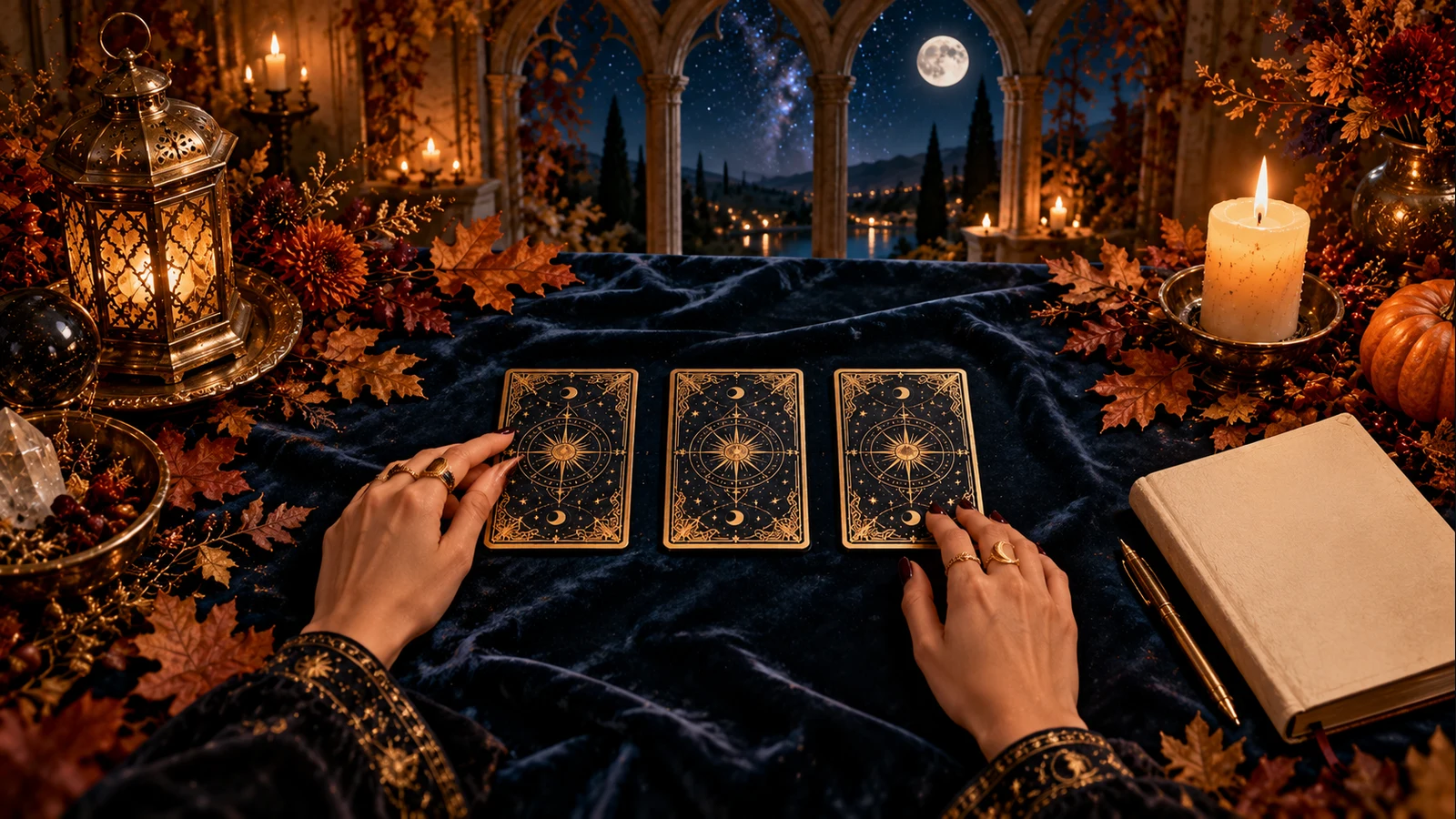
Use this when: something still occupies your attention even though you want to move on: an unfinished project, a recurring argument, or a commitment that has become difficult to sustain.
Write the name of that one matter on a small piece of paper. Set it beside the deck, rather than mixing several concerns into the reading.
Ask: “What is keeping this chapter open, and what would help me bring it to a clear close?”
Draw three cards:
- Situation: What is happening with this matter now?
- Challenge: What makes closure difficult?
- Advice: What approach could change the situation?
Read the challenge against the situation. Is it intensifying the problem, revealing something overlooked, or contradicting the way you initially described it? The advice card responds to that relationship; it is not an instruction to abandon everything.
A worked example
A fictional reader asks about a volunteer project that has outgrown the time she can offer. She draws Ten of Wands upright → Two of Pentacles reversed → Queen of Swords upright.
The figure carrying the wands suggests that the project is being held together through effort, not ease. The reversed juggling card makes the challenge more specific: rearranging the same overloaded schedule may no longer be enough. The Queen's upright sword points toward a defined conversation and clear limits. Together, these cards favor handing over a specific responsibility rather than silently hoping the work will decrease.
To close the ritual, write one sentence beneath the original question: “I will clarify which tasks I can finish and which need another owner.” Fold the paper and keep it with the reading. The symbolic ending is a marker; it is not a substitute for the conversation.
Ritual 2: Carry a strength forward
Use this when: the year has changed your circumstances and you want to understand what remains useful—not simply what to leave behind.
Choose an object connected with a real memory: a photograph, a letter, a recipe or a tool someone taught you to use. It can represent family, chosen family, a mentor or an earlier period of your own life. An ancestral theme is optional, not a requirement.
Ask: “What strength from my past is available to me now, and how might it develop as I enter November?”
Use Past / Present / Future:
- Past Influence: Which earlier experience is shaping this?
- Present Situation: How is that influence showing up now?
- Likely Development: Where could the present pattern lead?
A worked example
A fictional reader rebuilding a social life after a move draws Six of Cups upright → Queen of Pentacles upright → Four of Wands upright.
The childhood exchange in the Six of Cups brings attention to familiar forms of welcome. The Queen of Pentacles makes that warmth tangible in the present: a meal, a comfortable setting, or giving an invitation enough time and care. The Four of Wands suggests that these small acts could grow into shared occasions and a stronger sense of belonging. The connection between the cards matters more than labeling each one “nostalgia,” “nurturing” and “celebration.”
That does not establish a message from a deceased person or guarantee a gathering. It is a reading of how remembered warmth may take form in a new place.
Finish by placing the object somewhere you will notice it. Record what you want to carry forward, without requiring yourself to preserve every family custom.
Ritual 3: Light the first step
Use this when: you already know what you want to begin, but would like a focused reading on the first stage.
Choose one specific beginning and a limited period. “What should I expect from starting a drawing class in November?” is more readable than “What will my whole new life be like?” If you need help narrowing the question, see how to ask tarot questions.
Draw one card in Quick Answer, whose position is Insight. Look for the card's central action and how it relates to the proposed beginning.
For example, Page of Pentacles upright could suggest a class that rewards close attention and repeated practice. The young figure's concentration on the pentacle fits learning a concrete skill; progress may feel modest but satisfying. Knight of Wands upright would put more weight on enthusiasm, movement and experimentation. Neither interpretation means those cards must always predict art classes.
Write down the likely experience and one thing you want to notice when it happens. Keep the original card rather than drawing repeatedly until a more exciting answer appears. Return to the note after the first class or first week.
How to use these rituals with GOOD TIMING
Open Tarot Reading, enter your own question and select the existing spread named above. Use Situation / Challenge / Advice, Past / Present / Future, or Quick Answer as appropriate. Let the interpretation follow the actual cards and the displayed positions.
The seasonal setup happens around the reading, not through a hidden holiday mode. The examples in this article are teaching examples, not cards you will necessarily draw. For a fuller November planning context, continue to the November 2026 astrology calendar.
Frequently asked questions
When should I do a Halloween tarot spread in 2026?
October 31 falls on a Saturday. You can set aside that evening or choose another quiet time around the date. The calendar gives the ritual a theme; there is no need to hit midnight or treat a missed date as a failed reading.
Is a Samhain tarot reading an ancient Celtic practice?
No. Samhain and tarot have distinct histories. Seasonal tarot spreads are modern practices inspired by themes associated with the festival. They should not be presented as recovered ancient ceremonies.
What if Death, the Tower or a reversed card appears?
Read it in its actual position and beside the other cards. Death can describe an ending; the Tower can suggest disruption; a reversal may alter how a card's theme operates. Halloween does not turn a challenging card into evidence of a curse or a literal death prediction.
Can I use an online reading without a physical deck?
Yes. Use one of GOOD TIMING's available standard spreads and keep its original positions. The three rituals above are editorial guides, not three new features in the app.
Should I draw again if I do not like the answer?
First check whether the interpretation fits the question, position and surrounding cards. Note what remains unclear before starting another reading. A genuinely new question is more useful than repeatedly redrawing the same one to seek reassurance.