The first time you read oracle cards for yourself, there can be a strangely quiet moment after the card is revealed. The image catches your attention, but after looking at it for a few seconds, you may still wonder where the reading is supposed to begin.
That does not mean you are bad at reading cards. Oracle cards are not a system you have to memorize before you are allowed to use it. Different decks can have completely different symbolic languages, themes, and visual worlds, and once a card enters a reading, its meaning is rarely limited to a few printed keywords.
Sometimes you arrive with a very specific question, and the card unfolds within that question. Other times you ask nothing at all and simply draw a card to see what message meets you in the moment. Both are complete forms of oracle reading, because an oracle reading does not have to begin with a question. It can begin with receiving.
An oracle reading can begin with a question or with receiving
It is easy to think of divination as a question-and-answer exchange: you ask, and the cards respond. That is certainly one natural way to work with an oracle deck. You might ask about a relationship, a career decision, someone who keeps returning to your mind, or a theme such as money, career, an SP, or manifestation.
When you enter a reading with a question, the question gives the card a direction. You are not forcing it to produce one fixed answer; you are simply saying, this is the part of my life we are looking at today.
But oracle cards can also be used in another equally complete way. You may have nothing in particular to solve. You might draw one card in the morning to see what deserves your attention, one before sleep to see what is worth carrying with you from the day, or one simply because something in you wants to pause and listen.
In that kind of reading, the card appears first, and you gradually notice what part of your life it begins to touch. You have not told the reading what it must be about, but you still arrive with your current life, emotions, desires, and recurring thoughts.
So a reading without a typed question is not a lesser version of a reading. It simply begins from the other side: the card brings the theme forward first.
When there is no question, the card becomes the starting point of the message
One of the most interesting things about a no-question reading is that you have not decided in advance what the card is allowed to talk about.

You may see a doorway, a river, a bridge, a moon, a bird leaving the frame, or a figure standing between two spaces. At first you may not know what any of it means, but one detail may hold your attention for a little longer than the others.
Perhaps you have been thinking about starting a new job and the doorway is the first thing you notice. Perhaps you are trying to release a relationship and your eyes go immediately to a figure looking back. Or perhaps you were not consciously thinking about a certain desire at all, but one sentence on the card brings it straight back to the surface.
The reading does not have to become a conclusion immediately. It can begin as a simple prompt: why did this particular symbol stop me right now? Some messages connect instantly with what you are living through; others leave behind an image, a sentence, or a feeling that makes sense only hours or days later.
Oracle is a symbolic language, not a dictionary
If every oracle card is treated like one fixed word, readings become flat very quickly.
Imagine a card called The Threshold. It may certainly relate to transition, crossing over, or entering a new phase, but that does not mean everyone who draws it should receive the same interpretation.
In a relationship reading, The Threshold may point to a connection that has reached a point where its form has to change. You may be moving closer, or you may have reached the limit of keeping things undefined.
In a career reading, the same card may speak to a change of role, an opening, or the feeling of standing in front of a next chapter without fully stepping into it yet.
If you asked nothing at all, the first message may be much simpler: you are between two stages. You can then return to your life and notice where that threshold seems to be showing itself.
A card’s meaning in a reading is therefore closer to: the card’s symbols × your question or present context × the symbolic language of the deck itself. That is also why the same card can return months later and mean something very different. The card has not changed, but your position has.
A question gives the message a direction
A strong oracle question does not control the card or force the reading into a verdict. It creates a field in which the symbols can speak around one particular theme.
If you ask, “What do I most need to understand about this relationship right now?” the relationship has become the center of the reading. A card about distance, boundaries, waiting, or return will naturally be understood through that lens. The same card appearing beneath a career question may emphasize something entirely different.
This is why open-ended questions often work so well. It is not because they are somehow more spiritual or sophisticated. They simply allow more layers of a card’s symbolism to participate in the reading instead of compressing everything into an early yes or no.
At the same time, you can absolutely begin with a direct question such as “Will he come back?”, “Can I get this job?”, or “Is there movement with my SP?” Oracle does not require you to disguise what you genuinely want to know. If you want to go deeper, you can simply continue from there by exploring what stage the connection is in, what is changing, where resistance is appearing, or what deserves your attention now.
The image is not decoration; it is part of the reading
One of the most compelling things about an oracle deck is that it communicates through image as well as language. A doorway and a bridge may both suggest movement, but they do not feel the same. A river, an ocean, and rain all belong to the language of water, yet they can evoke flow, depth, release, cleansing, or something else entirely. Even the moon changes its tone depending on whether it is new, full, or partly hidden.
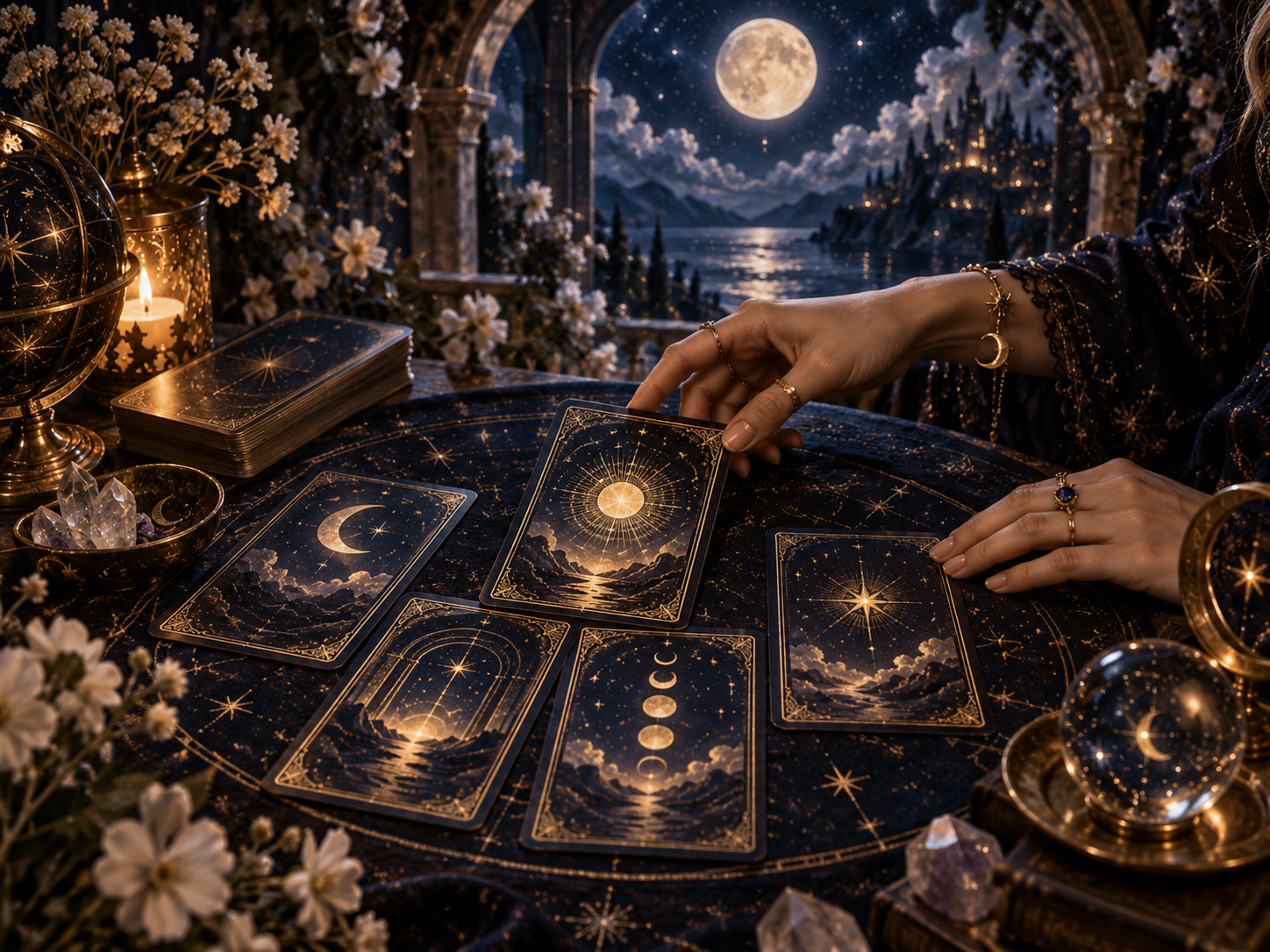
When a card appears, it can be useful to wait before reading the guide text. Look first. Notice where your eyes go. It may be the obvious central image, or a very small detail in one corner. Then ask yourself: why did this particular part catch me first?
That does not mean your first visual reaction is an absolute message from the universe. More simply, when an image contains several symbolic layers, the part you notice first often becomes your entry point into the card.
Your first feeling can be heard without being turned into a rule
Many oracle guides tell you to trust your first intuition. That can be useful, but intuition does not need to become another test you have to pass.
Sometimes your first reaction is obvious. A card makes you feel calm, lonely, uneasy, familiar, or gives you that strange sense of “of course this is the card I pulled.” Other times the reaction is almost imperceptible: a color, an expression, or one phrase makes you pause for a second longer.
Those reactions matter because they show where the card touched you first, but they do not have to carry the entire interpretation. If you feel nothing immediately, that is completely fine. You can read the title, keywords, and deck message, then return to your question. Some cards open instantly; others make sense a little later.
Card meanings are a symbolic map, not a standard answer
After looking at the image and noticing your first response, read the keywords, guide text, or formal message attached to the card.
Instead of asking which sentence is the one correct answer, notice what overlaps with your first impression, what surprises you, and which words suddenly connect with something real in your life.
A single card may hold several symbolic layers, but only some of them may belong to this particular reading. The written meaning is more like a map of the territory the card can enter than a prewritten conclusion for every possible question. A reading really comes alive where the card’s symbolism meets the context of your life.
Put the card back inside the original question
Suppose you began with: “What do I most need to understand about this relationship right now?” and drew The Threshold.
If you stop at “Threshold = transition,” you have only read the definition. The reading starts to deepen when you ask whether this relationship has reached a point where it can no longer remain exactly as it is. Are you waiting for the other person to cross a threshold, or are you standing at one yourself? Are you afraid of losing the connection, or afraid of what would happen if it truly entered a different stage?
At that point, the card is no longer simply a concept. It has entered the question and illuminated something that was previously harder to see.
One card can already be a complete reading
More cards do not automatically make an oracle reading better. If one card has already clarified the central theme, it is perfectly reasonable to stop there.
If you only want to know what deserves your attention today, or what you may be overlooking in a decision, one card is often enough to provide a clear entry point. It can reveal a present theme, an emotional pattern, a repeating dynamic, or one concrete direction.
A second card becomes most useful when the first one naturally creates a new question. If the first card shows that you are avoiding a decision, the next question might be, “What is keeping me from making it?” If the first card reveals a repeating relationship pattern, the next card can explore what needs to shift within that pattern.
That way, the second card continues the first message instead of replacing it because the first answer was not the one you wanted.
The Hidden Almanac is suited to patterns, thresholds, and turning points
Different oracle decks have different symbolic worlds, which is why changing decks can feel like changing languages.
GOOD TIMING’s The Hidden Almanac leans toward thresholds, repeating patterns, quiet turning points, and changes that are already happening before they are fully understood. It works naturally with questions such as “Why do I keep returning to this same kind of situation?”, “What stage is this relationship moving through?”, “What pattern keeps repeating?”, or “Have I already reached a new threshold?”
It also works beautifully without a question. In that case, the reading becomes more like an observation: which pattern, transition, or threshold in your life is moving into the foreground right now? The deck’s own symbolic world gives a no-question reading an invisible direction.
What can Manifestation Oracle show you about your manifestation process?
Manifestation Oracle is especially useful for observing where an intention currently is. You may be manifesting money, career, love, an SP, a new home, a different way of living, or a future that has become increasingly vivid in your mind. The cards can help you notice what movement is present, what is beginning to form, and where your attention may be most useful next.

Sometimes a reading shows that the manifestation is entering a different stage: conditions begin to align, something that felt stagnant starts to move, or the outer world has not fully changed yet while the internal structure already has. At other times, the focus is alignment — whether your thoughts, emotional state, expectations, and actions are still moving with the original intention, or whether an old assumption keeps pulling you back into a familiar pattern.
The deck can also help you notice resistance and receiving. You may be checking for results constantly, searching for reassurance, holding tightly to an older story, or staying in “thinking about it” long after the moment for receiving or taking action has arrived. For someone who has been working with the same manifestation for a while, a reading can become a useful check-in: what is different now from where this process was a few weeks ago?
That makes Manifestation Reading very specific. With an SP, you may look at connection and movement; with money, expansion, receiving, and opportunity; with career, direction, action, and openings. Or you may simply observe which stage an intention seems to be in.
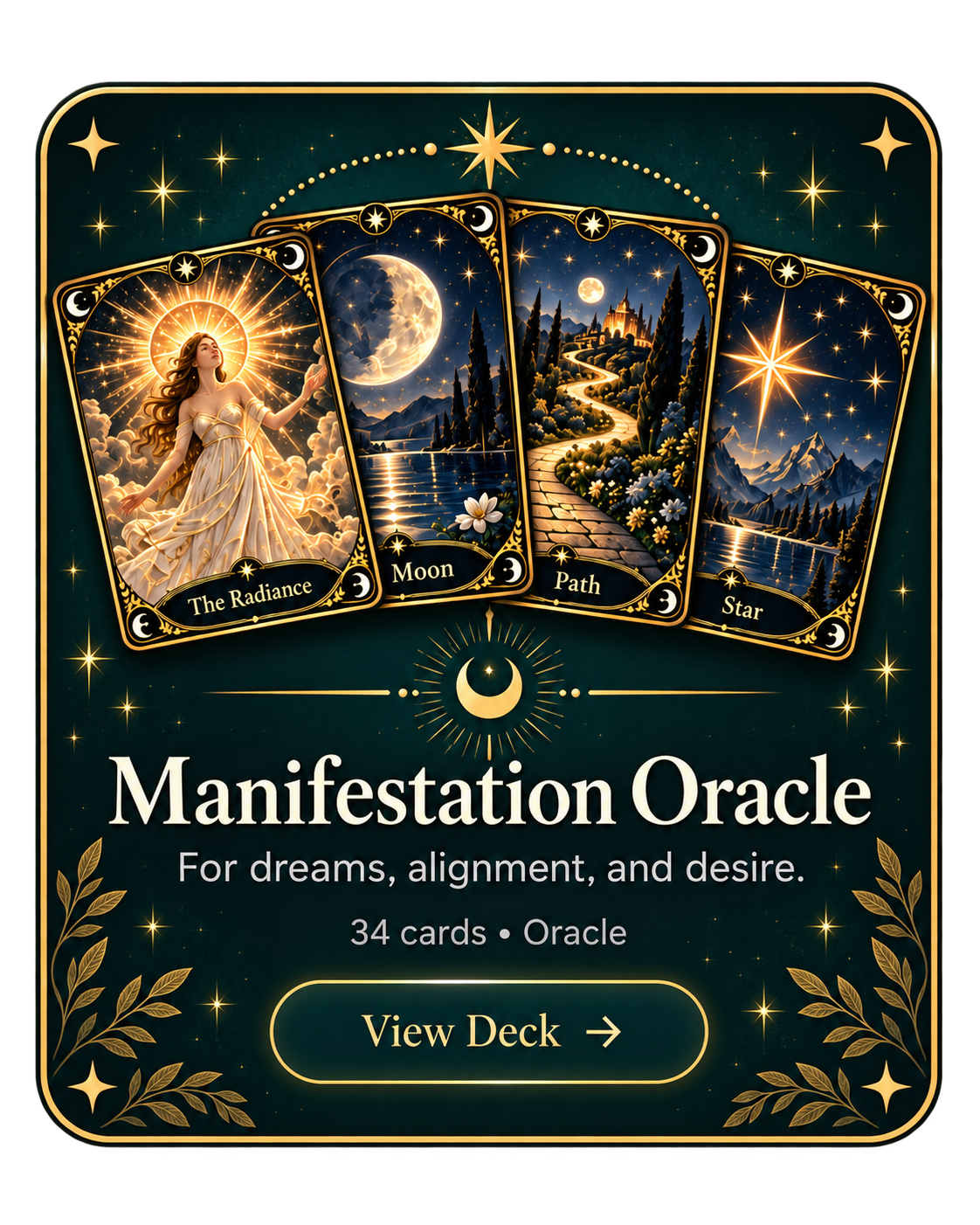
You can also use it as a manifestation check-in without asking a question
If an intention has been present in your mind for a while, you already bring context into the reading even if you do not type a formal question. Manifestation Oracle can still let a message connected with desire, alignment, movement, receiving, or action come forward through the deck’s own symbolic language.
If you have been manifesting money, a card may draw your attention toward expansion, opportunity, receiving, or a practical window for action. If your focus is an SP, the reading may bring connection, distance, movement, self-concept, or the stage the relationship is moving through into focus.
This does not mean one card is mechanically assigned to one manifestation topic. The meaning emerges from the card’s symbolic structure meeting the context of the reading. The same card can emphasize a different layer beneath a different intention.
So a no-question pull is not simply a random quote. It can function as a light check-in: which theme in this manifestation process is moving to the front right now?
Future-oriented oracle messages can be read through trajectory and emerging possibility
Some oracle cards naturally carry a strong sense of the future: opening, arrival, union, harvest, journey, new beginning. These symbols can absolutely become an important layer of a reading about what may be unfolding next.
But future-oriented symbolism often works through more than a single literal event. It can describe trajectory — where something seems to be moving; potential — what may already be forming; or readiness — whether you are close to entering a new stage.
When a card has the feeling of something approaching, you can look at where that movement is already visible, which conditions are beginning to come together, and whether you are currently in a phase of waiting, acting, adjusting, or receiving. This keeps the future dimension of the reading intact while giving it more depth.
A light three-minute oracle reading can look like this
If you want a simple reading, you do not need a complex ritual. Decide whether today you want to ask something or simply receive a message. If there is a question, write one sentence; if there is not, draw the card anyway.
When the card appears, look at it for a few seconds before opening the explanation. Notice what draws your eye first and what feeling appears. Then read the title, keywords, and full message, and finally return to your question or present life to see what the card actually touched.
If you want to keep something from the reading, one sentence is enough. It might be “I have been waiting for an answer I already know,” or “What I really want to manifest is not simply more money, but a life where I do not have to worry about money all the time,” or even “I do not need to decide today.” One card does not have to solve your entire life. It only needs to make one blurry thing a little clearer.
Oracle reading also gives a message the chance to be noticed
Sometimes you arrive with a question and receive a response. Sometimes you ask nothing and draw a card that only makes full sense later. Neither kind of reading is more legitimate than the other; one begins with asking, the other with receiving.
What makes oracle reading interesting is the space it creates for something that normally stays in the background to move into the foreground. It may be a repeating pattern, a feeling you have not put into words, or a desire that has been forming for a long time and is finally becoming visible.
A card becomes a reading not because it offers a beautiful keyword, but because its symbolic language begins to connect with the life you are actually living.
So the next time you draw an oracle card, you do not have to ask yourself whether your question is important enough. If there is something you want to ask, bring it. If there is not, you can simply pause and see what message meets you today.
You can come to ask something, or you can simply come to listen.