Have a question that keeps circling in your mind? Maybe someone’s behavior has changed, a relationship is stuck in an undefined space, you are waiting on a job decision, or you have been thinking about the same choice for days without feeling any clearer.
On GOOD TIMING, you can start a free tarot card reading online without signing in first. Guests can receive 3 free Tarot Readings per day: ask your own question, choose a spread, draw your cards, and get a full interpretation built around the question, the cards, and their positions.
This is not a one-card generator that gives you a few fixed keywords and stops there. Your question becomes part of the reading, which means the same card can be interpreted differently depending on what you asked and where it appears in the spread.
If part of the interpretation still feels unclear, you do not have to immediately draw a new spread. You can use Follow-up to keep asking about the same reading, using the original question and cards as the context.
Creating an account is free too. Once signed in, you can continue using GOOD TIMING’s free reading features and save your readings to your history, so you can come back days or weeks later and see what you drew and how the interpretation read at the time.
Is the Free Tarot Card Reading Really Free?
Yes. As a Guest on GOOD TIMING, you can complete 3 free readings per day without creating an account first.
If you only want to ask a question and see how the reading feels, you can go straight in, enter your question, and draw. If you later decide you want to keep your readings, creating an account is free and lets you save them to your history.

That matters more than it may seem. Some cards make much more sense after real life starts moving. A person may finally reach out, a job may progress to another stage, or a situation that felt completely stuck may change a week later.
Looking back at the original spread can reveal details that were easy to miss the first time. Your history is not only a place to store results; it gives you a way to revisit a reading after the situation itself has evolved.
How Does a Free Tarot Reading Work?
The basic flow is simple: ask a question, choose a spread, draw your cards, and then interpret those cards in the context of the question and their positions.
That last step is what makes a reading useful. Tarot is not simply a matter of reading out the standard definition of every card one by one. The real question is why this card appeared here, what part of the question it is answering, and how it changes when placed beside the other cards in the spread.
Take The Hermit. If you ask, “Why has he suddenly become distant?”, The Hermit may point toward withdrawal, reflection, personal space, or someone deliberately stepping back from interaction. In a career reading, the same card may be about working independently, research, focus, or temporarily tuning out outside noise.
In a timing question, The Hermit can slow the pace again, suggesting that the situation still needs time to develop. The card has not changed. What changes is the role it is playing inside the reading.

Still Have Questions? Use Follow-up
Sometimes a reading answers your main question clearly. Other times, the first answer immediately creates a more specific question.
Imagine your reading says that there is still an emotional connection, but distance, hesitation, and things left unsaid are shaping the relationship right now. Naturally, you may want to know who is creating that distance, whether the other person actually intends to move closer, or what a particular card means in this exact position.
That is where Follow-up is useful. Instead of starting over and drawing a completely different spread, you can continue the conversation using the original question, cards, and interpretation as context.
A new reading and a follow-up are not the same thing. If something has changed in real life — the person contacted you, you received an interview invitation, or the original time frame has passed — a new reading may make sense. If you are still trying to understand the spread already in front of you, Follow-up is usually the better place to continue.
What Can You Ask Tarot?
You do not need to invent a mystical-sounding question. Tarot can be used for the things you are actually thinking about: relationships, work, decisions, communication, timing, and situations that still do not make sense.
For a relationship, you might ask, “How does he currently see our connection?” If you are waiting on a job opportunity, you could ask, “How is this opportunity most likely to develop over the next month?” If you are stuck between two directions, you might ask, “What am I not seeing clearly about staying versus leaving?”
Your question does not have to be long. It simply helps to give the reading a clear target. Asking about the one part you care about most usually creates a more useful reading than trying to fit feelings, contact, outcome, and the entire future into a single sentence.

How Should You Ask a Love Tarot Question?
Love is one of the most common reasons people turn to Tarot, and there is nothing wrong with asking, “Does he like me?” But relationships usually contain more than feeling alone. Distance, action, attraction, hesitation, commitment, and practical circumstances can all exist at the same time.
If you want to understand someone’s attitude, you might ask, “How does he currently see me?” or “How does he understand our relationship right now?” If communication is what matters most, ask directly, “What is currently shaping the way we communicate?” If you want to look at development, add a useful time frame: “Where is this relationship most likely to move over the next month?”
That helps each card do a clearer job. Feelings, action, and relationship outcome can influence one another without necessarily moving at the same speed.
Can You Ask Tarot About Work, Money, and Decisions?
Absolutely. Job opportunities, workplace dynamics, projects, income direction, and major decisions can all be explored in a Tarot Reading.
You might ask, “What is the potential of this job offer?” “What should I be paying attention to in my current work situation?” or “If I leave this job, what should I prepare for next?” Often, looking at both what supports an outcome and what blocks it gives you more to work with than asking only whether something will succeed.
The Emperor is a good example. In the position of a career opportunity, it may highlight structure, authority, formal responsibility, or access to resources. In an obstacle position, the same card may instead point toward hierarchy, rigid systems, or a person with decision-making power.
One Card, Three Cards, or a Larger Spread?
A one-card reading works well when the question is already narrow. Questions like “What should I keep in mind before this conversation?” or “What am I overlooking about this decision?” can be answered with a single strong focal point.
When a situation has several layers, three cards or a larger spread can provide more structure. A relationship spread might look at you / the other person / the connection. A developing situation might use current situation / obstacle / next step. A career question could use opportunity / risk / advice.
The purpose of a spread is not simply to give you more cards. It gives each card a role. Once those positions are clear, the same card appearing as an obstacle will not be interpreted the same way as that card appearing as advice.
Start a One Card Tarot Reading →
What If Your Real Question Is “When?”
Sometimes the question is not whether something will happen, but when the situation will finally begin to move.
That is where a Tarot Timing Reading can be more useful. Timing is not only about forcing a precise date out of the cards. It can also show how much momentum already exists, what is accelerating the situation, what is delaying it, and which condition may need to change before the next stage begins.
For example, Eight of Wands can bring speed, messages, and movement. But if it appears in the same spread as Four of Swords, the reading becomes more nuanced: there may be momentum available, but it is still interacting with pause, recovery, waiting, or a period in which nothing is meant to be rushed.
Start a Tarot Timing Reading →
Can You Ask the Same Tarot Question Again?
Yes. The most useful time to ask again is usually when something in the real situation has changed.

Maybe you originally asked, “Will he contact me?” and then he actually did. The old question has reached a new stage, so the next reading might ask, “Now that communication has restarted, where is this connection moving?”
The same applies to work. If you were originally waiting to hear whether you would get an interview and then you receive the invitation, your next question can move forward too: “What should I focus on going into this interview?”
If nothing has changed and you keep redrawing the same question within a short period of time, the new cards may not add much clarity. In that situation, returning to the original reading and using Follow-up can be more useful than repeatedly starting over.
Tarot vs. Lenormand: What Is the Difference?
Tarot and Lenormand can both be used for relationships, work, and real-life questions, but they often emphasize different kinds of information.
Tarot is especially good at exploring emotion, motivation, choice, psychological patterns, and the deeper structure of a situation. Lenormand often works more concretely with communication, distance, movement, practical obstacles, and near-term developments.
Ask both systems, “How does he see me right now?” and Tarot may move more naturally into his emotional or psychological position and the dynamic between you. Lenormand may separate the relationship label, communication, distance, and next movement more directly.
Neither system is automatically better. They simply give you different ways to look at the same situation.
Bring a Difficult Spread to the Community
Sometimes the confusing part is not one card. It is the relationship between several cards.
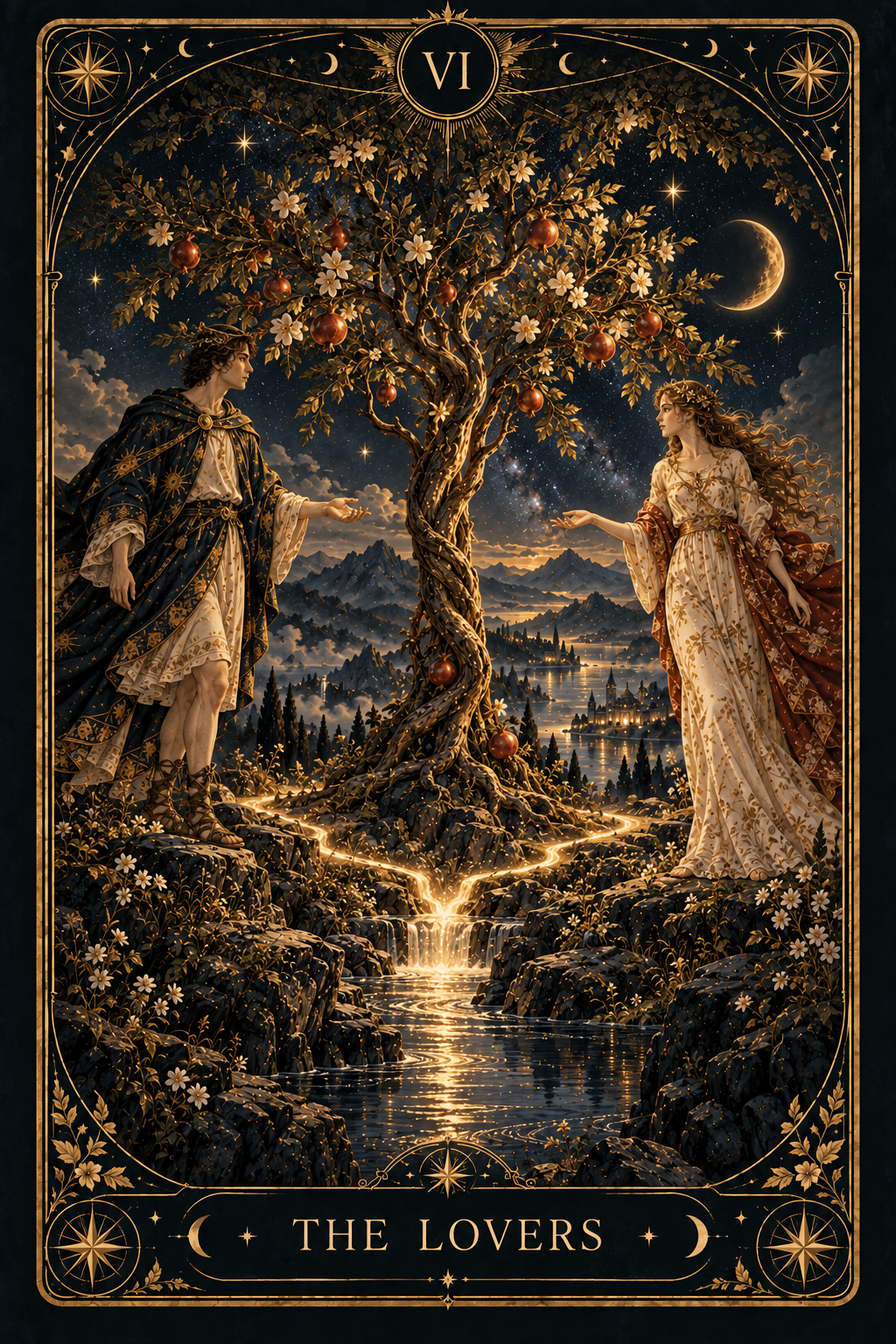
You may know what The Lovers means and what The Hermit means, but when they appear together in a relationship reading, the real question becomes whether the spread is describing an important bond with distance around it, or a choice that requires one person to step back and reflect first.
If you want another perspective, you can bring the question or card combination into the GOOD TIMING Community. Different interpretations do not have to compete for one “correct” answer. Sometimes another reader simply notices a layer you had not considered.
How to Get More Out of a Free Tarot Reading
The quality of a reading usually depends less on making your question sound perfect and more on giving it a clear focus. Name the relationship or situation, say what you actually want to understand, and add a time frame when it genuinely matters.
If the situation is complicated, look at outcome, support, and obstacles together. Once the cards are drawn, do not focus only on the card you like most or fear most. Pay attention to repeated themes, how the positions differ, and how the cards modify one another.
That is often where a spread stops feeling like a list of card meanings and starts becoming a coherent reading.
Start a Free Tarot Card Reading Now
If you already have a question in mind, you do not need to spend another ten minutes rewriting it into a “perfect Tarot question.”
Decide what you actually want to understand and start there. Guests receive 3 free readings per day, and if you later create a free account, you can save your readings and come back to them whenever you want.
If something in the interpretation still needs clarification, you can continue with Follow-up using the original reading as context.
FAQ
Is the Free Tarot Card Reading Really Free?
Yes. GOOD TIMING Guests can complete 3 free readings per day without signing in first. Creating an account is free as well, and signed-in users can save their reading history.
Can I Get a Tarot Reading Without Signing Up?
Yes. Guests can start reading immediately and receive 3 free readings per day. If you want to save your readings and return to them later, you can create a free account.
Can I Ask Follow-up Questions About My Reading?
Yes. If you want clarification on a card, part of the interpretation, or another layer of the same reading, you can use Follow-up to continue from the original question and cards instead of drawing a new spread.
Can I Ask Tarot How Someone Feels About Me?
Yes. Adding a little relationship context usually makes the interpretation more focused. “How does the person I’m dating currently see our relationship?” gives the reading more context than a pronoun alone.
How Many Tarot Cards Should I Draw?
It depends on the question. A focused question may only need one card. If you want to look at the current situation, obstacles, and development together, a multi-card spread gives those layers clearer positions.
Can Tarot Be Used for Timing?
Yes. A Timing Reading can look at speed, delay, momentum, and what still needs to happen before the situation changes, rather than relying only on a single exact date.
Is Tarot or Lenormand Better for Love Questions?
Both can work well. Tarot tends to open up emotion, motivation, and relationship patterns, while Lenormand often makes communication, distance, practical obstacles, and near-term movement more concrete.
Can I Ask the Same Tarot Question Again?
Yes, especially after a meaningful change in the real situation, such as a new conversation, decision, event, or development. If nothing has changed and you only need clarification on the existing reading, Follow-up is often the more useful option.